Without Government Borrowing, Global Liquidity Has Barely Left 2015
Eight governments borrowed the difference, M2 holds none of it, and the first weekly edition of Print Run™ runs to 20 charts, free for subscribers.

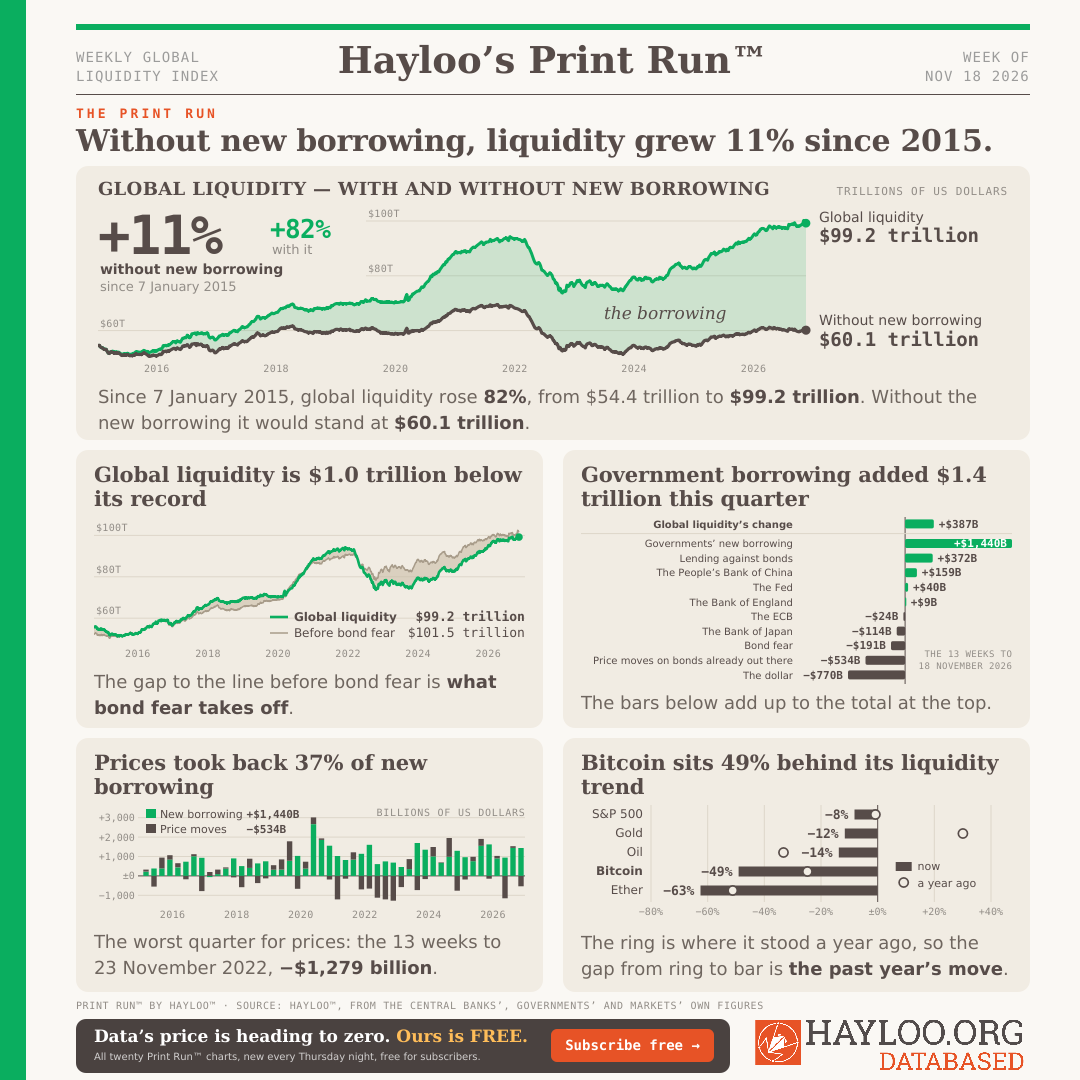
TAGS: Hayloo's Print Run™ global liquidity index board, first weekly edition: global liquidity since 2015 with and without new government borrowing, the last quarter's change by central bank, bond fear and the dollar, and Bitcoin, Ether, the S&P 500, gold, and oil against their liquidity trend.
Every Swiss house keeps a secret recipe. Ours is threefold, and it comes with a surfboard.
Trading risk assets, we like to say, is surfing. Liquidity is the swell. You read where it’s coming from and paddle into position before it breaks. Once you’re in position, flows tell you when to paddle into the wave. Hard assets tell you for how long.
No swell, no surf. That’s why liquidity research stands at the beginning of everything we do at Hayloo, and it’s the secret sauce that kept us alive through multiple cycles. We used to buy our swell report. We trusted paid data sources with our liquidity analysis, and for directional calls that was fine. Lately the cracks showed, and we’re glad we found them when only a ray of light shone through. That was early enough to spot the divergence, pull out of Bitcoin and crypto at local-top levels, and design Print Run™, our in-house liquidity index, and this is its first weekly edition.
Print Run™ measures forward-looking global liquidity, printed at a much finer grain: low noise, high signal. We read the water ourselves now. Our sources are the central banks’ and governments’ own figures, which are public, and we add them up into one number, in U.S. dollars. A new week goes to press every Thursday night, with back issues to October 2014.
Global M2 Means Four Economies Here and 21 There
Out in the lineup, most traders make do with M2, a count of the public’s liquid money. Crypto’s standard chart lays Bitcoin over a line called global M2, and that line is a homemade number: whoever draws the chart staples it together and picks the economies, four on one version and 21 on another. Never mind that the Federal Reserve (Fed) and the European Central Bank don’t mean the same thing by M2.
Take away what the eight governments have newly borrowed since 2015, and Global Liquidity stands about where it did then. M2 holds none of that.
Print Run™, Hayloo’s exclusive in-house read on Global Liquidity, starts with what M2 leaves out, and that turns out to be the front-page story. Take away what the eight governments have newly borrowed since 2015, and Global Liquidity stands about where it did then. M2 holds none of that.
The edition runs to 20 charts. The first eight show the number and take it apart to read where it’s coming from, down to which central bank moved and how much of the growth was governments borrowing. The number is counted in dollars, so one chart shows what the dollar’s move did on its own. Another puts a dollar figure on bond fear, our name for a bond market that has started to ask for more collateral against the same dollar loan.
What Did Bitcoin Do After Weeks Like This One?
The next eight hold the number up against Bitcoin, Ether, the S&P 500, gold, and oil to see who’s riding the swell, and they take the questions a trader would ask. Which markets have followed liquidity, and how many weeks late? Which have run ahead of the money behind them? How much of each rise was only more money? And what do the back issues say Bitcoin, the S&P 500, and gold did after weeks like this one?
Three more follow stablecoins, the cash crypto buys with, and ask whether that cash still grows with liquidity once new users are taken out. The last chart is the receipts: every figure behind the week’s number, with its date and the source to check it on.
All 20 charts sit one click away. Subscribers ride free.
Data’s price is heading to zero. Ours is FREE: Print Run™, our in-house liquidity index, and the Altcoin Tax™, crypto’s tax on Bitcoin. The analysis is paid: where liquidity takes markets, when the flows say get in, when hard assets say get out.
Disclaimer
The information is provided for information purposes only and on the basis that it will not be relied upon. No information contained herein constitutes a personal recommendation or investment advice.
The information (including any expressions of opinion or forecast) has been obtained from, or is based on, sources believed by the author to be reliable, but are not guaranteed as to their accuracy or completeness and should not be relied upon. The information is provided without obligation on the part of the author and on the understanding that any person who acts upon it or changes his investment position in reliance on it does so entirely at his own risk. The information does not constitute an offer to buy or sell or an invitation to make an offer to buy or sell any financial instrument.
Information is current only as at the date it is first posted and may no longer be true or complete when viewed by you. All information may be changed or amended without prior notice.
No representation, warranty or undertaking is given as to the accuracy or completeness of the information by the author and no liability is accepted by the author for the accuracy or completeness of such information. In no event will the author be liable to any person for any direct, indirect, special, or consequential damages arising out of any use of the information, including, without limitation, any lost profits.
You should be aware that the Internet is not a completely reliable transmission medium. The author does not accept any liability for any data transmission errors such as data loss or damage or alteration of any kind, including, but not limited to any direct, indirect or consequential damage, arising out of the use of the product or services referred to herein.
The materials provided here including text, photographs and other images, are protected by copyright and/or other intellectual property rights. All copyright (and any other intellectual property rights) in these materials is either owned by the author, or is used by the author under licence.
Discussion about this post