


Tape of the Week
Last Thursday, inside about fifty minutes, Japan’s Ministry of Finance bought the yen five figures off its weakest level since 1986 while the New York Fed worked the phones on Treasury’s behalf. The same day, American ordnance landed on three Iranian cities, the Revolutionary Guard claimed a hit on a US base in Kuwait, and Microsoft reported its fastest cloud growth in four years. Bitcoin’s response to all of it was roughly that of a parked car.
That was one day. The week around it held a Fed that froze its rate and got punished for it — a 19-year high in the 30-year bond — a Korean stock market that died and resurrected in biblical succession. The loudest week of the summer landed on the quietest market in three years. Because right now, nobody gets paid to move.
Since February a plain Treasury bill has paid more than the classic Bitcoin trade — buy the coin, sell the future, pocket the gap — so the pros sit still in bills. Five months now, the second-longest stretch on record, and the only longer one ended at the bottom of the last bear.
A market where everyone is on retainer does nothing. Until liquidity contraction reaches an overheated energy market in late August, no bell will end the beauty’s sleep.
Liquidity Tape
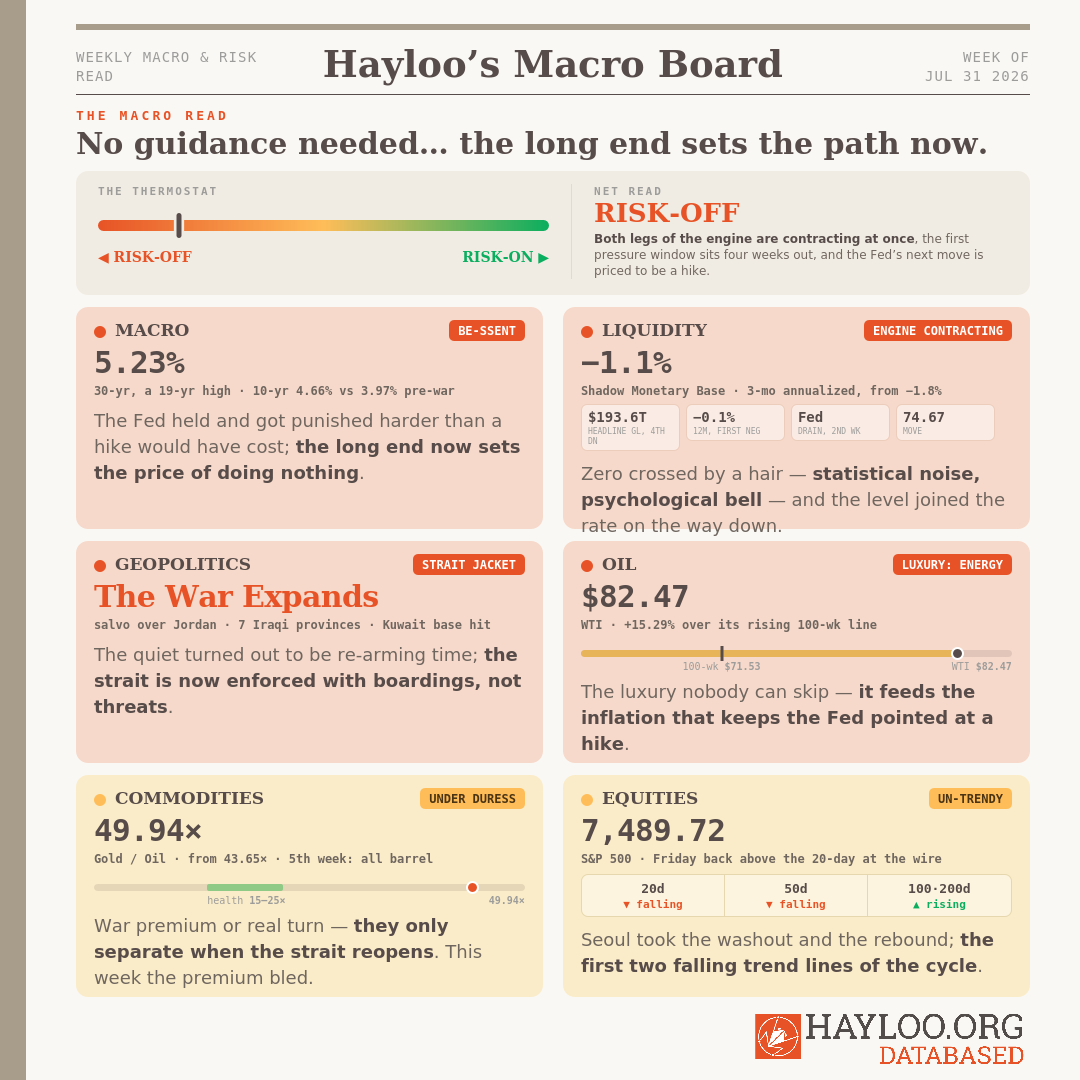
The liquidity engine behind everything had a bad week, and it matters more than anything else. Global liquidity — the world’s pool of money free to chase assets — fell a fourth straight week, to $193.6 trillion. The engine inside it, Michael Howell’s Shadow Monetary Base, shrank to $109.6 trillion, and for the first time this cycle both of its clocks read negative at once: the fast three-month clock at −1.1%, a third straight red, and the slow twelve-month clock crossing zero to −0.1%.
Honesty about that second number: a tenth of a point below zero is statistical noise, one revision from vanishing. But a crossing is a crossing — noise to a statistician, a bell to a trader. It changes our posture, not our position, and next week’s print gets our hawk-eyes.
Beijing is actually adding to the pool, but Beijing is alone. The Bank of England, a firmer dollar, and depreciating collateral keep draining liquidity, and the Federal Reserve now sits a second straight week among them.
The last time the world’s money plumbing behaved like this, in 2021 and 2022, the S&P went on to lose a quarter and Bitcoin three-quarters. That tail is what our short position was cut out for.
🔴 This week’s liquidity tape printed both clocks negative for the first time in the cycle.
— Global Liquidity Director (Julian Harlow)
Macro Tape
The Federal Reserve did nothing on Wednesday, and the bond market punished the board for the privilege. The interest rate hold came in 9-3 — three dissents, the most rebellious room since 2016 — and inside an hour the 30-year had spiked fourteen basis points to 5.23%, a level last seen nineteen years ago. The 30-year mortgage now starts with a six. Scott Bessent spent the good years asking to be judged by the 10-year yield. It sits at 4.66% against 3.97% before the war. The judgment is in, and it isn’t the one Bessent ordered.
Kevin Warsh floated changing how inflation gets measured — the chairman’s version of moving the goalposts after the shots sailed wide. The market ignored the stagecraft and priced the substance: a September hike near 60%, December is done and in the books. The growth data offered no exit — 1.5% headline growth with consumers spending 3.2% more and paying 3.5% more frees nobody — and Trump’s tariff wall has settled into what markets now price as a standing American regime of uncertainty.
The yen bled toward 164 before Tokyo blinked — five yen in fifty minutes. The New York Fed ran the check on Treasury’s behalf, and Bessent propped up the yen on TV. Washington didn’t just bless the yen intervention; it held the other end of the operation. Next morning the Bank of Japan held rates at 1%, and talked a tough game, raising its own inflation forecast — propping the currency with one hand, hardening the case for tighter money with the other. Around the region: India spent $7 billion on the rupee, Indonesia’s central-bank governor quit early, and big managers now openly weigh Australian and European bonds over Treasuries. Hayloo’s very own Geopolitical Intelligence Officer Margaux Lindqvist calls the international stint “authorities getting ahead of a disorderly unwind” — a defense that worked.
But Hayloo’s Chief Macro Strategist Theodore Brennan reads it darker: “a line that needs the US Treasury to hold is built too close to the fire.” The arithmetic is shared either way: a central bank raising its inflation call while propping its currency is the carry trade’s worst arrangement, and if that trade unwinds, it unwinds into a contracting liquidity engine — it’s just insult added to injury.
🔴 The bond market filled the void the Fed’s silence left behind, and the yen needed Washington to hold the line.
— Chief Macro Strategist (Theodore Brennan)
Geopolitical Tape
It wasn’t a pause. It was a gun being reloaded in front of us. Five quiet days drained 8.7% out of crude oil; a Tuesday-night salvo over Jordan, strikes across seven Iraqi provinces, tankers boarded inside Hormuz, Oman’s compromise rejected and a claimed hit in Kuwait put most of it back in one night. That is the whole chronology. Nobody used the quiet to talk — they used it to shop for ammunition.
The front worth studying is the one nobody is shooting on. At Bab el-Mandeb the Houthis no longer run a blockade; they run a customs post. Chinese ships sail through, Saudi hulls get turned or hit. Beijing collects its barrels at market price, Riyadh watches its own coastline tax its own exports, and everyone else pays the toll in miles — around the Cape, a month longer, roughly $2.5 million a voyage, costs that outlive any ceasefire. Because insurers reprice risk in years, not news cycles.
At Hayloo, we never priced a war premium that evaporates on a handshake, much rather we expect the premium to morph into the cost of doing business. Our short book is positioned for the repricing of the latter.
🔴 This week’s geopolitical tape watched a pause re-arm both sides.
— Geopolitical Intelligence Officer (Margaux Lindqvist)
Commodity Tape
A regime is a relationship to a line, not a week’s direction. The barrel gave back 11% of its war premium and still sits 15% above a 100-week average that is itself rising — a market this twitchy on headlines can’t see the forest for the trees, and the forest changed in February. Energy is a different input cost now, and the only thing that turns this ship around unharmed is the strait reopening free of charge. Good luck with that.
What the new regime buys us is a chain with every link pointing one way: expensive energy floors inflation, floored inflation keeps the next move a hike, hikes keep the engine draining — the exact weather that inspires our continued short position.
🔴 This week’s oil tape confirmed a new regime. The war traded its mood swings around it.
— Inflation & Real Asset Analyst (Sienna Whitfield)
Hard Assets
Gold spent the week surviving its own audit. The World Gold Council revised first-quarter central-bank buying down by 187 tons — to 57. Read that twice: the buyer the entire gold price leans on was, for a quarter, mostly a bookkeeping mirage. The floor held anyway, because the physical buyer showed up where the paper one faded — China imported roughly 173 tons in June, a two-year high, third monthly rise running.
The week’s gain — 2.96% above the floor, still 6.6% under the 20-week line — came from the dollar: gold rose when Tokyo’s intervention knocked the dollar down. A currency effect in a bull costume; the structural bid stayed quiet.
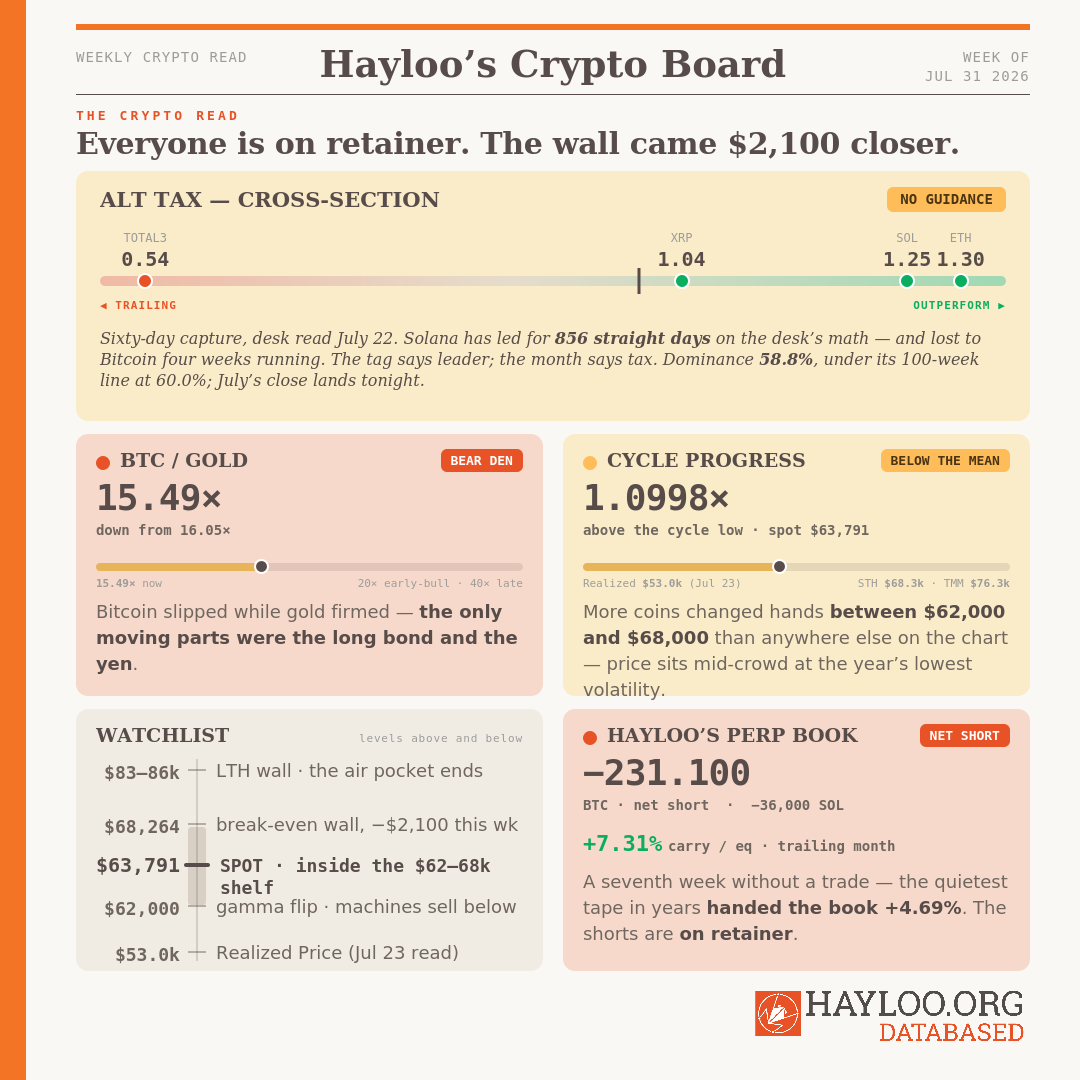
The ratios are the reality filter. Gold/Oil at 49.94× has moved five straight weeks on the barrel alone which says this inflation is a supply story, the kind no central bank can cut its way out of. BTC/Gold slipped to 15.49×, but the only moving parts were the long bond and the yen. The coin did no structural work.
And Strategy, the largest corporate holder of Bitcoin: a fifth straight week without buying a coin, an $8.2 billion quarterly loss, a two-year dividend runway banked, its financing vehicle $10.50 under par. A Bitcoin treasury company is selling stock to hold dollars to pay Bitcoin dividends. That’s it. That’s the sentiment. There must be a bottom somewhere below that statement.
🔴 This week’s hard-asset tape held the floor on the dollar’s move, not Beijing’s.
— Hard Asset Strategist (Marcus Vasquez)
Equity Tape
The scratch became a run: six straight closes below the 20-day, and for the first time this cycle the 20-day and 50-day are both falling — two coats of paint peeling at once while the deep trend rises untouched underneath.
The crack opened in Seoul, where the AI trade is priced hardest. Nvidia’s roughly $750 billion web of circular supply-and-financing deals — the supplier bankrolling its customers’ ability to buy — put a dollar figure on the market’s ugliest suspicion: the demand signal isn’t independent. The Kospi dropped 10% in a session, 25% off its June peak; SK Hynix printed record profit and still missed; Samsung grew chip profit 250-fold to a shrug — a trade priced for divine perfection. The S&P lost 1.5%, the Nasdaq 100 slid into an 11% correction.
Then the epicenter healed itself. Microsoft’s fastest cloud growth in four years and Amazon’s beat landed against Meta’s miss, and the market drew a bright line: it pays for revenue that already printed money — Microsoft up 9% — and punishes promises financed in a circle — Meta down 8%. Friday the Kospi ripped 17%, SK Hynix nearly 30%, and the S&P closed the month at 7,489.72, back above the 20-day on the final print. One close is a poke, not a repair. At Hayloo we stopped looking at the hype. We are looking at trend lines, and the trend lines are topping.
🟠 This week’s equity tape logged a trend, with trend lines tipping over.
— Technical Analyst (Lukas Marchetti)
On-Chain Tape
Walk the room, it’s empty. Exchange traffic is the quietest in three years; spot volume, counted in coins, the lowest since 2019; balances flat since early July. The tourists who stormed the ETF turnstiles last week went home as foreseen, seven-day flows swinging to minus $433 million from plus $711 million.
This year’s buyer’s cost-basis sits at $68,264, seven percent overhead, the line that decides the next leg. Below it, price sits in the busiest band on the chart — more coins changed hands between $62,000 and $68,000 than at any other price in Bitcoin’s history. Half those owners are underwater and sell every bounce; that caps the rallies. The other half sat through the whole decline and sell nothing; they catch the dips. One band, two crowds — the mechanical definition of a range. We argue patience.
Volatility is the narrowest since January, a quiet market before the storm? Volatility this tight, this close under a wall, resolves with a move, not a drift. Below $62,000 sits the Bitcoin trapdoor, where dealers stop absorbing selling and their own hedges force them to join the rout.
In a leveraged market whose biggest buyer is managing its debt with dollars instead of Bitcoin, a break of the shelf would not drift — it would run. Our shorts from January remain open for that run; the ladder beneath is where we buy.
🟠 The pros are on retainer in dollars until Bitcoin moves.
— Capital Flow Analyst (Priya Sandoval) · Fundamental Research Analyst (Charlotte Donovan)
Hayloo’s Perp Book
Size and direction. Net short, both legs. Bitcoin: −231.100 coins net, −$16,205,413 at entry. Solana: −36,000 net, −$2,052,162 at entry. Equity: $8,847,690, up 4.69% on a week Bitcoin fell 1.72% and Solana 4.15%.
The Solana leg. Solana paid a tax to Bitcoin for the past 4 weeks. The short stays as sized. Nothing near a trigger.
Funding rate carry. The trailing month pays +$1,770.83 a day — $646,352 a year, 7.31% of equity — with Friday the best single day of the window. Both funding rates positive, both short legs collecting. This is Hayloo’s version of a retainer. The best way to spend the worst phase of a cycle. Stay short and collect funding from bulls too early to show balls.
Next levels we watch. Down: $62,000 Bitcoin, $70 Solana — let’s see if a crowd builds. Up: $68,264 and $90 — the short adds or invalidation.
— Lead Trader (Jordi Federer)
🔴 Hayloo’s perp book is net short, on retainer by immature bulls, as we navigate the ugliest part of the cycle.
Forward Thesis
When nobody is paid to move, this range can last. If Bitcoin reclaims $68,264 on real volume with the ETF channel genuinely buying, there will be open air to the $83,000–$86,000 long-term-holder block. This is the single most likely way this book is wrong within a month.
Drop through the trapdoor at $62,000 and you can buy $55,000 Bitcoin in November. That’s where our long build begins. And we’re paid to wait.
What would change our mind, each against its current value:
1. The liquidity engine’s three-month rate clearly positive and non-base-effect, with the twelve-month turning up alongside. This week printed the exact opposite. We’re far away from cool.
2. The Realized Profit/Loss Ratio sustained above 2.0 with confirmed accumulation. Now 0.77, from 0.87. We’re moving the wrong way.
3. A weekly close above $69,000, sustained on volume. Now $63,791, 8.17% below; Coinbase the only bid, the venue sum still negative — the selling eased, but no buying occurred.
4. A sustained run of S&P closes below its twenty-day line. Equities ran six straight before Friday’s close interrupted the count, and the 20- and 50-day are still falling. The latter is the one we care about: The trend is tipping (look how we didn’t say topping).
Watchlist
The weekend’s scoreboard. It’s the monthly close, and we’ll look at Oil’s fifth weekly close inside the new energy regime (of rising prices), and Bitcoin dominance’s July close against its 100-week line at 60.0%.
The engine’s next print. After a photo-finish, a second double-negative makes the liquidity trend official; the annual rate back above zero un-rings it.
The wall at $68,264, 7.01% up. Still the named way this book is wrong within a month; a real reclaim opens the air to $83,000–$86,000.
The $62,000–$68,000 shelf. Lose it with inflows waking and the tape runs through the $62,000 trapdoor toward the $55,000 ladder, where the long build begins.
The yen near 160. A line held with Washington’s help. A second intervention that fails is the escalation, and it lands in a contracting liquidity window.
The interrupted run. Whether Friday’s close above the 20-day was the break or a one-day poke; the falling 20- and 50-day answer the trend question.
The Team
Jordi Federer — Lead Trader. Owns the book and the publication. Sizing, staging, and every decision that moves capital.
Theodore Brennan — Chief Macro Strategist. Central-bank reaction functions, the dollar, and the rate path.
Julian Harlow — Global Liquidity Director. The liquidity engine, the collateral multiplier, and the transmission lag into price.
Margaux Lindqvist — Geopolitical Intelligence Officer. State behavior, escalation mechanics, and the tails that reprice commodities.
Marcus Vasquez — Hard Asset Strategist. Gold, the debasement basket, and the hard-money ratios.
Sienna Whitfield — Inflation & Real Asset Analyst. Energy, the inflation impulse, and the real-asset complex.
Priya Sandoval — Capital Flow Analyst. Fund flows, positioning, derivatives, and where the marginal dollar comes from.
Charlotte Donovan — Fundamental Research Analyst. On-chain cohorts, cost bases, and the structural read beneath the tape.
Lukas Marchetti — Technical Analyst. Market structure, moving-average regimes, and the levels that fire.
On our use of AI:
Measuring AI to value writing is like rating a restaurant by whether the chef used a food processor.
Humans have written machine-assisted for centuries. What never changes is who decides.
Nothing at Hayloo INC. was ever decided by a machine.
There’s no meter, no word count, no hour count, no token that tells you how much of us is in our work. We use AI, we run scripts, we process data, we ask questions, and we debate what the machine contributes.
What survives is what we defended as a team.
When it’s wrong, it’s wrong because us, the humans, signed it.
Jordi Federer, Founder, Hayloo INC.
Disclaimer
The information is provided for information purposes only and on the basis that it will not be relied upon. No information contained herein constitutes a personal recommendation or investment advice.
The information (including any expressions of opinion or forecast) has been obtained from, or is based on, sources believed by the author to be reliable, but are not guaranteed as to their accuracy or completeness and should not be relied upon. The information is provided without obligation on the part of the author and on the understanding that any person who acts upon it or changes his investment position in reliance on it does so entirely at his own risk. The information does not constitute an offer to buy or sell or an invitation to make an offer to buy or sell any financial instrument.
Information is current only as at the date it is first posted and may no longer be true or complete when viewed by you. All information may be changed or amended without prior notice.
No representation, warranty or undertaking is given as to the accuracy or completeness of the information by the author and no liability is accepted by the author for the accuracy or completeness of such information. In no event will the author be liable to any person for any direct, indirect, special, or consequential damages arising out of any use of the information, including, without limitation, any lost profits.
You should be aware that the Internet is not a completely reliable transmission medium. The author does not accept any liability for any data transmission errors such as data loss or damage or alteration of any kind, including, but not limited to any direct, indirect or consequential damage, arising out of the use of the product or services referred to herein.
The materials provided here including text, photographs and other images, are protected by copyright and/or other intellectual property rights. All copyright (and any other intellectual property rights) in these materials is either owned by the author, or is used by the author under licence.