


Tape of the Week
Anyone who checks four prices and goes back to bed had a good week. The S&P 500 closed around records, crude fell on Trump’s headfakes, gold held due to the Chinese bid, and Bitcoin is in a coma.
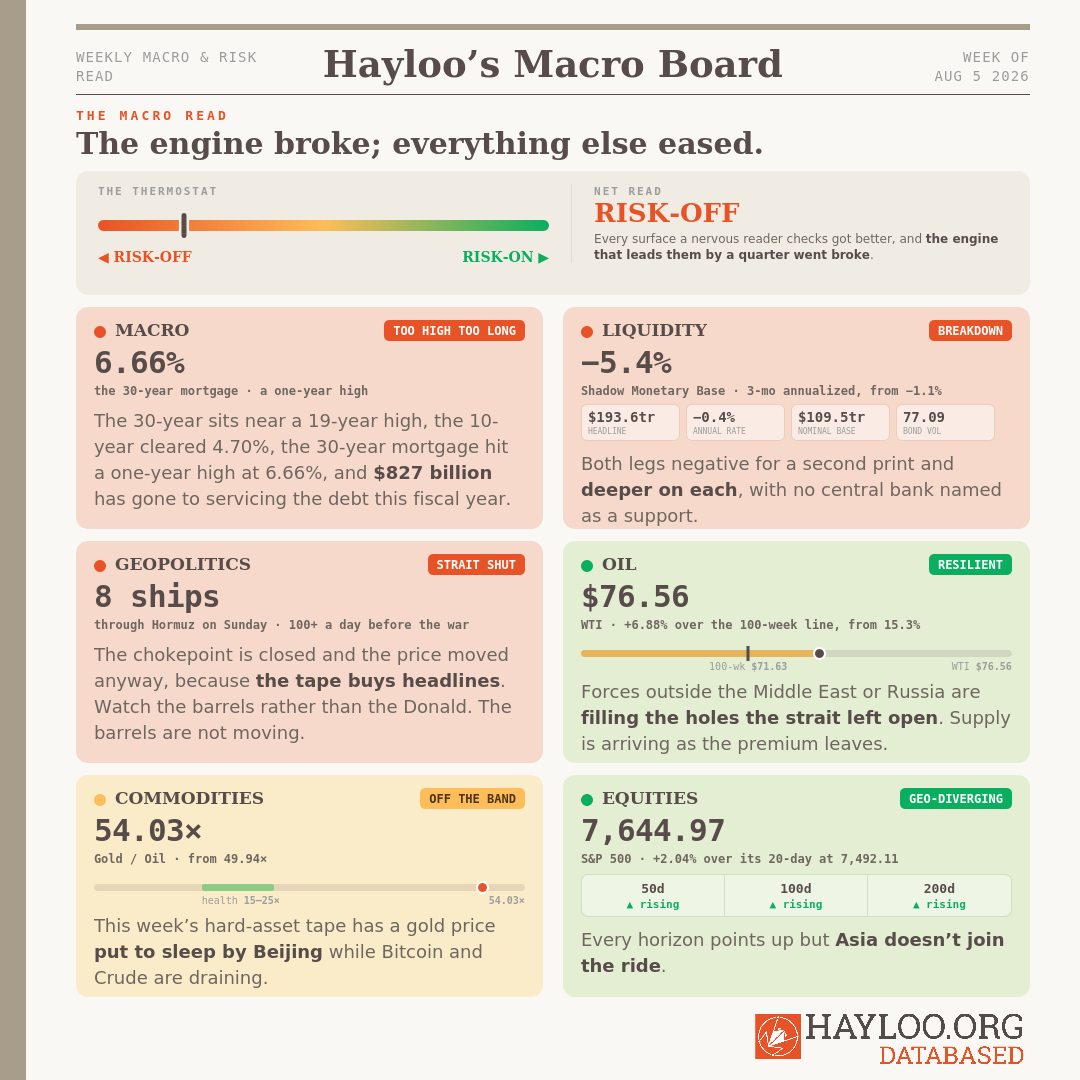
The thing that drives all four fell off a cliff underneath them. GLI’s Shadow Monetary Base went from −1.1% three-month annualized to −5.4% in one print, and the annual leg slipped from −0.1% to −0.4% without a central bank anywhere, at least not in this universe, providing support. This dry well will hit the pipe in roughly a quarter.
Bitcoin is writing its’ own obituary this week, for every dollar of profit taken more than two dollars of loss went with it, every goddamn day of the week. Roughly 13,700 coins moved onto exchanges over four days after Coldcard, the self-custody name the hardest holders trust, told users its keys could (and would) be cracked. Bitcoin slept through the robbery on $470 million of spot volume, the lowest in coin terms since 2019.
The rest of the week fills in around that. Two treasuries are now holding hands with one yen, gold’s floor is being set in Beijing rather than Washington, and no ship moves through Hormuz but the oil price ticks with Donal Trump’s brain-farts.
Our book is short crypto into this liquidity contraction that just deepened, and if you want to argue our directional call you can, we’ve been short crypto since January, and we might have grown a bit fat and lazy. However, funding pays us a whopping 7.32% annualized to sit still, so we’ll sit out another Treasury auction and keep cashing in.
Liquidity Tape
The liquidity engine did not drift this week. It fell. The Global Liquidity Index’s (GLI) Shadow Monetary Base printed −5.4% three-month annualized against −1.1% a week ago, the annual rate went from −0.1% to −0.4%, and the nominal base slipped to $109.5 trillion from a revised $109.7 trillion. This is the second consecutive print with both timeframes below zero.
The latest liquidity contraction is a global trend, with even the People’s Bank of China (PBoC) draining liquidity, which will hit financial markets in Q4 2026. We’re in a Crescendo towards more leverage corrections, with three-month growth contracting.
Bond volatility averaged 76 last week against roughly 100 since 2022 and a March peak of 115, which is probably the US Treasury deliberately suppressing Treasuries. All central banks globally, including the Fed, drain liquidity right now. The Treasury deliberately squeezing liquidity out of a muted bond market is a structure that does not unwind gently.
🔴 This week’s liquidity tape printed a new trough and moved the hard part to Q4 2026.
— Global Liquidity Director (Julian Harlow)
Macro Tape
Two treasuries are now holding one currency line. The first joint US-Japan intervention since 1998 landed on July 31. The yen strengthened, the dollar eased, but that usually doesn’t hold. Which is why the US Treasury Secretary also asked the Federal Reserve to upsize a facility Japan can draw on, and the explicit purpose of that request is to stop Japan from having to sell Treasuries to fund its own defence.
What’s rather peculiar about the self-serving US support of Japan is the Japanese easing of taxes on food items by 800% in the same week, without announcing any fiscal measures that should close the gap. So, in a nutshell, the way our desk reads the American-supported rescue of the yen is that it is an unsustainable closed loop among friends that owe each other a lot of solids, and the minute the money flowed, the one in need went on a spending spree. Sounds like Japan first, America second.
The geopolitical short-term read is that the coordinated intervention worked, the USD/JPY pair eased. The macro read is that a credit line requiring two treasuries and a central-bank backstop is broken.
Which seams a good moment to remind US Treasury Secretary Scott Bessent of the standard he set for himself in better years: judge me by the 10-year. Will do, Scott. The 30-year sits near a 19-year high, the 10-year cleared 4.70%, the 30-year mortgage hit a one-year high at 6.66%, and $827 billion has gone to servicing the debt this fiscal year — more than the United States spent on defence, on the Associated Press’s count.
Kevin Warsh, the new Fed chair, withholds guidance, floats meeting fewer times a year, and thinks out loud about moving the goalposts on inflation. Brandywine Global and Wellington both warned this week that the risk of a deeper Treasury rout is rising, and both named the silence as the reason. Warsh’s posture adds a term premium on top of bonds without him lifting a damn finger, and a US economy that just printed its fastest manufacturing month since 2022 gives him no reason to stop.
🟠 This week’s macro tape has the yen defended by two governments and the long end widening on the reaction function.
— Chief Macro Strategist (Theodore Brennan)
Geopolitical Tape
Oil is priced on headlines while the strait stays shut, and the barrel treats brain-farts from the US president as real enough to move. Eight ships went through Hormuz on Sunday and eleven on Saturday, against more than a hundred a day before the war. Kuwait’s exports have stopped completely. Another vessel was struck. Tehran denies asking for the talks the tape rallied on, and Trump has moved to demanding total surrender, even though the US president has been largely shut out of resolving a war he started. Watch the barrels rather than the Donald. The barrels are not moving.
Add insult to injury, there is a second energy war running on its own clock. Ukraine struck a Saratov refinery and the Engels airfield inside this window, and the tape is pricing none of it. Iran dominates the read while Ukraine takes more refining capacity off the board.
🔴 This week’s geopolitical surface is wider than the price that reflects it.
— Geopolitical Intelligence Officer (Margaux Lindqvist)
Commodity Tape
Forces outside the Middle East or Russia are filling the holes the strait left open. Supply from outside the Organization of the Petroleum Exporting Countries (OPEC) hit records, with Brazil and Kazakhstan both at all-time highs. OPEC+ restored the last of its 2023 cuts with 188,000 barrels a day for September while explicitly keeping further capacity for after the war ends. Supply is arriving as the premium leaves.
🟢 This week’s oil tape is proving resilience.
— Inflation & Real Asset Analyst (Sienna Whitfield)
Hard Assets
Gold sits comfortably above $4,000, with Chinese institutional money buying every dip. In reality, the line the Chinese are defending is RMB27,000 an ounce, which is roughly $4,000. Looking at the exchange rate from the Chinese perspective, the thing to watch for gold becomes Chinese bond yields, and Chinese yields are falling.
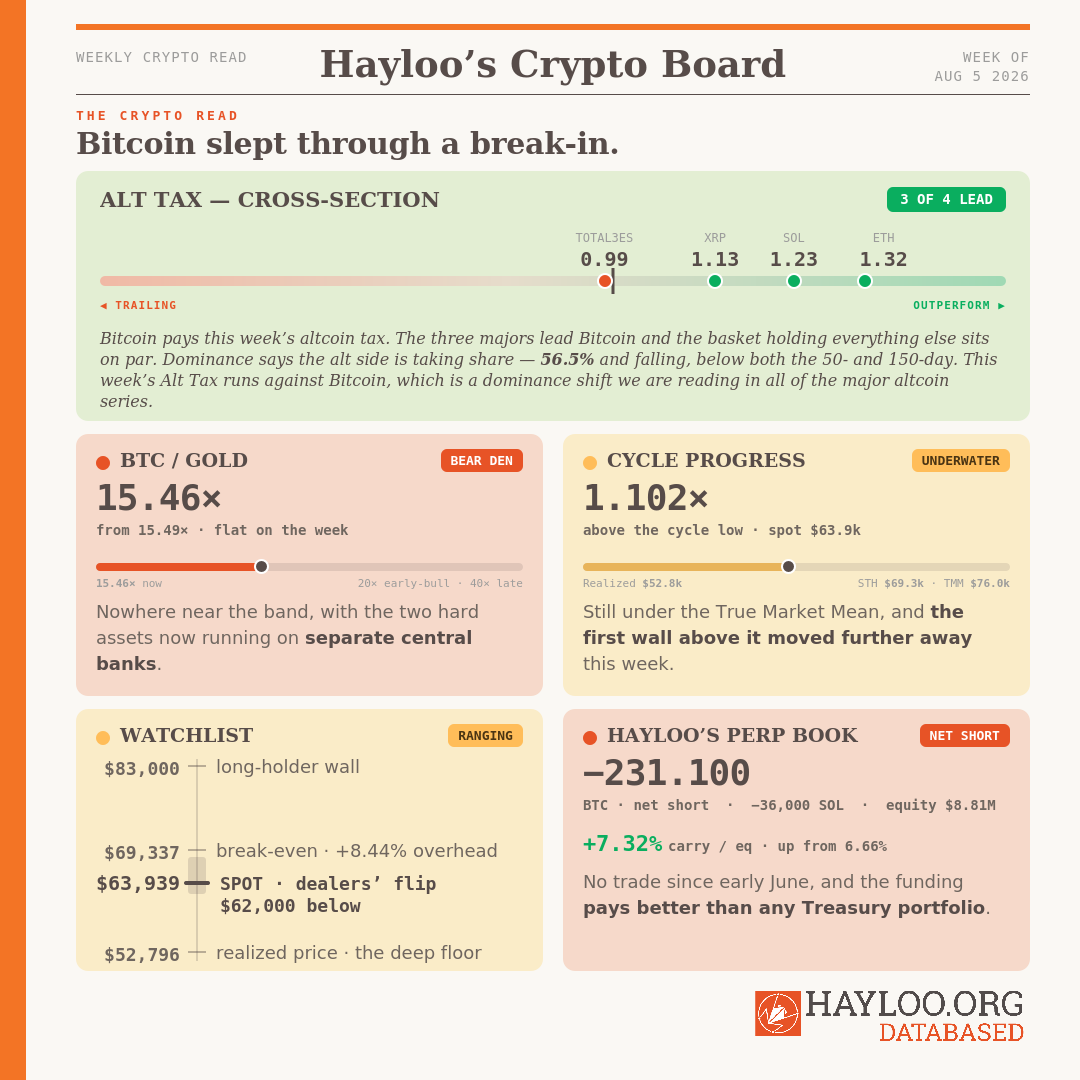
With institutional money defending gold’s floor and oil following the US president into every rabbit hole, the Gold/Oil ratio widened to 54.03× from 49.94×, because crude fell and gold sat still. BTC/Gold sits at 15.46× flat, and still nowhere near the 20× early-bull band. The two hard assets now answer to two different central banks: the Fed drives Bitcoin and Beijing drives gold.
The copper leg is distorted this week and should not be read as confirmation of anything: US imports are running at their fastest rate in at least twelve years, front-running a tariff decision from Trump rather than responding to any real demand.
🟠 This week’s hard-asset tape has a gold price set by Beijing while Bitcoin is draining.
— Hard Asset Strategist (Marcus Vasquez)
Equity Tape
The scratch healed in a week. The S&P 500 is back above alll four rising trend lines. The artificial-intelligence (AI) trade, however, is undergoing some second guessing in Asia, without investors pulling in their horns. They are rotating away from the trade that has led the cycle, and their risk appetite is bite-sized.
🟢 This week’s equity structure reclaimed every trend line, but Asia disagrees.
— Technical Analyst (Lukas Marchetti)
Hayloo’s Crypto Tape Week 32 – Bitcoin slept through a robbery
On-Chain Tape
Bitcoin’s realized profit-loss ratio fell to 0.443 — more than two dollars of loss realized for every dollar of profit. Loss-taking has dominated on-chain spending every single day of the week, not one day came even near the 1.0 balance line. This is the section that runs against the calm everywhere else, and it is the strongest divergence in the week.
Long-term-holder realized loss on a 30-day average rose for a third consecutive print to $297.1 million, from $271.5 million and $224.7 million before that. Percent of supply in profit fell to 52.6% from 56.0%. Short-term holders are underwater on average and their cohort is running a 6.3% loss. Bitcoin spending is happening at a small loss everywhere.
Exchange netflow ran +2,877 BTC onto venues on the day and roughly 13,700 across four, after Coldcard, Bitcoin’s most coveted self-custody name, was cracked by an attacker finding weak keys. On August 4 the company told users to move their coins, because the flaw was still live on specific models and firmware, and the exchange OKX reported record inflows to centralised exchanges the same day. The people most committed to holding Bitcoin in cold storage had just learned their preferred method carried an invisible flaw, and they moved.
At this point, demand for Bitcoin leverage is so weak that even the hack of Bitcoin’s most coveted cold-storage device doesn’t force anyone out of anything, and the story didn’t matter at all. Bitcoin slept through the robbery of its own core, confident that part of its advancement is that custody by private, regulated Swiss vault managers, somewhere dug into the Alps, is kind of sexy the way a Coldcard was sexy in 2021.
More coins changed hands between $62,000 and $68,000 than at any other price in Bitcoin’s history, yet the current spot volume is dead — $470 million on the day, and in coin terms the lowest since 2019, with Chicago Mercantile Exchange (CME) open interest back at 2023 levels. Bitcoin is basically in a coma. The clinical death of Bitcoin normally resolves to the upside. We just don’t hold our breath yet.
Strategy sold another 1,638 coins for $104.7 million, raised $290.6 million of common stock, bought back $81.2 million of its own preferred, and held that preferred’s dividend at 12% while the shares trade below par. A treasury company selling stock to hold dollars to pay dividends on a Bitcoin position. That’s it. That’s the sentiment. If there is no bottom somewhere below that statement, then there is no floor at all...
🔴 This week’s on-chain read is the seventh death of Bitcoin in 15 years.
— Capital Flow Analyst (Priya Sandoval) · Fundamental Research Analyst (Charlotte Donovan)
Dominance is falling and the altcoin majors are catching up
Bitcoin dominance fell to a three-month low. Bitcoin’s share of total crypto market value is 56.5% and falling, trading below its 50-day and 150-day average. Falling dominance means Bitcoin is losing share and everything else is gaining it, which is what we are reading in all of the major altcoin series.
🟢 This week’s Alt Tax runs against Bitcoin — AGAIN.
Hayloo’s Alt Tax Week 32 – All the three Majors charge a Bitcoin Tax

Hayloo’s Perp Book
Size and direction. Hayloo’s book remains net short both legs, it did nothing this week, but earned funding fees. Bitcoin: −231.100 coins net, an entry-net of −$16,205,413 and −$14,776,303 at mark. Solana: −36,000 coins net, −$2,052,162 entry-net and −$2,661,120 at mark.
Funding Rate Carry — income, and it improved. The trailing four-week smoothed mean of daily funding rate income reads +$1,766.71 a day, which annualizes to +$644,850 and 7.32% of equity, up from 6.66% a week ago. Both funding rates are positive against a net-short book, so both short legs collect.
Next levels that fire. Downside: $55,000 on Bitcoin and $55 on Solana, both Long Add and Short Take-Profit. Upside: $98,000 on Bitcoin and $90 on Solana.
Position vs. thesis. The book is short into a liquidity contraction that just deepened and an on-chain tape where loss-taking dominated every day of the week. It is also short into a range where nothing on either ladder is within reach of spot. That combination is exactly the zone where this book has nothing to do, and it is being paid 7.32% a year to sit back and wait.
— Lead Trader (Jordi Federer)
🔴 Hayloo’s perp book is net short, paid better than any Treasury, and that’s for doing nothing.
Forward Thesis
We didn’t move this week, but our clock did. A falling liquidity engine print is a new trough rather than an extension of the old one, which pushes the deepest transmission pressure out to early November and demotes late August to the first and milder of two windows. We had been treating late August as the main event. It is now the warm-up, and that is a change in when the pressure lands rather than whether it does.
Bitcoin works inside the $62,000 to $68,000 shelf until something takes it out. The first wall above is the short-term-holder cost basis at $69,337, 8.44% overhead and further away than it was last week. Behind that sits the long-term-holder block at $83,000 to $86,000. The downside ladder runs to the realized price at $52,796, the average price at which every coin in circulation last moved.
Since Bitcoin is arguably already dead, and spot volumes as well as leveraged positioning confirm there is little life, we argue for a grind. There are breakouts and there are breakdowns, and we expect neither. A decisive reclaim of $69,337 on returning volume with the fund channel actually buying opens the air pocket toward $83,000. A loss of the shelf with exchange inflows continuing accelerates toward $55,000, where the staged sizes stand for first contact. We are positioned for the slow grind down.
What would change our mind:
1. The Shadow Monetary Base three-month rate clearly positive and non-base-effect, with the annual rate turning up at the same time. This week printed the exact opposite on both legs: −5.4% and −0.4%. Moved decisively further away.
2. The realized profit-loss ratio sustained above 2.0 across multiple weeks, with confirmed accumulation. Now 0.443, and every daily print in the window below the balance line. Moved further away.
3. A Bitcoin weekly close above $69,000 with sustained spot demand.
4. A sustained run of S&P 500 closes below its 20-day line.
Watchlist
WTI’s coming weekly close against the 100-week line at $71.63.
The yen at 155. The named test of whether the joint intervention holds. A second round that fails to hold is the escalation, and it would land inside an ugly liquidity contraction.
The next liquidity engine print. A third consecutive double-negative hardens the Tape’s read. A bounce back toward −1.1% says the −5.4% was a revision artifact rather than a trough.
Bitcoin at $69,337 — the short-term-holder cost basis. The named way this book is wrong inside a month, with the air pocket to $83,000 behind it. It moved further overhead this week rather than closer.
Whether the relocated coins ever trade. Roughly 13,700 coins moved to exchanges over four days on a custody scare. Fear, not selling. The only thing worth watching is whether they actually change hands on strength.
The realized profit-loss ratio at 0.443. The weekly halving sits on a series that swings hard day to day, so it is either capitulation building or an artifact. The next print says which.
Asia against Wall Street. GLI risk-appetite gauge has Korea at +61 against a +79 peak while Europe takes the flow. One tape is pricing the ceasefire and the other the artificial-intelligence unwind, and they cannot both be right for long.
Chinese bond yields and PBoC liquidity. The newly named instrument panel for gold’s floor at $4,000, with spot 3.42% above it.
Strategy’s STRC at $92.32. Below par and the best level in weeks, while the company sold another 1,638 coins and raised $290.6 million of stock.
The Team
Jordi Federer — Lead Trader. Owns the book and the publication. Sizing, staging, and every decision that moves capital.
Theodore Brennan — Chief Macro Strategist. Central-bank reaction functions, the dollar, and the rate path.
Julian Harlow — Global Liquidity Director. The liquidity engine, the collateral multiplier, and the transmission lag into price.
Margaux Lindqvist — Geopolitical Intelligence Officer. State behavior, escalation mechanics, and the tails that reprice commodities.
Marcus Vasquez — Hard Asset Strategist. Gold, the debasement basket, and the hard-money ratios.
Sienna Whitfield — Inflation & Real Asset Analyst. Energy, the inflation impulse, and the real-asset complex.
Priya Sandoval — Capital Flow Analyst. Fund flows, positioning, derivatives, and where the marginal dollar comes from.
Charlotte Donovan — Fundamental Research Analyst. On-chain cohorts, cost bases, and the structural read beneath the tape.
Lukas Marchetti — Technical Analyst. Market structure, moving-average regimes, and the levels that fire.
On our use of AI:
Measuring AI to value writing is like rating a restaurant by whether the chef used a food processor.
Humans have written machine-assisted for centuries. What never changes is who decides.
Nothing at Hayloo INC. was ever decided by a machine.
There’s no meter, no word count, no hour count, no token that tells you how much of us is in our work. We use AI, we run scripts, we process data, we ask questions, and we debate what the machine contributes.
What survives is what we defended as a team.
When it’s wrong, it’s wrong because us, the humans, signed it.
Jordi Federer, Founder, Hayloo INC.
Disclaimer
The information is provided for information purposes only and on the basis that it will not be relied upon. No information contained herein constitutes a personal recommendation or investment advice.
The information (including any expressions of opinion or forecast) has been obtained from, or is based on, sources believed by the author to be reliable, but are not guaranteed as to their accuracy or completeness and should not be relied upon. The information is provided without obligation on the part of the author and on the understanding that any person who acts upon it or changes his investment position in reliance on it does so entirely at his own risk. The information does not constitute an offer to buy or sell or an invitation to make an offer to buy or sell any financial instrument.
Information is current only as at the date it is first posted and may no longer be true or complete when viewed by you. All information may be changed or amended without prior notice.
No representation, warranty or undertaking is given as to the accuracy or completeness of the information by the author and no liability is accepted by the author for the accuracy or completeness of such information. In no event will the author be liable to any person for any direct, indirect, special, or consequential damages arising out of any use of the information, including, without limitation, any lost profits.
You should be aware that the Internet is not a completely reliable transmission medium. The author does not accept any liability for any data transmission errors such as data loss or damage or alteration of any kind, including, but not limited to any direct, indirect or consequential damage, arising out of the use of the product or services referred to herein.
The materials provided here including text, photographs and other images, are protected by copyright and/or other intellectual property rights. All copyright (and any other intellectual property rights) in these materials is either owned by the author, or is used by the author under licence.