


Five obsessives behind a spreadsheet have worked out, to four decimal places, exactly how much your favorite altcoin ETF fleeces you every time Bitcoin clears its throat. They will not — under any circumstances, and believe me I tried — tell you what to buy.
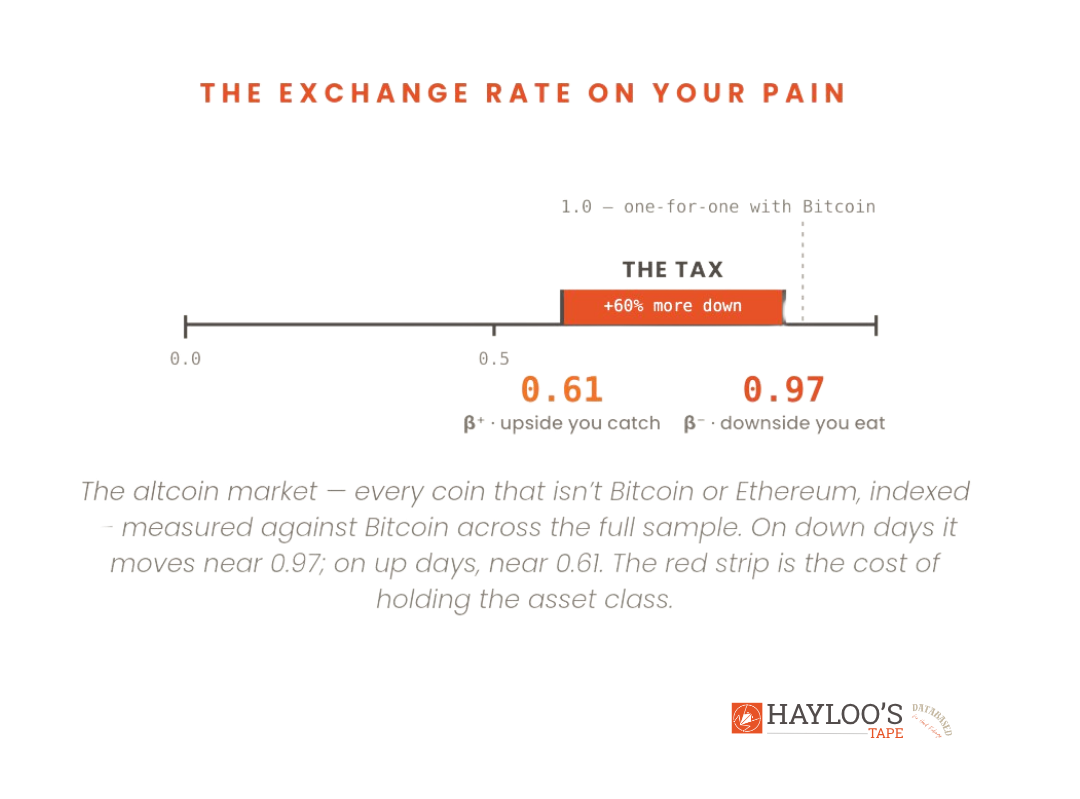
If you hold anything in crypto that isn’t Bitcoin there is a tax you are paying right now, this very second. It works like this. Bitcoin stumbles three percent on a Tuesday and your altcoin is down five before you’ve finished your coffee. Bitcoin rips three percent the day after and your altcoin, sluggish and hungover, manages two. Heads the house wins. Tails the house wins by less. Stretch those two crooked coin-flips across a few years and they compound into a quiet, grinding levy on everyone who ever decided Bitcoin was too boring to get rich.
Everybody in crypto feels this tax. Almost nobody has bothered to measure it. So we went looking for the right people who can.
They call the thing they measure beta — the same beta the finance professors have muttered about since the 1960s, the number that says how hard one thing swings when another thing moves. They ran this beta across the entire altcoin market — every coin that isn’t Bitcoin or Ethereum — over nearly a decade of daily closes, through two complete crypto manias and two terminal Bitcoin graveyards.
Beta is the exchange rate on your pain.
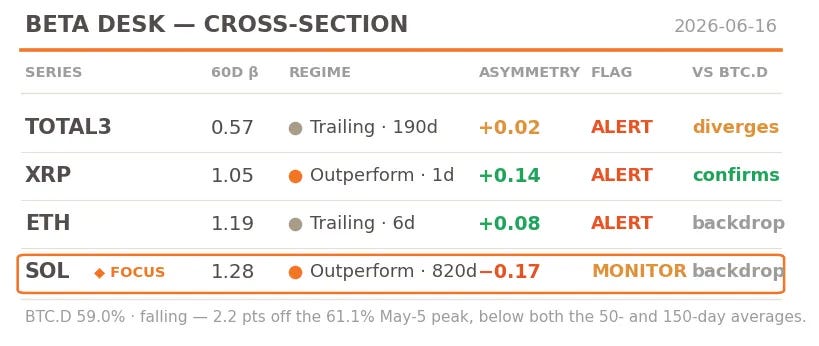
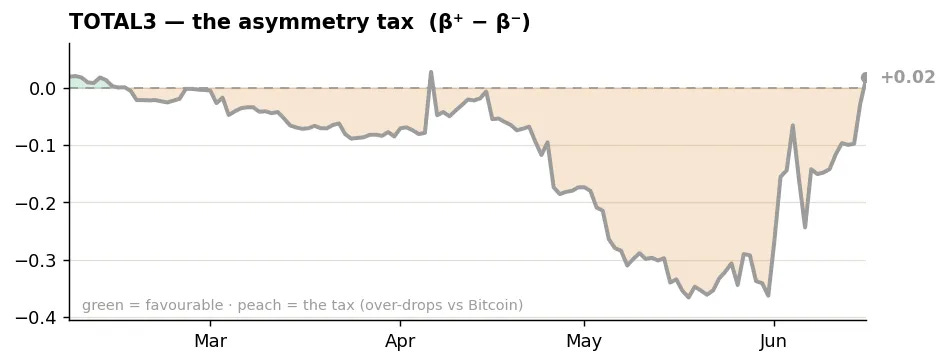
Beta is how much of Bitcoin’s daily move a coin captures. Above 1, it amplifies Bitcoin; below 1, it lags. Split that capture by direction — what a coin grabs on Bitcoin’s up-days (up-capture, β⁺) against what it gives back on the down-days (down-capture, β⁻) — and the gap between the two is the asymmetry. When down-capture runs heavier, a coin is paying a tax: it over-drops relative to how it rallies.
The heresies
Four things everyone got wrong
Our beta desk got built because somebody upstream had been estimating joint cross-margin liquidation numbers based on a single, symmetric beta — one number, plugged in like a thermostat setting, as if a coin behaved exactly the same on the way down as on the way up. A backtest took that assumption out behind the shed. It turned out the old number was wrong in four separate, structural ways.
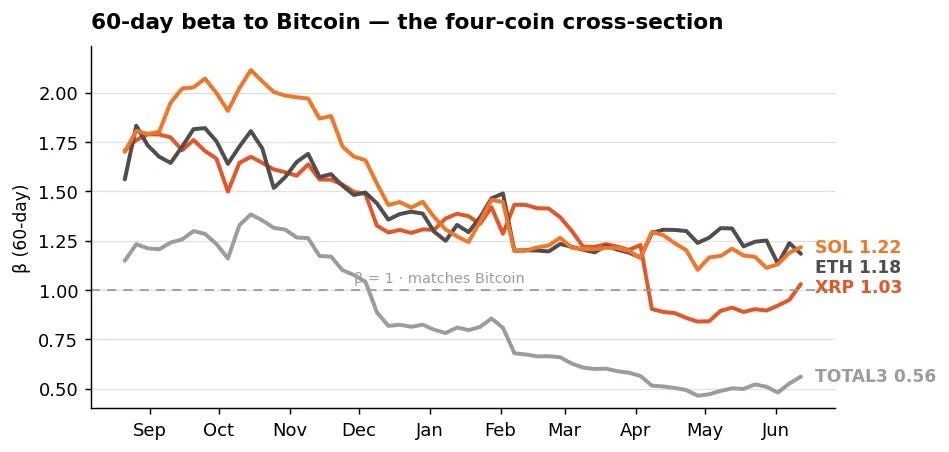
Beta is asymmetric — in our sample, the tax on the down-move was systematically fatter than on the up-move.
Beta is not a constant at all but a thing that cycles through distinct regimes.
Beta carries genuine measurement error, a fact the old single-number approach simply pretended away.
Bitcoin dominance, the dashboard gauge that gets treated as a crystal ball for the next move, turns out on the evidence to be nothing of the kind. It’s a rear-view mirror. More on that ghost later.
The Math · 01
What beta actually is
Returns are daily log returns. Beta is the slope of an Ordinary Least Squares regression of the altcoin’s returns on Bitcoin’s — how far the alt moves, on average, per unit move in Bitcoin.
r_t = ln( P_t / P_{t−1} )            # daily log return
β = Cov( r_alt , r_BTC ) / Var( r_BTC )   # the OLS slope
The desk computes it two ways. The symmetric beta uses every day in the window. The conditional betas split on the sign of Bitcoin’s return:
β⁺ = slope on days where r_BTC > 0   # up-market beta
β⁻ = slope on days where r_BTC < 0   # down-market beta
Asymmetry ≡ β⁺ − β⁻
Symmetric beta runs at three windows — 30, 60 and 120 days. The conditional pair runs at 60 days only: shorter windows don’t hold enough up-days or down-days inside them to estimate each slope before the error swamps the signal.
The machine
How you find a regime without guessing
Most people who talk about market “regimes” mean it as a vibe — risk-on, risk-off, the usual hand-waving. The Beta Desk refuses to eyeball it. Instead they take a decade of rolling beta readings, pour them out into a histogram, and ask the statistics how many distinct humps are actually in the pile. The tool is a Gaussian Mixture Model — picture laying a handful of bell curves over the heap until they snap onto the natural clusters — and the number of bell curves is not chosen by the analyst’s taste. It’s chosen by a scoring rule, and the rule has a temperament: it is a miser.
The naive move is to let the score pick whatever number of clusters “fits best,” full stop — but more clusters almost always fit better, the same way more crayons always color more, by shattering real groups into meaningless sub-groups. So the desk climbs instead of optimizing. Start at two clusters. Add a third only if it earns its keep by a decisive margin; the instant a step fails to clear that bar, stop, and keep the last honest number. They deliberately sweep all the way up to seven clusters — not because they’ll ever use seven, but to make the stopping point visible, to watch the over-fitting begin and then refuse to follow it off the cliff.
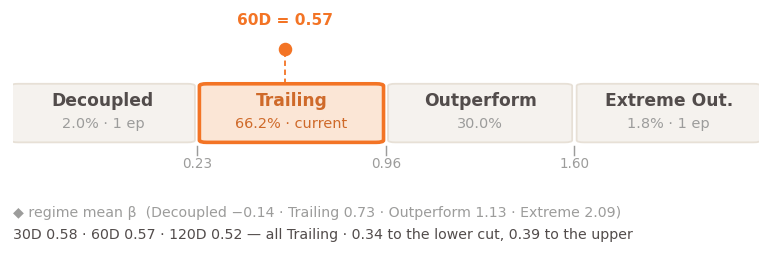
For the altcoin market (TOTAL3), the honest number came out to four. Two big regimes do most of the living: Trailing, the dominant lazy state where alts under-move Bitcoin, which is where the market spends about two-thirds of its life; and Outperform, the high-energy state where alts amplify Bitcoin’s every twitch, about a third. And then, out at the edges, two ghosts. A regime they call Decoupled, where alts stop tracking Bitcoin almost entirely. And one called Extreme Outperform, the blow-off, where alts move at violent multiples of the parent. Each of those two ghosts accounts for roughly two percent of all recorded history. Each corresponds to exactly one episode the market has ever actually visited.
The fact that the market went to the extremes at all, even once, is Hayloo’s house position — that is the signal, not the noise.
Most shops would round those ghosts off as outliers and smooth them into the nearest neighbor. Hayloo’s Beta Desk treats them as sacred. The fact that the market went there at all, even once, is Hayloo’s house position — that is the signal, not the noise. A regime that has happened a single time in ten years is, statistically, almost nothing. It is also a flare fired from the exact top and the exact bottom of a cycle. The Hayloo desk’s whole philosophy lives in these extreme tensions, and we have a name for the trap of ignoring these signals: smoothing away the only thing worth seeing.
The Math · 02
Finding the regimes, with a miser for a judge
Regimes are defined on the distribution of the 60-day symmetric beta. Fit Gaussian Mixture Models for k = 2…7 components. Select k by a parsimony-sequential reading of the Bayesian Information Criterion:
start at k = 2
step up to k+1  ⟺  BIC drops by ≥ 10   # strong-evidence margin
stop at the first step that fails  →  keep the last accepted k
The selected k is the most granular model every step up to it earned — not the global BIC minimum, which over-fits by splitting real clusters into sub-components. A candidate fit is thrown out as degenerate if any component pairs weight < 5% with an extreme spread:
reject if  weight < 5%  AND  ( σ < 0.05  OR  σ > 0.4 )
   σ < 0.05 → a delta-spike on a handful of points
   σ > 0.4  → a sponge soaking up outliers
A low-weight component with a healthy σ is a real tail regime and is kept — the weight gate is what separates a degeneracy from a genuine rare state. Boundaries between regimes are the Bayes-optimal cuts: the beta values where adjacent weighted Gaussians cross densities. Labels are assigned by cluster mean, anchored on β = 1: Decoupled (≤ 0), Trailing (< 1), Outperform (> 1), Extreme Outperform (≫ 1).
The brake
This is only the beginning, and we say so, out loud
It is Hayloo’s Beta Desk’s job not to sound confident, but to openly admit doubt. This is Hayloo’s house dialect, and it is enforced. The regime machine I just described could, in the wrong hands, become a hype cannon. The phrase “the data robustly shows” is effectively banned from our desk.
In an industry that sells certainty by the kilo, the Beta Desk’s entire product is calibrated doubt.
Crypto is a stumbling child. Our backtest catalog of major market turning points runs to something between ten and twenty events per type — a sample so thin that the standard move of bootstrapping a ninety-five-percent confidence interval is simply off the table, so we say so, out loud. We will confess the limits of our own error bars: the standard errors we report quietly assume each day is independent of the last, which for crypto requires a stricter calculation. We volunteer this — unprompted. In an industry that sells certainty by the kilo, Hayloo’s Beta Desk’s entire product is calibrated doubt.
The Math · 03
How much to trust it
The desk’s defensibility test for any estimate is the relative standard error:
SE(β) / |β|   <  30%   → defensible
              <  20%   → comfortable
Symmetric beta clears this easily — under 10% at the 60-day window. The conditional betas sit tighter against the rail: roughly 13% on β⁻ and 21% on β⁺ at 60 days. That is precisely why 60 is the chosen window — short enough to respond to a turn, long enough to keep the down-day and up-day subsamples estimable.
And the honesty tax on their own numbers: the reported standard errors assume serial independence. True Heteroskedasticity-and-Autocorrelation-Consistent errors would run an estimated 20–30% wider. With ~10–20 events per inflection type and the tail regimes often N = 1, 95% bootstrap intervals are not computed — and that caveat ships with every output that leans on them.
The refusal
The number they will never give you
Which brings me to the thing that nearly broke the forming of Hayloo’s Beta Desk. I asked these math-dudes — point blank — whether we were near a bottom. Whether the altcoin tax was about to spike. Whether we should, you know, buy more aggressively?
The room went quiet. The Beta Desk does not forecast. This is the spine of our whole operation. Our signal is asymmetry contraction, the moment the gap between the up-beta and the down-beta starts narrowing toward zero — and historically it has shown up between twenty and sixty days before major turns.
Hayloo’s Beta Desk hands you the shape of the risk you’re standing in, names its own uncertainty about that shape, and then — this is the part the industry cannot comprehend — it stops talking.
But Hayloo’s Beta Desk is fanatical that this is a regime-change tell, not a direction call. It fires before tops and before bottoms with equal enthusiasm and tells you absolutely nothing about which one is coming. It says: something is about to change. It does not say: buy. Or sell. Hayloo’s Beta Desk hands you the shape of the risk you’re standing in, names its own uncertainty about that shape, and then — this is the part the industry cannot comprehend — it stops talking.
The Math · 04
The only thing close to a warning — and the dominance ghost
A confirmed inflection is a price extremum that reverses by at least a swept threshold (25% on Bitcoin and the altcoin index, in this sample) from the prior confirmed extremum, with ≥ 21 days between candidates; the threshold is tuned per series to land turns ~80–120 days apart. At each catalogued top and bottom the desk records the full beta state at T−60, −40, −20, −10, −5 and 0.
pre-turn signature:  | β⁺ − β⁻ |  narrowing toward 0
appears 20–60 days ahead of BOTH peaks AND troughs
→ regime-change signature, NOT a direction signal
And the rear-view mirror everyone mistakes for a crystal ball: Bitcoin-dominance turns, far from leading price, come in at a median lag of roughly −10 to 0 days against price turns, with a standard deviation north of 30 days. Coincident at best. Useless as a standalone forecast. Useful only as confirmation, when it happens to cluster with the beta and the price all turning at once.
Bitcoin-dominance turns, far from leading price, come in at a median lag of roughly −10 to 0 days against price turns, with a standard deviation north of 30 days.
That discipline runs all the way down into how we work at Hayloo’s Beta Desk. Our governing law — the one principle we’ll recite like a creed — is that the truth is in the trace: a claim is worth nothing without a record proving it.
You won’t find the dudes from Hayloo’s Beta Desk on a podcast circuit. Their job is not to tell you that something is going to ten dollars, or a hundred, or zero. We measure the tax — the real, structural levy the altcoin market quietly extracts from everyone who isn’t paying attention to the whispers — and we measured it down to a decimal place that would make an accountant blush.
In a genre built entirely on the confident prediction, Hayloo’s Beta Desk might be the most rock-and-roll thing I have ever been able to build.
By Jordi Federer · co-owner, Hayloo Unchained Inc.
Editor’s note
No Bitcoin price was forecast in the making of this article. The Beta Desk does not own a crystal ball. It owns a spreadsheet. These figures reflect the desk’s full-sample measurements; like all of its numbers, they drift as the data grows, and we would insist on telling you so.