


Signal is Hayloo’s newsreader, customized to the portfolio Hayloo scores, weighing every macro, geo, and on-chain headline against the risk in Hayloo’s portfolio and Hayloo’s market positioning. Signal respects Hayloo enough to stay quiet until the day’s noise becomes signal. To customize your own newsreader, go to hayloo.org.
TOP-OF-STACK SUMMARY
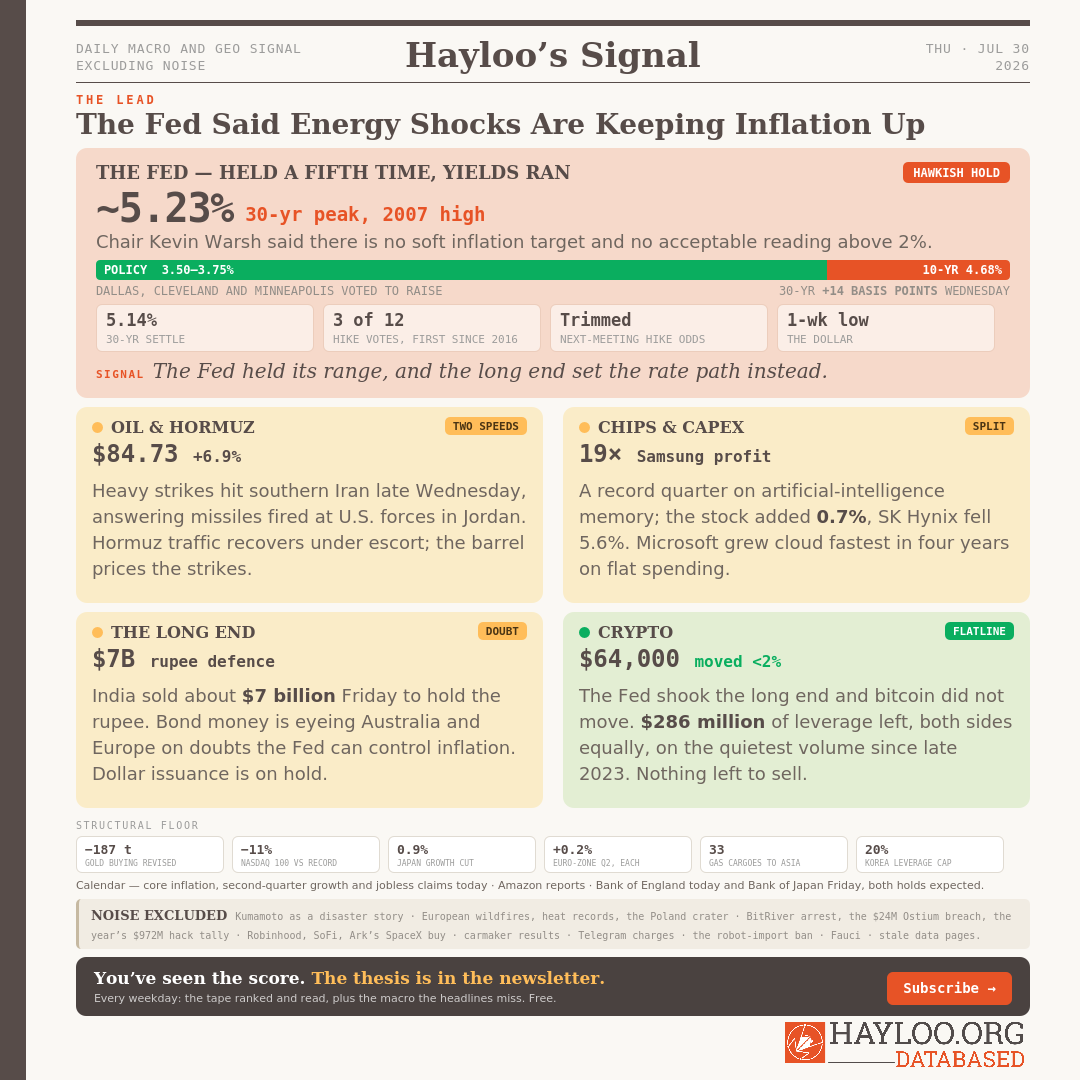
The Federal Reserve left its target range at 3.50% to 3.75% on Wednesday, a fifth straight hold, and three of its twelve voters wanted a quarter-point rise instead. Federal Reserve Chair Kevin Warsh told reporters there is no soft inflation target. Thirty-year Treasury yields rose to their highest level since 2007, the dollar fell to a one-week low, and bond traders trimmed their bets on a rise at the next meeting.
The United States struck targets across southern Iran late on Wednesday, after Iranian missiles were fired at American forces at a base in Jordan the day before. Officials from three governments told Bloomberg the war looks set to run for months, because neither side can break the deadlock over the Strait of Hormuz. Shipping through the strait has picked up over recent days, with the US Navy escorting some tankers across. Oil gave back part of Wednesday’s jump on Thursday.
Samsung Electronics said on Thursday that quarterly operating profit rose 19-fold to a record on demand for AI memory chips, and its shares gained less than a percent. Semiconductor factories in southwest Japan halted production after Tuesday’s earthquake. Microsoft’s cloud business grew at its fastest pace in four years and its shares rose 8% before Thursday’s open, which lifted US index futures.
#1 — The Federal Reserve held rates for a fifth straight meeting over three dissenting votes
The Federal Reserve left its target range at 3.50% to 3.75% on Wednesday. The presidents of the Dallas, Cleveland and Minneapolis reserve banks all voted for a quarter-point rise, making it the first decision since 2016 to draw three dissents in the same direction.
The Fed’s statement said energy shocks driven by the Middle East war are keeping inflation above its 2% target. Warsh opened his press conference by saying there is no soft inflation target, and repeated that he treats any reading above 2% as unacceptable. Investors sold long-dated Treasuries after the decision. The 30-year yield rose as much as 14 basis points on Wednesday to nearly 5.23%, its highest since 2007, and settled near 5.14%. The 10-year yield reached about 4.68% on Thursday. Market measures of inflation expectations rose on Wednesday and the dollar fell to its lowest level in nearly a week.
Bond traders lowered their expectations of a rise at the next meeting, Bloomberg reported on Wednesday. Torsten Slok of Apollo said on Wednesday that the Fed’s abandonment of guidance is fuelling historic volatility in the bond market.
#2 — The United States struck targets across southern Iran late on Wednesday
US Central Command said it completed a heavy wave of attacks on Iran on Wednesday. Current and former officials from the United States, Iran and Europe told Bloomberg on Wednesday that the war looks set to run for months, because neither side can break the deadlock over the Strait of Hormuz.
Shipping across the strait has picked up over recent days despite the fighting, and the United States said its navy escorted some tankers through. West Texas Intermediate and Brent both slipped early Thursday as tankers kept leaving the region.
#3 — Samsung Electronics reported a record quarterly profit on AI chip demand
Samsung Electronics said on Thursday that second-quarter operating profit rose 19-fold from a year earlier to a record, on demand for memory chips used in AI systems, and that earnings at its mobile business fell. Its shares rose 0.7% in Seoul on Thursday. SK Hynix fell 5.6%, taking its decline to about 27% over three days. The Kospi closed down 1.2% on Thursday.
Semiconductor and other factories in Japan’s Kumamoto Prefecture halted production on Wednesday after the magnitude-7.1 earthquake there the previous day, and Kyodo reported concern about wider economic damage if the shutdowns run on.
The Nasdaq 100 entered a technical correction on Wednesday, 11% below its record. Microsoft said after Wednesday’s close that its cloud business grew at its fastest pace in four years while it held spending flat, and its shares rose 8% before Thursday’s open. Meta Platforms issued a weaker forecast the same evening, and Qualcomm and Arm both guided below expectations. S&P 500 futures rose 0.2% and Nasdaq 100 futures rose 0.4% on Thursday. What the market is doubting is whether the companies buying the memory can keep paying for it. Microsoft’s spending line speaks to that, and the reaction on Thursday split along that line.
#4 — The World Gold Council said central banks bought far less gold early this year than it had reported
The World Gold Council said on Thursday that central banks bought 57 tonnes of gold in the first quarter, 187 tonnes less than it previously reported. It said official demand has recovered since then, and that central-bank purchases are expected to fall over the year as a whole. Spot gold rose 0.6% on Wednesday to $4,053.76 an ounce. Copper, aluminium and zinc rose on Wednesday after the Fed held rates, which eased concern about industrial demand. Gold has been holding this level on the argument that official buyers sit underneath it. The council has now told the market that bid was smaller than it thought.
#5 — India’s central bank sold about $7 billion to defend the rupee
The Reserve Bank of India sold about $7 billion to support the rupee on Friday last week, one of its largest direct interventions in months, people familiar with the matter told Bloomberg on Thursday. Bloomberg reported separately on Thursday that some global bond investors are looking to move money toward markets such as Australia and Europe, as doubts grow about the Federal Reserve’s ability to keep inflation under control. Indonesia’s sovereign wealth fund is unlikely to price its planned dollar notes quickly while the bond rout runs, people familiar with the matter told Bloomberg on Thursday.
#6 — Japan cut its growth forecast for the year on higher oil prices
Japan’s government cut its growth forecast for the fiscal year that began in April to 0.9% on Thursday, from an earlier estimate of 1.3%, citing crude oil prices in an economy that imports almost all of its energy.
Saudi Arabia’s economy contracted at its sharpest quarterly pace since 2020, Bloomberg reported on Thursday, as the war disrupted its oil exports.
The euro-zone economy grew slightly faster than forecast in the second quarter, with Germany, France and Italy each expanding 0.2% on AI-related investment and government spending, which offset the drag from the war and from energy costs.
#7 — About $286 million of crypto positions were liquidated around the Fed decision
Roughly $286 million of leveraged crypto positions were closed out over the 24 hours around the Federal Reserve’s decision, with losses split evenly between bulls and bears, CoinDesk reported on Thursday. The crypto market held around the Fed’s hawkish hold, there’s simply nothing left to sell.
K33 said on Wednesday that bitcoin spot trading volume is on course for its weakest month since late 2023. Options volume on Deribit stayed weighted toward downside puts on Thursday and 30-day implied volatility held below 40%.
OPERATIONAL/STRUCTURAL FLOOR
- South Korea moved to cap holdings of single-stock leveraged funds. The finance ministry said on Wednesday it would limit an individual’s investment in such products to 20% of their total investment assets, and the government held an emergency market meeting on Wednesday evening after the sell-off.
- Saudi Arabia sought an international coalition to protect Red Sea shipping. Two people familiar with the deliberations told Reuters on Wednesday, and Reuters separately reported the Houthis are weighing fees on ships using the southern Red Sea, a week after they declared a blockade of the kingdom.
- QatarEnergy bought 33 US cargoes of liquefied natural gas to cover customers cut off by Hormuz. Trade sources told Reuters the cargoes are going to South Korea, Taiwan, Bangladesh, India and Japan, and Asian buyers are turning to Canadian crude on the same supply pinch.
- Ukraine struck one of Russia’s largest oil refineries. Ukrainian forces hit the plant on Wednesday.
- Iranian oil kept selling off Malaysia despite the blockade. Al Jazeera reported on Thursday that a large anchorage off the Malaysian coast remains a marketplace for sanctioned crude, and the US Treasury sanctioned two Iranian firms over a scheme requiring vessels to buy insurance to cross Hormuz.
- Japan’s prime minister decided to cut the sales tax on food to 1%. Prime Minister Sanae Takaichi settled on a two-year cut from next April, a senior ruling-party official said on Thursday, after cross-party talks ended on Wednesday without agreement.
- Calendar. Core PCE inflation, second-quarter GDP and weekly jobless claims print on Thursday. Amazon reports on Thursday. The Bank of England decides on Thursday and the Bank of Japan on Friday, and both are expected to hold. The Senate has about two weeks before its August 8 recess to take up the crypto market-structure bill, and senators revising the bill’s ethics provisions said they are close to a version that can pass.
NOISE EXCLUDED TODAY
The Kumamoto earthquake as a disaster story, the wildfires in France, Spain and Crete, the European heat records and the missile crater in Poland; China generating under half its power from coal and the shift in its liquefied natural gas demand; the arrest of BitRiver’s founder in Russia, the $24 million Ostium breach, Aave’s reserve deprecations; Robinhood’s prediction-market revenue, SoFi’s crypto revenue, Ark Invest’s SpaceX purchase and portfolio trims, and results from Shell, Stellantis, BMW, Adidas, Renault, Porsche and Air France-KLM; the terrorism charges against Telegram’s founder in Russia and Australia’s suit against the company; think-pieces on perpetual-futures risk and MoonPay’s PayBox; the FIFA World Cup investor plan, the US ban on Chinese humanoid robot imports and China’s threatened retaliation, Anthony Fauci’s Senate hearing and the terrorism conviction of Salman Rushdie’s attacker; and market-data pages carried on stale dates.
On our use of AI:
Measuring AI to value writing is like rating a restaurant by whether the chef used a food processor.
Humans have written machine-assisted for centuries. What never changes is who decides.
Nothing at Hayloo INC. was ever decided by a machine.
There’s no meter, no word count, no hour count, no token that tells you how much of us is in our work. We use AI, we run scripts, we process data, we ask questions, and we debate what the machine contributes.
What survives is what we defended as a team.
When it’s wrong, it’s wrong because us, the humans, signed it.
Jordi Federer, Founder, Hayloo INC.