


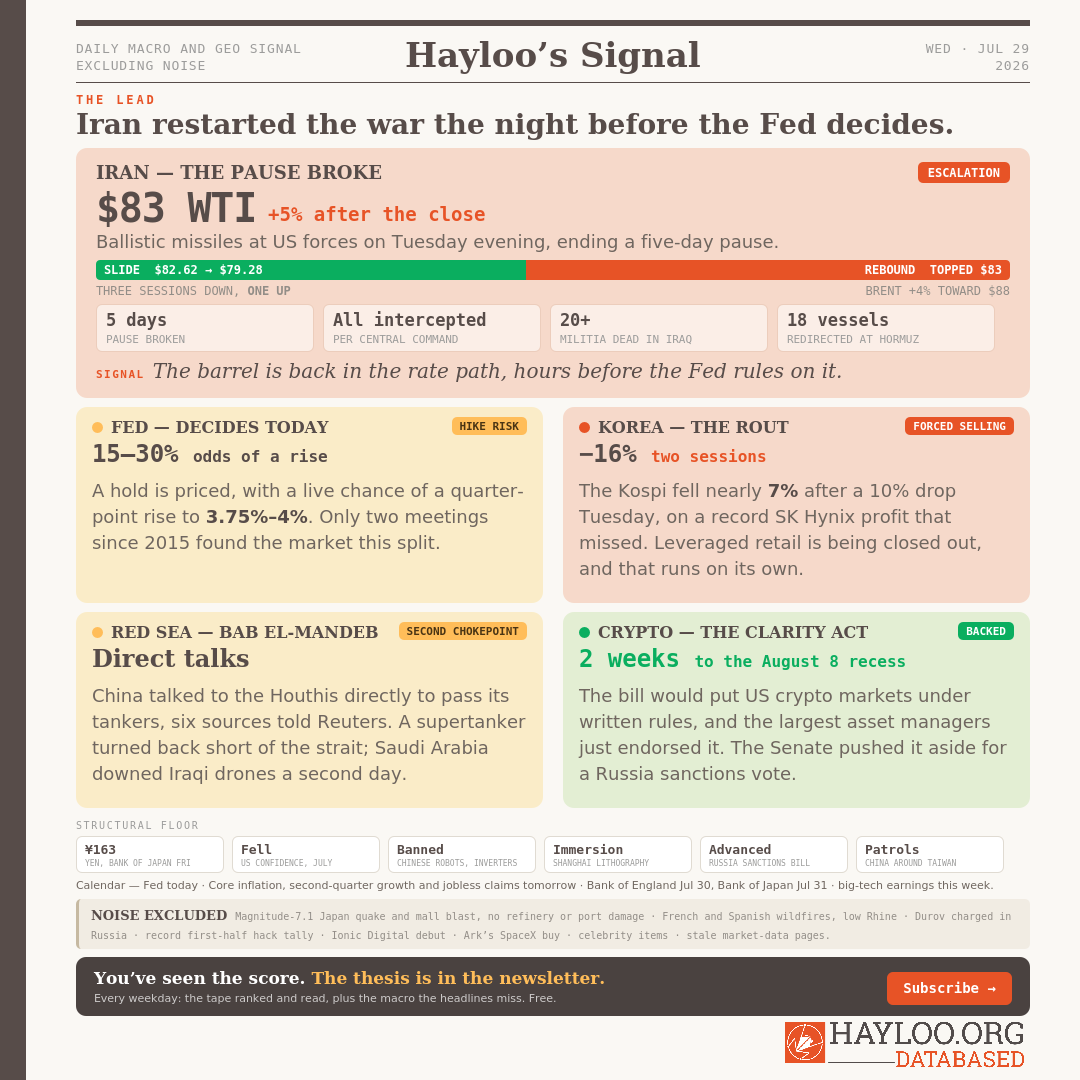
Signal is Hayloo’s newsreader, customized to the portfolio Hayloo scores, weighing every macro, geo, and on-chain headline against the risk in Hayloo’s portfolio and Hayloo’s market positioning. Signal respects Hayloo enough to stay quiet until the day’s noise becomes signal. To customize your own newsreader, go to hayloo.org.
TOP-OF-STACK SUMMARY
Iran fired ballistic missiles at United States forces in the Middle East on Tuesday evening, ending a five-day pause in the war. US Central Command said it intercepted all of them. Saudi Arabia and Central Command struck Iran-backed militias across Iraq early Wednesday, killing at least 20 fighters. West Texas Intermediate jumped about 5% to top $83 a barrel after the US close.
The Federal Reserve decides rates later Wednesday, with futures pricing a hold and Citadel’s macro team calling for a rise. South Korea’s Kospi fell nearly 7% in a second straight session after SK Hynix missed estimates and its shares fell 17%. Asian markets outside Korea rebounded on Wednesday.
China has held direct talks with Yemen’s Houthis to move its tankers through the southern Red Sea. Japan’s prime minister lost further ground in the polls two days before the Bank of Japan decides. Morgan Stanley launched spot ether and solana funds on Tuesday, and five of the largest US asset managers endorsed the crypto market-structure bill.
#1 — Iran fired ballistic missiles at US forces in the first attack since a five-day pause
Iran fired ballistic missiles at United States forces in the Middle East on Tuesday evening, breaking a five-day pause in the war. US Central Command said all of them were intercepted, and that the Islamic Revolutionary Guard Corps had aimed at an airbase and a command center in Jordan.
Saudi Arabia and Central Command struck Iran-backed militias across Iraq early Wednesday, killing at least 20 fighters and wounding 32 in seven provinces, and Iraq’s Popular Mobilisation Forces said eight of its members were among the dead.
Both governments blamed those militias for drone attacks on Saudi oil facilities, which Riyadh said on Wednesday it had intercepted for a second day. West Texas Intermediate jumped about 5% to top $83 a barrel after the US close, ending a three-day slide, and Brent rose about 4% toward $88.
#2 — The Federal Reserve decides rates today in one of its most divided meetings in a decade
The Federal Reserve delivers its decision later Wednesday in Chair Kevin Warsh’s second meeting, with markets pricing a hold and assigning an unusually high chance to a 25-basis-point rise that would lift the target range to 3.75% to 4%. Futures put the odds of a rise between 15% and 30%.
Block Scholes said only two Fed meetings since 2015 have found markets more divided over the outcome. Citadel’s macro team said on Wednesday that it expects a rise, arguing that moving now would end the Fed’s era of heavy forward guidance and reassert its independence more effectively than a widely anticipated September move.
#3 — South Korea’s Kospi fell nearly 7% in a second straight session
South Korea’s Kospi fell nearly 7% on Wednesday after falling more than 10% on Tuesday, torching small investors, many of whom held heavily leveraged single-stock positions. The selling followed SK Hynix’s quarterly results, which showed operating profit up 557% to a record on demand for advanced memory chips and still short of analyst estimates. Its shares fell 17%. This is a healthy correction of an unhealthy leveraged segment.
#4 — China held direct talks with Yemen’s Houthis to move its tankers through the Red Sea
China has held direct talks with Yemen’s Houthi movement to let its tankers sail through the southern Red Sea without being attacked, six sources told Reuters.
#5 — Japan’s prime minister lost further ground in the polls before Friday’s Bank of Japan decision
Prime Minister Sanae Takaichi is losing support in opinion polls, which makes retreating from her promised tax cuts harder and leaves her officials without the political backing they need to talk down bears in the yen and the government bond market, Reuters reported on Wednesday. The Bank of Japan decides policy on Friday.
#6 — US consumer confidence fell in July as gas prices climbed again
The Conference Board’s consumer-confidence index fell in July as Americans’ views of current business conditions and of the labor market deteriorated, Bloomberg reported on Tuesday.
The Associated Press tied the decline to gasoline prices resuming their climb after the United States and Iran stepped up fighting.
A Reuters poll of nearly 500 economists published Tuesday found the risk of persistently high inflation in the global economy rising, with most respondents raising their inflation forecasts and cutting their growth views.
#7 — Morgan Stanley launched ether and solana funds at the market’s lowest fee
Morgan Stanley debuted spot ether and solana exchange-traded products with staking rewards on Tuesday, undercutting rivals on fees.
BlackRock, Fidelity, Franklin Templeton, Goldman Sachs and SoFi publicly endorsed the Clarity Act, the crypto market-structure bill, on Tuesday as the Senate’s window to act narrowed.
The rails are being built while the law meant to govern them sits stalled, and the firms building them are for once the ones asking for clarity.
OPERATIONAL/STRUCTURAL FLOOR
The US tightened curbs on Chinese robots and power inverters. Washington unveiled the bans on Tuesday to protect the US artificial-intelligence buildout, and barred new Chinese humanoid robots, weeks before a planned meeting between the two countries’ leaders, per Reuters, Bloomberg and the BBC.
Oman put a transit-fee plan to Iran for the Strait of Hormuz. Tehran would collect voluntary fees from shipping under the proposal, and Gulf states have backed it, Reuters reported Tuesday.
Iran is rebuilding its air defenses with Chinese help. Tehran expects the first of up to 400 Chinese-made shoulder-fired launchers within weeks, three sources told Reuters on Wednesday.
The Senate advanced a Russia energy-sanctions bill. A large majority voted Tuesday to advance the sanctions as Ukraine’s president visited the Capitol, per Reuters, and the European Union planned to blacklist a record 1,600 firms it says aid Russia.
Russia is routing more oil through the Arctic. At least six tankers are lined up to navigate Arctic ice, and crude deliveries to Egypt are cutting Russian traffic through the Red Sea, per Bloomberg on Tuesday.
India moved to cut taxes for foreign buyers of its sovereign debt. The government expects Parliament to pass the bill, betting its bipartisan support clears other disputes, per Bloomberg on Wednesday.
China stepped up maritime patrols around Taiwan. New law-enforcement operations near the island could escalate into a blockade, analysts told Al Jazeera on Wednesday.
Calendar. The Federal Reserve decides today. Core PCE inflation, second-quarter GDP and weekly jobless claims print July 30. Microsoft, Meta, Apple and Amazon report this week. The Bank of England and the Bank of Japan decide July 30 and 31. The crypto market-structure bill has roughly two weeks of Senate time before the August 8 recess.
NOISE EXCLUDED TODAY
The magnitude-7.1 Japan earthquake and the shopping-mall explosion that followed it, with no reported damage to refineries, ports or nuclear plants; the wildfires in France and Spain and the Rhine’s falling water level, with the river’s energy-shipping angle noted; the terrorism charge and arrest warrant issued in Russia against Telegram founder Pavel Durov; the record first-half crypto-hack tally, Zcash’s Ironwood upgrade, Ethereum layer-two value at a two-year low, 1inch’s Aqua launch, Ondo’s network pivot and the flash crash in perpetual futures tied to SK Hynix; Ionic Digital’s Nasdaq debut, the Core Scientific deal with AMD and Galaxy’s Texas data-center campus; Ark Invest’s SpaceX purchase and portfolio trims and UBS’s $2.8 billion quarterly profit; the White House meetings with Israeli and Ukrainian leaders and the funeral of Senator Lindsey Graham; the FIFA World Cup investment vehicle and the Indian Premier League valuation.
On our use of AI:
Measuring AI to value writing is like rating a restaurant by whether the chef used a food processor.
Humans have written machine-assisted for centuries. What never changes is who decides.
Nothing at Hayloo INC. was ever decided by a machine.
There’s no meter, no word count, no hour count, no token that tells you how much of us is in our work. We use AI, we run scripts, we process data, we ask questions, and we debate what the machine contributes.
What survives is what we defended as a team.
When it’s wrong, it’s wrong because us, the humans, signed it.
Jordi Federer, Founder, Hayloo INC.