


Signal is Hayloo’s newsreader, customized to the portfolio Hayloo scores, weighing every macro, geo, and on-chain headline against the risk in Hayloo’s portfolio and Hayloo’s market positioning. Signal respects Hayloo enough to stay quiet until the day’s noise becomes signal. To customize your own newsreader, go to hayloo.org.
TOP-OF-STACK SUMMARY
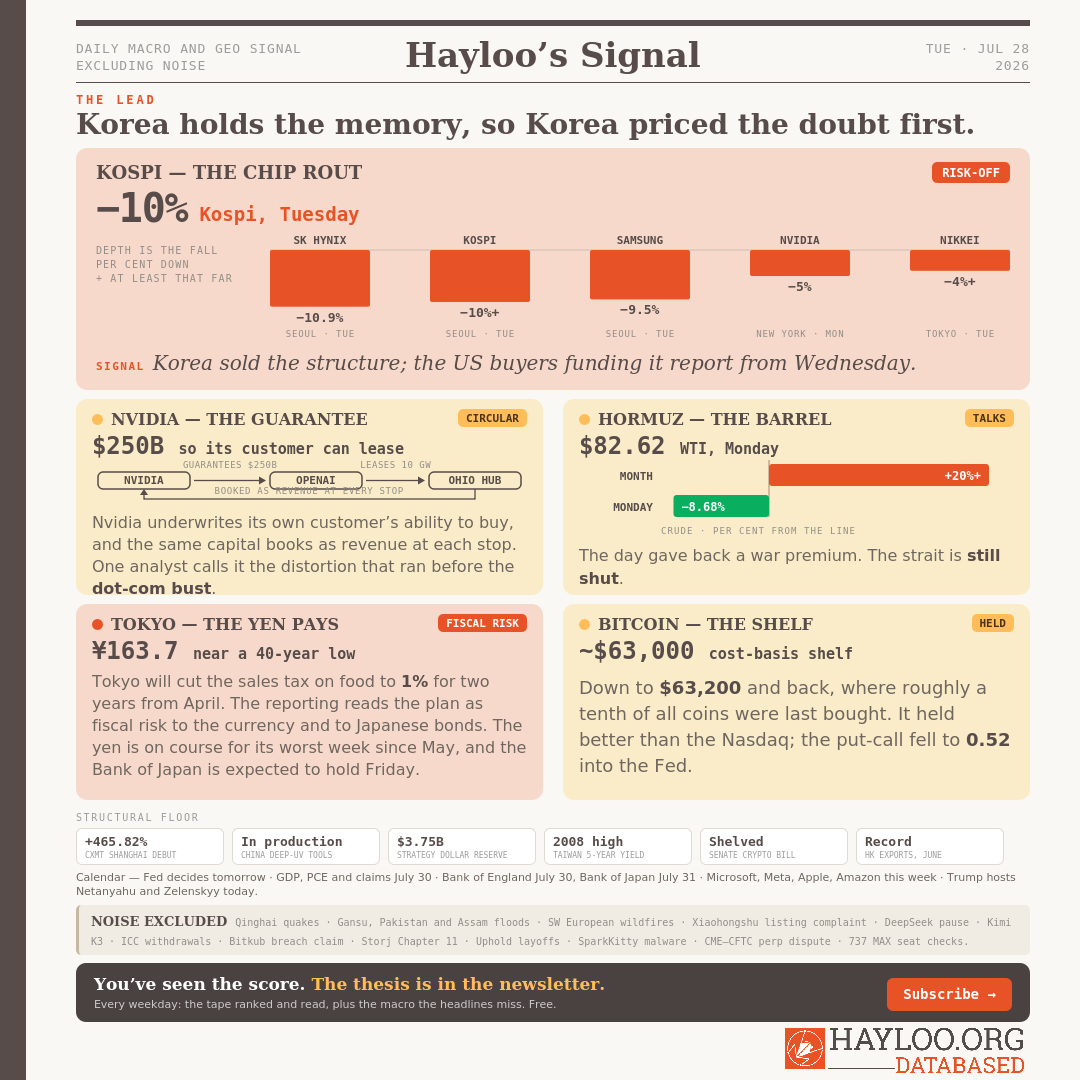
Asian markets dumped chipmakers on Tuesday and South Korea’s Kospi fell more than 10%. Samsung Electronics dropped as much as 9.5% and SK Hynix as much as 10.9%, while Japan’s Nikkei fell more than 4%. Investors were selling on Nvidia’s plan to guarantee as much as $250 billion so that OpenAI can lease computing power, an arrangement that has the chip supplier underwriting its own customer’s ability to buy.
Oil ran the other way and the relief did not reach bond markets. West Texas Intermediate fell about 8.7% on Monday to $82.62 a barrel as the United States and Iran held fire for a third day. Reuters reported that the drop in crude did little to lift bonds and left traders nervous about a US rate rise as soon as this week. The dollar held at a one-month high and Taiwan’s five-year bond yield reached its highest level since 2008. The Federal Reserve decides on Wednesday and the Bank of Japan on Friday.
Bitcoin fell about 2% after the US close to near $63,000, the price at which roughly a tenth of all coins in circulation were last bought, and recovered from there to hold better than the Nasdaq. The largest corporate holder of the asset went a fifth straight week without buying, raised its dollar reserve to $3.75 billion and sold $544.5 million of its own stock.
#1 — South Korea’s Kospi fell more than 10% on heavy selling of chipmaking stocks
South Korea’s Kospi index plunged more than 10% on Tuesday on heavy selling of chipmaking stocks, according to the Associated Press, which cited concerns over the sustainability of the boom in artificial intelligence.
Samsung Electronics fell as much as 9.5% and SK Hynix as much as 10.9% in Seoul, Reuters reported, as investors dumped AI-related positions over financing risks tied to AI infrastructure spending and intensifying competition from China. Japan’s Nikkei fell more than 4% tracking the losses in US chipmakers, per Kyodo.
Reuters reported that the selloff ran across Asian markets on unease about the funding demands of the AI build. The US session on Monday closed mixed, with the Nasdaq Composite lower and the Dow higher.
Korea holds the memory supply the AI build runs on, so it is pricing the doubt ahead of the American companies that set the spending. Microsoft, Meta, Apple and Amazon report later this week.
#2 — Nvidia is in talks to guarantee $250 billion of OpenAI’s data-center lease
Nvidia is in discussions to guarantee as much as $250 billion so that OpenAI can lease computing capacity from a large US data-center project, according to Bloomberg.
Nvidia separately unveiled a partnership with the South Korean conglomerate SK Group late Friday under which the two companies will do more than $500 billion of business with each other, including a memory-chip supply agreement with SK Hynix.
Nvidia fell 5% after the announcements. Critics quoted in the reporting note that Nvidia, Microsoft and Oracle have all invested billions in AI developers that then become large buyers of their own cloud services, which sends the same capital through several companies and books it as revenue at each stop, and one analyst compared the pattern to the demand distortions that preceded the dot-com bust.
The defence is that computing supply is genuinely scarce and long-term commitments lock it in. Earnings from the four largest buyers of that computing arrive on Wednesday and Thursday.
#3 — Iran and Oman negotiated to restart shipping through the Strait of Hormuz
Negotiators from Iran and Oman are working toward an agreement to restart shipping traffic through the Strait of Hormuz, Bloomberg reported, citing people familiar with the matter. Iran’s foreign minister discussed the security of the strait in separate phone calls with his Saudi and Omani counterparts on Monday evening, according to a statement on his Telegram channel.
The United States and Iran held fire for a third day, and President Donald Trump said talks were taking place during the pause in US strikes. Iran said on Monday that it still controls the Strait of Hormuz and is not seeking to resume talks with the United States, after Trump halted a two-week bombing campaign that his commanders told him had run its course.
West Texas Intermediate fell 8.68% on Monday to $82.62 a barrel and Brent fell about 7%, giving back the previous week’s war premium, and crude remains up more than 20% on the month.
Russia’s Novorossiysk, its largest oil port on the Black Sea, resumed crude loadings after several days of disruption from bad weather and drone attacks nearby. Yemen’s Houthis said on Monday they had targeted crude supply and transport sites linking eastern Saudi Arabia to the Red Sea export hub at Yanbu, and Saudi Arabia said its air defences intercepted drones launched from Iraq.
Yemen’s foreign minister said the Houthis want to replicate Iran’s control of Hormuz in the Red Sea.
#4 — Taiwan detained an Nvidia employee in a widening chip-smuggling investigation
Taiwanese prosecutors detained an Nvidia employee and searched the company’s offices as part of a widening investigation into the alleged smuggling of AI accelerators into China, Bloomberg reported.
#5 — Taiwan’s five-year bond yield reached its highest level since 2008
Taiwan’s five-year government bond yield climbed to its highest level in almost two decades after a weak 20-year auction last week and growing expectations of a rate rise from the island’s central bank.
Reuters reported that the slide in oil prices did relatively little to lift bonds and left traders nervous about a US rate rise as soon as this week. The dollar held at a one-month high as traders weighed a slim but lingering chance of a rise at this week’s Federal Reserve meeting.
A fund manager at Azimut Group said Japanese government bonds now offer one of the best opportunities in global fixed income despite being viewed as high risk.
The yen traded around 163.7 per dollar on Tuesday and was on course for its worst week since May, and the Japanese government plans to cut the sales tax on food and drink to 1% for two years from next April, which Bloomberg reported risks adding to concern about the fiscal outlook.
The Bank of Japan is widely expected to leave its policy rate unchanged on Friday.
#6 — Strategy went a fifth straight week without buying bitcoin
Strategy bought no bitcoin for a fifth consecutive week, raised its US dollar reserve to $3.75 billion and sold $544.5 million of its common stock, and repurchased $25 million of its STRC preferred shares, according to The Block and CoinDesk.
Bitcoin fell about 2% after the US close as South Korea’s Kospi plunged, taking its session low to roughly $63,200 and reaching the $63,000 area where the heaviest concentration of coins was last bought, roughly a tenth of the circulating supply.
Ether, XRP and Solana are each down roughly 4% on the day. Options traders dropped their hedges going into the Fed meeting, with the put-call ratio falling to about 0.52 from 0.76 in late June and the price of one-week downside protection collapsing.
TD Cowen cut its price target on the bitcoin treasury company Nakamoto by 58%, citing pressure on its capital structure. Bloomberg reported that the collapse of the market for crypto treasury stocks is pushing several such firms to pivot toward artificial intelligence, without success so far. A company that once sold stock to buy bitcoin is now selling stock to hold dollars. It reports earnings this week.
Alt Tax – Major Alts caught more of Bitcoin's rise than its fall this week

Beta is how much a coin moves when Bitcoin moves a dollar: above 1.00 it amplifies Bitcoin, below 1.00 it lags. The desk splits that into what a coin catches on Bitcoin’s up-days and what it gives ba…
OPERATIONAL/STRUCTURAL FLOOR
A magnitude-7.1 earthquake struck southwest Japan. The quake hit Kumamoto Prefecture and other parts of the southwest, injuring several people and halting Shinkansen and local train services across Kyushu, per Kyodo. No damage to refineries, ports or nuclear plants was reported.
India’s growth is expected to slow sharply on the oil shock. A Reuters poll of economists found India’s economy will slow sharply this fiscal year and recover only modestly the next, as weak private investment and the higher oil prices triggered by the Iran war weigh on domestic demand.
Europe prepared for a trade fight with China. German officials are working to identify Chinese economic vulnerabilities they could exploit if the European Union enters a trade war, per Bloomberg, and US customs officials ran spot inspections on China-linked factories in Vietnam, stoking fresh tariff concern.
Brazil requested WTO consultations over US tariffs. Brazil opened a case against the Trump administration’s tariffs under the WTO dispute-settlement system, per Reuters.
Trump hosts Netanyahu and Zelenskyy on Tuesday. It is the president’s first White House meeting with Israeli Prime Minister Benjamin Netanyahu since the Iran war began, per AP and Reuters, and Ukrainian President Volodymyr Zelenskyy is due to meet US senators with a Russia sanctions vote expected.
Calendar. The Federal Reserve decides July 29. Second-quarter GDP, June PCE inflation and weekly jobless claims print July 30. Microsoft, Meta, Apple and Amazon report this week, and the Bank of England and Bank of Japan decide July 30 and 31.
NOISE EXCLUDED TODAY
Cut as below the threshold: the Qinghai earthquakes, the Gansu flash floods and the Pakistan and Assam floods; the southwest European wildfires and a warning on El Niño’s effect on food supply; the Xiaohongshu Hong Kong IPO complaint, the Zhongji Innolight listing, Mercedes’ quarterly results and BYD’s minicar launch in Japan; DeepSeek’s fundraising suspension and Moonshot’s Kimi K3 model; protests at Benjamin Netanyahu’s motorcade, settler violence in the West Bank, a US walkout during France’s UN address and a wave of withdrawals from the International Criminal Court; an alleged concealed cyberattack at Bitkub, Storj’s Chapter 11 filing, layoffs at Uphold, the SparkKitty wallet malware and the CME-CFTC dispute over onchain perpetual futures; India’s student protests, the Pakistan-administered Kashmir vote and the resignation of Indonesia’s central bank governor; Johnson & Johnson’s $5.5 billion talc settlement, the FAA’s Boeing 737 MAX seat inspections and the Cracker Barrel chief executive’s departure.
On our use of AI:
Measuring AI to value writing is like rating a restaurant by whether the chef used a food processor.
Humans have written machine-assisted for centuries. What never changes is who decides.
Nothing at Hayloo INC. was ever decided by a machine.
There’s no meter, no word count, no hour count, no token that tells you how much of us is in our work. We use AI, we process data, we kill drafts, we ask questions, and we read everything the machine contributes.
What survives is what we defended as a team.
When it’s wrong, it’s wrong because we signed it.
Jordi Federer, Founder, Hayloo INC.