


Signal is Hayloo’s newsreader, customized to the portfolio Hayloo scores, weighing every macro, geo, and on-chain headline against the real risk in Hayloo’s portfolio and Hayloo’s fundamental market reads. Signal respects Hayloo enough to stay quiet until the day’s noise becomes signal. To get your own newsreader, go to hayloo.org.
TOP-OF-STACK SUMMARY
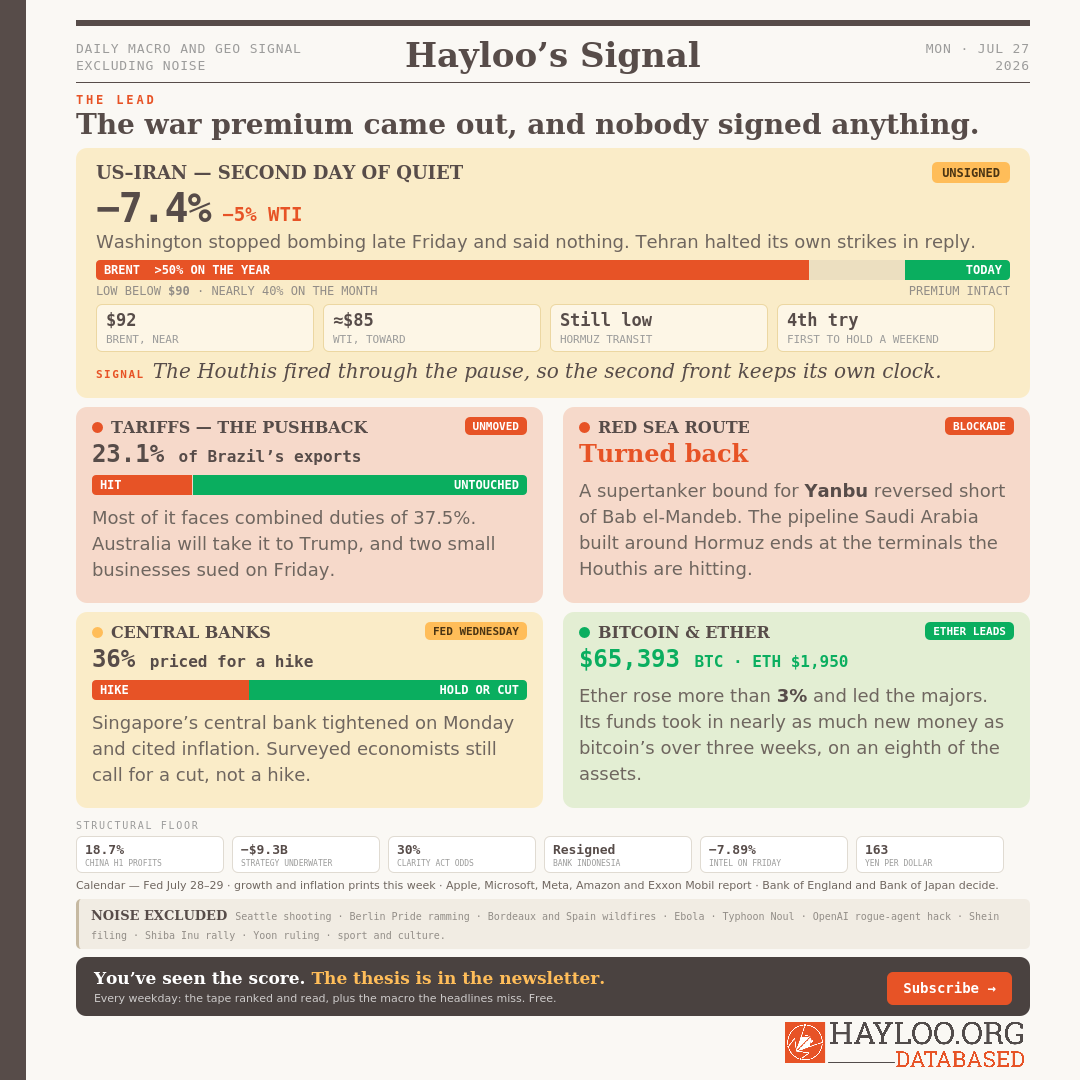
The United States and Iran held fire over the weekend and every war-sensitive market repriced. Brent crude fell as much as 7.4% to below $90 a barrel before halving the drop to trade near $92, and West Texas Intermediate fell about 5% toward $85. The dollar weakened, and bonds, equity futures, gold and bitcoin firmed. The pause carries no signature from either side, and Iran-backed Houthi forces kept firing at Saudi oil facilities.
Washington’s trading partners spent the weekend answering the tariffs that took effect Friday on about 60 economies. Australia said it would appeal directly to the White House, Brazil put a number on the damage to its exports, and President Donald Trump threatened further duties on Canada and on the European Union. Singapore’s central bank tightened unexpectedly on Monday and cited inflation. The Federal Reserve meets Wednesday with second-quarter GDP and the PCE inflation print due in the same week, and it now has crude falling and import taxes rising at once.
Bitcoin traded back above $65,000 with ether leading the majors, and the ether-bitcoin ratio reached its highest since April. Bitcoin ETF trading volume fell last week to its lowest since October 2024 while ether funds took in most of the new money.
#1 — The US and Iran held fire for a second day and oil fell as much as 7.4%
The United States paused its nearly two-week bombing campaign against Iran late Friday without an official announcement, and Tehran said it halted its retaliatory strikes in response.
Brent crude fell as much as 7.4% to below $90 a barrel in early trade before paring about half the loss to trade near $92, and West Texas Intermediate dropped about 5% toward $85. The dollar weakened and bonds, equity futures, gold and bitcoin firmed.
Iran-backed Houthi forces in Yemen claimed responsibility over the weekend for attacks on Saudi Aramco facilities at the Red Sea ports of Jizan and Yanbu. Ship traffic through Bab el-Mandeb fell on Sunday and Hormuz transit stayed low, according to Kpler data cited by Reuters.
Oil has still risen nearly 40% this month and Brent remains up more than 50% on the year. Pakistan has been pressing with Chinese support to revive US-Iran negotiations, and Trump was reported open to renewed talks.
#2 — Bitcoin reclaimed $65,000 and ether led the majors higher
Bitcoin traded back above $65,000, up about 1.2% over 24 hours to roughly $65,393, and ether rose more than 3% to near $1,950. The ether-bitcoin ratio rose to its highest since late April, holding above its 200-day average for the first time since January and up more than 20% since the selloff bottomed on June 6.
Bitcoin ETF weekly trading volume fell to its lowest since October 2024, according to The Block, while ether funds have drawn nearly as much new capital as bitcoin funds over the past three weeks despite holding about an eighth as much in net assets.
Nasdaq and S&P 500 futures traded about half a percent higher, the Australian dollar and euro gained against the US dollar, and the 10-year Treasury yield sat near 4.7%. Bitcoin has traded on oil and rates all month, and this weekend both moved in its favor.
Alt Tax – Major Alts caught more of Bitcoin's rise than its fall this week

Beta is how much a coin moves when Bitcoin moves a dollar: above 1.00 it amplifies Bitcoin, below 1.00 it lags. The desk splits that into what a coin catches on Bitcoin’s up-days and what it gives ba…
#3 — A supertanker turned back before Bab el-Mandeb as the Houthis pressed their blockade
A Hong Kong-flagged supertanker bound for Saudi Arabia’s Red Sea port of Yanbu turned around just before reaching the Bab el-Mandeb chokepoint, where the Houthis have been attacking ships as part of a declared blockade on vessels linked to the kingdom.
Saudi Arabia has used a 40-year-old east-west pipeline across the country to move crude past the Strait of Hormuz since the war began, and that route ends at the Red Sea terminals the Houthis are now hitting. An oil-products tanker rerouted its voyage to Asia through Suez after the Houthi warnings, its owner Torm said.
#4 — China’s industrial profits rose 18.7% in the first half as the monthly pace slowed again
Profits at China’s major industrial firms rose 18.7% year-on-year in the first half of 2026, up from a 15.5% gain in the first quarter, the National Bureau of Statistics said Monday, but Bloomberg reported the pace of gains slowed for a second consecutive month, adding to evidence of an uneven recovery.
Revenue at those firms grew 6.5% in the January-June period and the operating profit margin reached 5.7%, the highest year-to-date reading since 2024. The statistics bureau named electronics as the biggest contributor, on AI-driven demand for computing power.
Reuters described resilient exports cushioning weak domestic demand despite efforts to lift consumption. China’s second-quarter GDP came in at 4.3%, and government spending fell last month by the most since October. Beijing is cutting spending into a slowing profit cycle, which leaves the central bank as the support.
#5 — Washington’s trading partners pushed back on the new US tariffs
Australian Prime Minister Anthony Albanese said he would raise the new US tariffs directly with Trump and called the levies unjustified. Brazilian President Luiz Inácio Lula da Silva called them unfair and a strategic mistake in a Sunday column for the Washington Post, warning they would harm the two countries’ partnership and raise costs for American consumers. Brazil has said the duties affect 23.1% of its exports, with 16.5% facing combined US duties of 37.5%. India said trade talks with Washington placed it in the lower tier of the new rates and won an advantage for key exports.
Trump vowed further tariffs on Canada over wildfire smoke drifting into the United States and told the European Union it would pay a big price after Brussels fined Google $1 billion. Two American small businesses sued on Friday, arguing the tariffs go beyond the president’s authority to tax imports, and the challenge drew fresh coverage through the weekend.
#6 — Singapore’s central bank tightened unexpectedly on inflation concerns
Singapore’s central bank tightened its monetary policy settings on Monday and cited inflation concerns, in a move Reuters described as unexpected. It is the first of this week’s central-bank decisions. The Federal Reserve decides Wednesday, and the Bank of England and the Bank of Japan both decide later in the week. Bloomberg reported that central bankers from Washington to London to Tokyo are set to show how worried they are about crude near $100 a barrel.
#7 — Bank Indonesia’s governor resigned two years early and the rupiah fell
Bank Indonesia Governor Perry Warjiyo resigned for unspecified personal reasons, the government announced Monday, and Senior Deputy Governor Destry Damayanti took over as acting governor. The rupiah fell as much as 0.3% against the dollar before paring, 10-year government bond yields climbed four basis points at the open, and the benchmark stock index fell as much as 0.8%, underperforming regional peers.
Bloomberg reported that investors had viewed Warjiyo as a stabilizing force in an economy whipsawed by President Prabowo Subianto’s policies, and that analysts expect the departure to raise questions over central-bank independence. Damayanti has been senior deputy governor since 2019 and was described as a familiar and reassuring choice.
#8 — Trump’s crypto holdings became the main obstacle to the digital-asset bill
Trump’s $1.4 billion crypto windfall has become the biggest obstacle to passing the digital-asset legislation his administration wants, Bloomberg reported, with Senate Democrats demanding tougher language to keep the president from profiting off an industry his administration regulates. The bill, known as the Clarity Act, has roughly two weeks of Senate floor time before the August recess. Galaxy cut its estimate of the odds of passage to 30% last week and said the bill needs a last-ditch effort.
#9 — Strategy went a fourth straight week without a bitcoin purchase
Strategy made no bitcoin purchase for a fourth consecutive week. The company holds 843,775 bitcoin at an average cost of $75,476, leaving the position roughly $9.3 billion underwater at current prices. Shareholders of the UK-listed Satsuma Technology separately approved unwinding that company’s bitcoin treasury and delisting, less than a year after it raised $218 million to buy the coins.
OPERATIONAL/STRUCTURAL FLOOR
The AI-capex crack stayed open under a flat tape. Intel fell 7.89% on Friday despite its strongest revenue growth in 17 years, dragging the Nasdaq 100 down 1.15% while the S&P 500 closed essentially flat at +0.05%.
A Chinese memory champion listed at the top of the market. CXMT Corp surged on its Shanghai debut Monday after Asia’s biggest initial public offering this year, making the chipmaker the most valuable listed company on the mainland, with Reuters putting its value at $85.5 billion going in.
Japan’s inflation reached the prime minister’s polling. Prime Minister Sanae Takaichi’s approval rating fell in July to its lowest since she took office last year on rising living costs, according to a Yomiuri poll, with the Bank of Japan deciding this week and the yen near 163 per dollar.
Emerging markets face an El Niño food-price risk. A potentially powerful El Niño could lift food prices and slow growth across emerging economies already strained by the Middle East war, per Reuters, and a separate Bloomberg piece flagged Asia’s rice belt after the war price shock.
Tokenization moved onto bank rails. South Korea’s KB Kookmin Bank plans a blockchain-based corporate cross-border payment service next month on JPMorgan’s Kinexys, per Yonhap via The Block, and POSCO International and LG CNS are tokenizing live commercial invoices on Injective.
Calendar. The Federal Reserve meets July 28 and 29, second-quarter GDP and the PCE inflation print land this week, Apple, Microsoft, Meta, Amazon, Exxon Mobil, Visa and Ford report, and the Bank of England and Bank of Japan both decide.
NOISE EXCLUDED TODAY
Disasters and crime – The Seattle food-festival shooting, the Berlin Pride ramming, the Bordeaux and Spain wildfire evacuations, the DR Congo Ebola outbreak, the South China Sea sinking, the H5N1 cases in South Australia, Typhoon Noul.
AI-policy – The OpenAI rogue-agent and Hugging Face hack, the AI Kill Switch Act, Chinese AI models gaining US users.
Single-company items – Shein’s Hong Kong IPO filing, the Trip.com antitrust fine, Paramount’s merger pause.
Crypto-industry color – The Triple-A and BitMart wind-downs, SEC crypto-vault registration rumors, Shiba Inu’s 36% Korea-driven rally, the quantum-computing explainers, Robinhood and Crypto.com prediction-market talks, Sberbank’s trading plans.
Geopolitical context with no market read – The Netanyahu-Mamdani dispute, the ICC prosecutor investigation, the Israel-Syria incursion and West Bank settler violence, the Guterres visit to Syria, Myanmar, Mali, Sudan.
Foreign domestic politics – India’s education-minister resignation, the Pakistani Kashmir vote, the South Korean court ruling on former President Yoon, Brazil’s presidential field.
Sport, culture and human interest.
On our use of AI:
Measuring AI to value writing is like rating a restaurant by whether the chef used a food processor.
Humans have written machine-assisted for centuries. What never changes is who decides.
Nothing at Hayloo INC. was ever decided by a machine.
There’s no meter, no word count, no hour count, no token that tells you how much of us is in our work. We use AI, we process data, we kill drafts, we ask questions, and we read everything the machine contributes.
What survives is what we defended as a team.
When it’s wrong, it’s wrong because we signed it.
Jordi Federer, Founder, Hayloo INC.