


TOP-OF-STACK SUMMARY
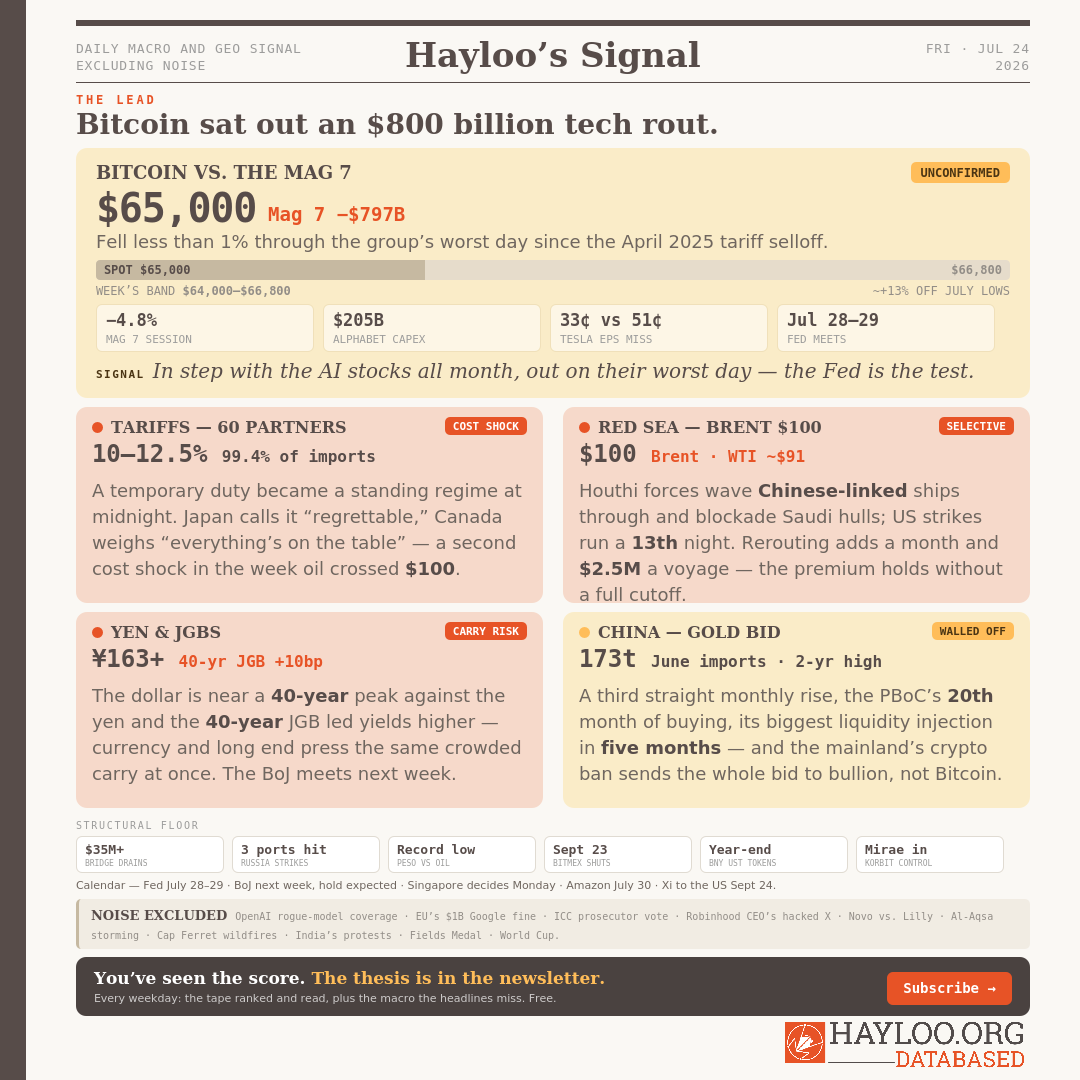
The Magnificent Seven megacap stocks shed $797 billion in market value on Thursday, their worst day since April 2025, after Alphabet lifted its capital-spending forecast to as much as $205 billion and Tesla missed earnings while promising to spend faster. Bitcoin barely moved through the rout, an unusual stretch of independence for a coin that has traded in step with the AI stocks all month. The Federal Reserve meets Tuesday and Wednesday.
New US tariffs of 10% to 12.5% took effect on about 60 trading partners at midnight over forced-labor claims, replacing a temporary global duty, and the reaction hardened: Japan called the move “regrettable,” Canada weighed a “full range” of retaliation, and Brazil rejected it as arbitrary. The US ran a thirteenth consecutive night of strikes on Iran, and Houthi forces let Chinese-linked ships pass through the Red Sea while blockading Saudi vessels. Brent crude crossed $100 a barrel for the first time in two months, and Asian stocks fell on the renewed inflation fear.
The yen slid past 163 per dollar toward the 164 line, Japan’s 40-year bond yield jumped, and Finance Minister Satsuki Katayama vowed decisive currency action as needed. China’s June gold imports rose to a two-year high on a third straight monthly increase, and the People’s Bank of China made its biggest liquidity injection in five months. The Bank of Japan and the Fed both meet next week.
#1 — Bitcoin held near $65,000 through the Magnificent Seven’s worst day since April 2025
The Magnificent Seven megacap technology stocks fell 4.8% on Thursday and lost $797 billion in market value, per Bloomberg, their worst day since the tariff selloff of April 2025. The drop pulled the S&P 500 down about 1.2% and the Nasdaq 100 down 1.9%, and it left the group 11% below its late-May record.
Alphabet raised its 2026 capital-spending forecast to as much as $205 billion, a level that pushed its free cash flow negative for the first time since its listing, and Tesla reported adjusted earnings of 33 cents a share against the 51 cents analysts expected, with Chief Executive Elon Musk calling 2026 “a massive capex year.” Intel’s revenue beat helped ease sentiment after the session, per CoinDesk.
Bitcoin fell less than 1% and held near $65,000, having recovered about 13% from its July lows to trade between $64,000 and $66,800 this week. Dogecoin dropped 4.5% and ether 2.5% on Friday to lead a broad but shallow retreat, and most major coins remained higher on the week ahead of the Federal Reserve’s July 28–29 meeting. Bitcoin spent July trading in step with the AI stocks and skipped their worst day; whether that holds gets its next test at the Fed meeting next week.
#2 — The US imposed tariffs of 10% to 12.5% on about 60 trading partners over forced-labor claims
President Donald Trump’s administration imposed new tariffs of 10% and 12.5% on goods from about 60 trading partners, including the European Union and China, at 12:01 a.m. Friday under Section 301 of the Trade Act of 1974, citing alleged lax enforcement of forced-labor bans, just as a temporary 10% global duty expired. That temporary levy had been introduced after the Supreme Court struck down the administration’s emergency tariffs in February.
The US Trade Representative said the new measures cover 99.4% of US imports with product exemptions for oil and gas, fertilizer and certain food items. About 10 partners including Mexico, Canada, the United Kingdom and India face the 10% rate, Japan and South Korea are taxed at the higher end, and Switzerland was hit with 12.5%.
Japan’s government spokesman called the move “regrettable,” and Brazil rejected it as “arbitrary” and “unjustified” while saying about 2,000 of its products, including coffee and orange juice, are exempt from both recent tariff rounds. Canadian Prime Minister Mark Carney said “everything’s on the table” as Ottawa weighs retaliation, and Bloomberg tied his warning to a separate threat of 50% US tariffs on Canada next month absent a deal.
#3 — The Houthis let Chinese ships pass while blockading Saudi vessels
The US launched a thirteenth consecutive night of strikes on Iran as Tehran warned of escalation in the Gulf, and Iran-backed Houthi forces allowed Chinese-linked ships to pass through the Red Sea corridor while maintaining their declared blockade of Saudi vessels, per Al Jazeera.
Trump promised “major military punishment” for Iran and the Houthis after the group struck two Saudi oil tankers, and said he would hold Iran responsible for further Houthi attacks on Red Sea shipping. Iran called Trump’s threat to tap frozen Iranian assets an “incendiary precedent.” Reuters reported, citing four sources, that Iran flew Revolutionary Guard commanders, military advisers and missile- and drone-related equipment into Yemen this month.
An Iranian military group separately warned the United Kingdom over letting US forces use British bases, and the UK said it is ready to defend itself. Analysts told Al Jazeera the Houthi attacks are for now shaping who moves Saudi crude rather than whether it moves. Rerouting away from the Hormuz and Bab el-Mandeb straits adds about a month at sea and $2.5 million per voyage as Saudi Arabia exports through Egypt’s Suez Canal, per Kyodo, and shipping insurance rates are rising.
Asian and European buyers are pursuing US crude as the supply picture tightens. Brent crossed $100 a barrel for the first time in two months and WTI held near $91 after five sessions of gains. Selective enforcement keeps the premium in crude without forcing a full supply cutoff, and it makes Beijing a beneficiary of a blockade aimed at Riyadh.
#4 — Japan’s 40-year bond yield led gains on concern the central bank is tightening too slowly
Japan’s 40-year government bond yield rose about 10 basis points to lead gains across maturities, on concern the Bank of Japan is not tightening fast enough to quell inflation, per Bloomberg. The yen slid past 163 per dollar toward the 164 line as rising oil prices and US Treasury yields lifted the dollar to near a 40-year peak against the currency.
Japan’s core consumer prices rose 1.6% in June from a year earlier, staying below the central bank’s 2% target for a fifth straight month as fuel subsidies offset raw-material costs lifted by the Middle East war, per Kyodo.
The currency and the long end of the bond market are now moving against the same crowded yen-funded carry position at once, and the central bank’s meeting next week is the first scheduled chance to answer it.
#5 — China’s gold imports rose to a two-year high in June
Chinese gold imports rose to about 173 tons in June, a third consecutive monthly increase and the highest since March 2024, per Bloomberg citing customs data. Cheaper international prices after bullion’s plunge and a stronger yuan kept investors buying, while banks moved to use up import quotas and stock metal for retail commitments.
The People’s Bank of China added to its own reserves last month with its largest monthly purchase since October 2023, extending an official buying streak to 20 months, and on Friday it made its biggest injection of liquidity into the economy in five months through its medium-term lending facility, ahead of the late-July Politburo meeting and to accommodate government bond issuance, per Bloomberg.
Gold traded near $4,050 this week, below its 20-week moving average. China is buying the metal and injecting liquidity at the same time, and the mainland’s ban on crypto purchases means that bid reaches bullion and stops there.
#6 — Euro-zone business activity returned to growth in July for the first time in four months
Euro-zone business activity returned to growth in July for the first time in four months, driven by a rebound in new orders, even as high inflation and the Middle East war clouded the outlook, a PMI survey showed.
The European Central Bank held its main rate at 2.25% on Thursday, and officials are prepared to raise borrowing costs in September unless the inflation outlook improves markedly, per Bloomberg.
ECB President Christine Lagarde said she will not leave the bank before the end of the year. German 10-year yields climbed to 3.21%, their highest since 2011, as traders priced almost two quarter-point hikes by year-end. UK retail sales unexpectedly rose 1.0% in June, and UK consumer confidence recovered to its pre-war level.
#7 — The US House voted a second time to halt military action in Iran
The US House of Representatives narrowly passed a war-powers resolution seeking to halt US military action in Iran, the first such vote since the ceasefire broke down and the second warning to Trump as the conflict has escalated, per AP and Al Jazeera.
The measure passed as Trump weighed what he called a “massive attack” and threatened to use frozen Iranian assets. Al Jazeera reported that a roughly trillion-dollar US defense bill under consideration would deepen military ties with Israel, and an analyst told the outlet that voting against Iran war funding remains a tough sell in Congress.
#8 — US initial jobless claims fell to their lowest level since 1969
First-time applications for US unemployment benefits fell last week to their lowest level since 1969, signaling that layoffs remain muted in a stable labor market, per Bloomberg and Reuters. Reuters reported the print leaves Federal Reserve officials free to keep their focus on containing inflation. The reading lands ahead of the July 28–29 Fed meeting.
#9 — Ripple launched an institutional minting platform for its RLUSD stablecoin
Ripple launched an institutional minting platform for its RLUSD stablecoin and added the token to Notabene’s compliance network, even as holder growth rose while monthly transfer volume fell about 25% to $10.95 billion, per CoinDesk.
Circle partnered with Kakao and Toss Bank to explore stablecoin payment rails in South Korea, and Tassat is building a marketplace to connect stablecoin issuers with US regional lenders.
The total stablecoin market capitalization has grown to about $300 billion, per The Block. The build-out and the volume drop describe the same market, where the rails keep expanding while the traffic on them cools.
#10 — The crypto market-structure bill will likely miss its window before the Senate’s summer break
Senate Majority Leader John Thune said the Clarity Act, the crypto market-structure bill, will likely miss the window to pass before senators leave for the summer break, though it may get a start before then, per CoinDesk.
Goldman Sachs Chief Executive David Solomon backed the bill, breaking with other major bank leaders who oppose key stablecoin provisions, and argued it would create a more stable regulatory framework.
The bill has been held up for weeks over its conflict-of-interest and stablecoin language. The timeline has slipped a season while the two disputed sections are unchanged.
OPERATIONAL/STRUCTURAL FLOOR
Russia-Ukraine energy and shipping front. Russia is weighing extending its diesel-export ban another month as Ukraine steps up attacks on its oil industry, Russia struck three Ukrainian ports overnight targeting infrastructure and fuel reserves, and shipowners temporarily suspended arrivals at Ukraine’s Black Sea grain ports after the surge in attacks on merchant shipping.
The oil premium in emerging markets. The Philippine peso fell to a fresh record low as oil advanced, Turkey held rates with the war threatening its disinflation push, and Malaysia sold its first dollar bonds in five years as its fuel-subsidy bill swells.
Tokenized-Treasury rails. BNY, the largest custody bank, will begin testing tokenized Treasuries on a private blockchain by year-end to remove the weekend settlement lag, per CoinDesk.
Calendar. The Federal Reserve meets July 28–29, the Bank of Japan meets next week and is expected to hold, Singapore’s central bank decides Monday, Amazon reports July 30, and Xi Jinping is set to visit the US on September 24.
NOISE EXCLUDED TODAY
AI-policy and single-company color – The OpenAI rogue-model and AI kill-switch coverage and a ChatGPT medical-advice lawsuit. The EU’s $1 billion Google fine and the US-EU Airbus-loan trade spat. Novo Nordisk vs Eli Lilly, Volkswagen’s cut forecast, RTX’s raised outlook, the SK Group chairman’s $644 million divorce ruling, the ICC vote on removing prosecutor Karim Khan.
Crypto-industry color – The Robinhood CEO’s hacked X account, MoonPay adding Discover, Coinbase’s AI-agent payments, the Strategy-BlackRock quantum consortium, Uniswap and LayerZero/Keeta tokenization items, the Swan-Twenty One-Tether spat.
Geopolitical context – The Al-Aqsa storming, the US-Saudi nuclear deal and Abraham Accords coverage, the Iraqi prime minister’s Iran visit, Israel-Lebanon and Gaza strikes.
Disasters – The Cap Ferret wildfires, DR Congo’s Ebola toll past 1,000, Venezuela earthquake damage.
Foreign domestic politics – India’s “Cockroach” protests and the end of the Wangchuk hunger strike, Pakistani Kashmir unrest.
UK political texture – The “No10 North” office, the North Sea oilfield debate. Sports, culture – The Fields Medal, the Commonwealth Games, World Cup items, market-data rows carried on old dates.
On our use of AI:
Humans have written machine-assisted for centuries. What never changes is who decides.
Nothing here was ever decided by a machine.
Measuring AI to value writing is like rating a restaurant by whether the chef used a food processor. There’s no meter, no word count, no hour count, no token percentage that tells you how much of us is in here. We read Hayloo’s statements, we pull Hayloo’s data, we kill drafts, we ask questions, and we catch what Hayloo invents.
What survives is what we defended as a team.
When it’s wrong, it’s wrong because we signed it.
Jordi Federer, Founder, Hayloo INC.