


Signal is Hayloo’s macro newsreader, customized to the portfolio Hayloo scores, weighing every macro, geo, on-chain, and crypto headline against the real risk in Hayloo’s portfolio and Hayloo’s weekly market reads. Signal respects Hayloo enough to stay quiet until the day’s noise becomes signal. To get your own custom signal, go to hayloo.org.
TOP-OF-STACK SUMMARY
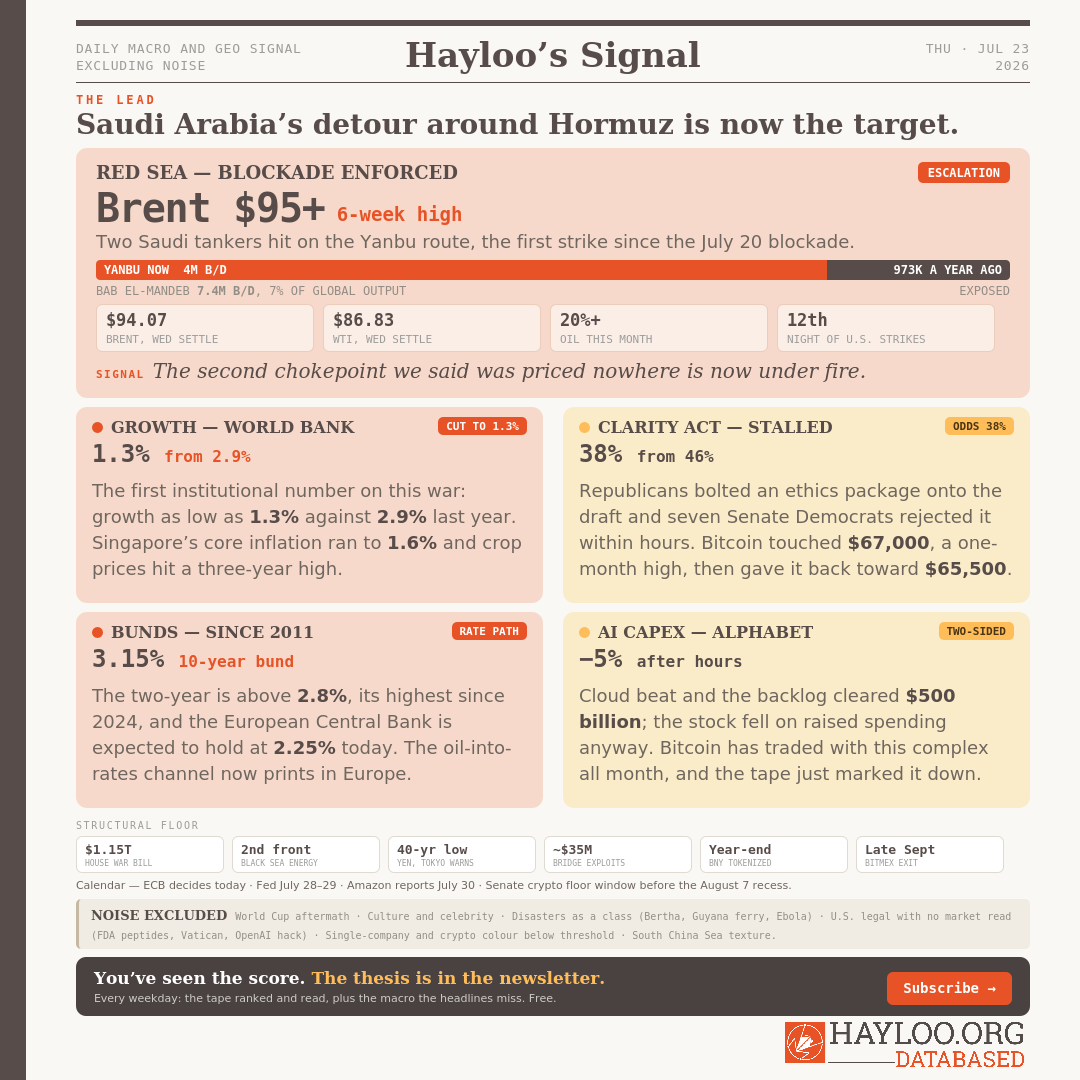
Yemen’s Iran-aligned Houthis said they attacked two Saudi oil tankers in the Red Sea, the first strike since the group declared a naval blockade of Saudi Arabia on July 20. Saudi Arabia confirmed one of the ships was hit and said the crew was safe. Roughly 7% of the world’s oil output moved through that strait last month, and Saudi Arabia had been routing about four million barrels a day through it to get around a Strait of Hormuz that has been shut for weeks. Brent traded above $95 on Thursday. US forces struck Iran for a 12th consecutive night.
Indermit Gill, the World Bank’s chief economist, told Reuters that escalating hostilities between the United States and Iran could reignite inflation and cut global growth to as low as 1.3% this year, against 2.9% last year. Smaller economies are already carrying the energy cost. Singapore’s core inflation accelerated to 1.6% in June and crop prices reached a three-year high. The Philippine peso held at a record low. German bond yields rose to their highest since 2011 hours before the European Central Bank’s rate decision.
Senate Republicans released a new draft of the crypto market-structure bill with an ethics package attached, and seven Democratic senators said it fell short within hours. Odds on the bill passing this year fell from 46% to 38% on the prediction market Polymarket. Bitcoin touched $67,000 during the session, its highest in a month, then slipped as oil and Treasury yields rose. Alphabet raised its capital spending forecast and fell nearly 5% after hours.
#1 — Houthi forces struck two Saudi oil tankers in the Red Sea
Yemen’s Iran-aligned Houthis said they attacked two Saudi oil tankers for violating the maritime blockade the group declared against Saudi Arabia on July 20. Military spokesman Yahya Saree said all crew members were safe.
About 7.4 million barrels a day of crude and refined products moved through the Bab el-Mandeb strait in June, roughly 7% of global oil output, according to Kpler data reported by Reuters. Saudi Arabia had been shipping about four million barrels a day from its Red Sea port of Yanbu in recent weeks, against about 973,000 barrels a day a year earlier, after the Strait of Hormuz closed.
Reuters reported that a full closure of Bab el-Mandeb would cut global oil supply by 7%, on top of the 10% the Gulf fighting has already removed. Fully loaded supertankers cannot use the Suez Canal, and the Sumed pipeline cannot absorb all the threatened volumes. Routing around the Cape of Good Hope adds about four weeks to an Asia-bound voyage.
At least seven tankers turned around or changed course after the Houthi warning. Brent settled at $94.07 on Wednesday, up more than 3%, and traded above $95 on Thursday, its highest in nearly six weeks. US Central Command said American forces completed a 12th consecutive night of strikes on Iran.
#2 — The World Bank’s chief economist said the war could cut global growth to 1.3%
Indermit Gill, the World Bank’s chief economist, told Reuters that escalating hostilities between the United States and Iran could reignite inflation and drive interest rates higher. He said global growth could fall to as low as 1.3% in 2026, against 2.9% last year.
Singapore’s core inflation accelerated to 1.6% in June as higher global energy costs began reaching consumer prices. Crop prices rose to a three-year high as heat waves and attacks in the Black Sea threatened grain shipments, opening a food-price channel alongside the energy one.
#3 — Seven Senate Democrats rejected the new Clarity Act draft hours after Republicans released it
Senate Republicans published a revised draft of the Digital Asset Market Clarity Act on July 22, carrying an ethics package negotiated with the White House. The draft bars the president, the vice president, members of Congress, federal judges and covered officials, along with their spouses, from issuing or sponsoring digital assets for compensation while in office, with the restriction sunsetting on January 20, 2029.
It would require covered officials to divest crypto holdings or place them in a blind trust, and it would give the Justice Department civil enforcement powers to sue exchanges that list prohibited tokens. Senator Bernie Moreno called it the most powerful ethics language in US history. Senator Cynthia Lummis, one of the lead negotiators, said she was pleased the updated bill was ready for release.
Seven Democratic senators objected within hours, saying they want state attorneys general to enforce the ethics provisions, against the White House’s push for federal enforcement.
Odds of the bill passing in 2026 fell from 46% to 38% on Polymarket. Bitcoin touched $67,000 during Wednesday’s session, its highest in a month, before slipping toward $65,500 as oil and Treasury yields rose. Ether traded near $1,920, Solana near $77.80 and XRP near $1.16. US spot bitcoin ETFs recorded a sixth consecutive day of net inflows on July 21, taking in about $203 million.
#4 — German bond yields hit their highest level since 2011 before the ECB decision
German bond yields rose to their highest since 2011 as surging energy prices and rising inflation expectations fueled bets on further rate increases ahead of the European Central Bank’s decision. The 10-year bund traded near 3.15%, close to a two-month high, and the two-year climbed above 2.8%, its highest since July 2024.
The ECB is expected to leave its deposit rate at 2.25% after raising it in June, with markets putting the probability of no change at about 95%. Traders continue to price roughly two more increases by the end of the year, with the next possible move in September.
Eurozone inflation has fallen to 2.8% and remains above the 2% target, and GDP growth is projected at 0.8%. July is a non-projection meeting, and the next set of forecasts arrives on September 10. The oil-into-rates channel that has been running through US Treasuries is now printing in the euro-zone bond market.
#5 — Alphabet fell after hours on a raised capital spending forecast
Alphabet reported cloud revenue well above expectations and said the division’s backlog of contracted business had grown beyond $500 billion. The company raised its full-year capital expenditure forecast, and the stock fell nearly 5% in extended trading.
Tesla missed earnings estimates, and IBM lowered its annual sales outlook. The results were the first of the largest US technology companies to report this quarter. The Philadelphia Semiconductor index finished higher after recovering from early losses, a third straight gain following three sessions that had confirmed a bear market the previous week.
US equity futures slipped in early Thursday trading. Asian stocks rose after the spending plans pointed to further orders for chipmakers in the region. Amazon reports on July 30, and the Federal Reserve meets on July 28 and 29.
#6 — The US House passed a $1.15 trillion military bill
The US House passed a defense policy bill carrying President Donald Trump’s request for $1.15 trillion in Pentagon spending. The bill adopts the renaming of the Department of Defense to the Department of War and expands military cooperation with Israel. Defense Secretary Pete Hegseth has sought roughly $67 billion more to sustain the Iran campaign.
OPERATIONAL/STRUCTURAL FLOOR
Tokenized Treasury rails. Bank of New York Mellon said it will begin testing tokenized Treasuries on a private blockchain by year-end and is laying groundwork for around-the-clock US Treasury settlement.
Strategy price targets. Wall Street analysts kept a bullish stance on Strategy, with published targets implying about 170% upside.
Yen and Japanese policy. Japan’s finance chief said Tokyo will act resolutely against the yen’s fall as the currency sat near a four-decade low, and Deutsche Bank said Japan may shift toward managing bond yields instead of the currency.
Black Sea energy front. Ukrainian drones struck Russian intrastructure, adding to supply concerns, keeping a second energy front open alongside the Gulf.
Calendar. The ECB decides on rates today, Amazon reports July 30, the Senate’s crypto floor window runs before the August 7 recess, and the Federal Reserve meets July 28 and 29.
NOISE EXCLUDED TODAY
FIFA World Cup – The halftime-performer streaming bump, William Saliba’s injury, Guillermo Ochoa’s retirement, Morgan Rogers’s transfer.
Culture, celebrity and human-interest – The Shania Twain album, the D4vd murder hearing, the Austrian police station at Hitler’s birthplace, the Everland panda cub.
Disasters and accidents – Tropical Storm Bertha, the Guyana ferry recovery, the Lima house fire, the Congo Ebola toll passing 1,000, the Sri Lanka dengue drones.
US domestic and legal items – The FDA peptides review, the Wisconsin police-shooting protests, the Vatican abuse case, the OpenAI “rogue model” hack and the Moonshot-Anthropic intellectual-property allegation.
Single-company and sector color – Nestlé’s water spin-off, Nokia’s and Airbus’s results, the Paramount-Warner EU clearance, Revolut’s $115 billion valuation, Aston Martin’s debt raise, Porsche’s job cuts, Tesla’s bitcoin-treasury impairment.
Crypto-industry color – The Kraken and xStocks tokenized-equity expansion, the Balance and SecondFi and Zilliqa exploits, the “wrench attack” tally, the Coinbase-SEC records settlement, Hester Peirce’s DeFi-vault warning, the Robinhood prediction-market note.
South China Sea, Taiwan-Strait and Japan-China force-posture – The Huangyan Dao coast-guard statements, the Motegi-Wang foreign-minister call, the FCC device-parts ban.
Indian “cockroach” protests and the Ukraine command reshuffle were reviewed as geopolitical context and did not clear to ranked slots.