


Signal is Hayloo’s macro newsreader, customized to the portfolio Hayloo scores, weighing every macro, geo, on-chain, and crypto headline against the real risk in Hayloo’s portfolio and Hayloo’s weekly market reads. Signal respects Hayloo enough to stay quiet until the day’s noise becomes signal. To get your own custom signal, go to hayloo.org.
TOP-OF-STACK SUMMARY
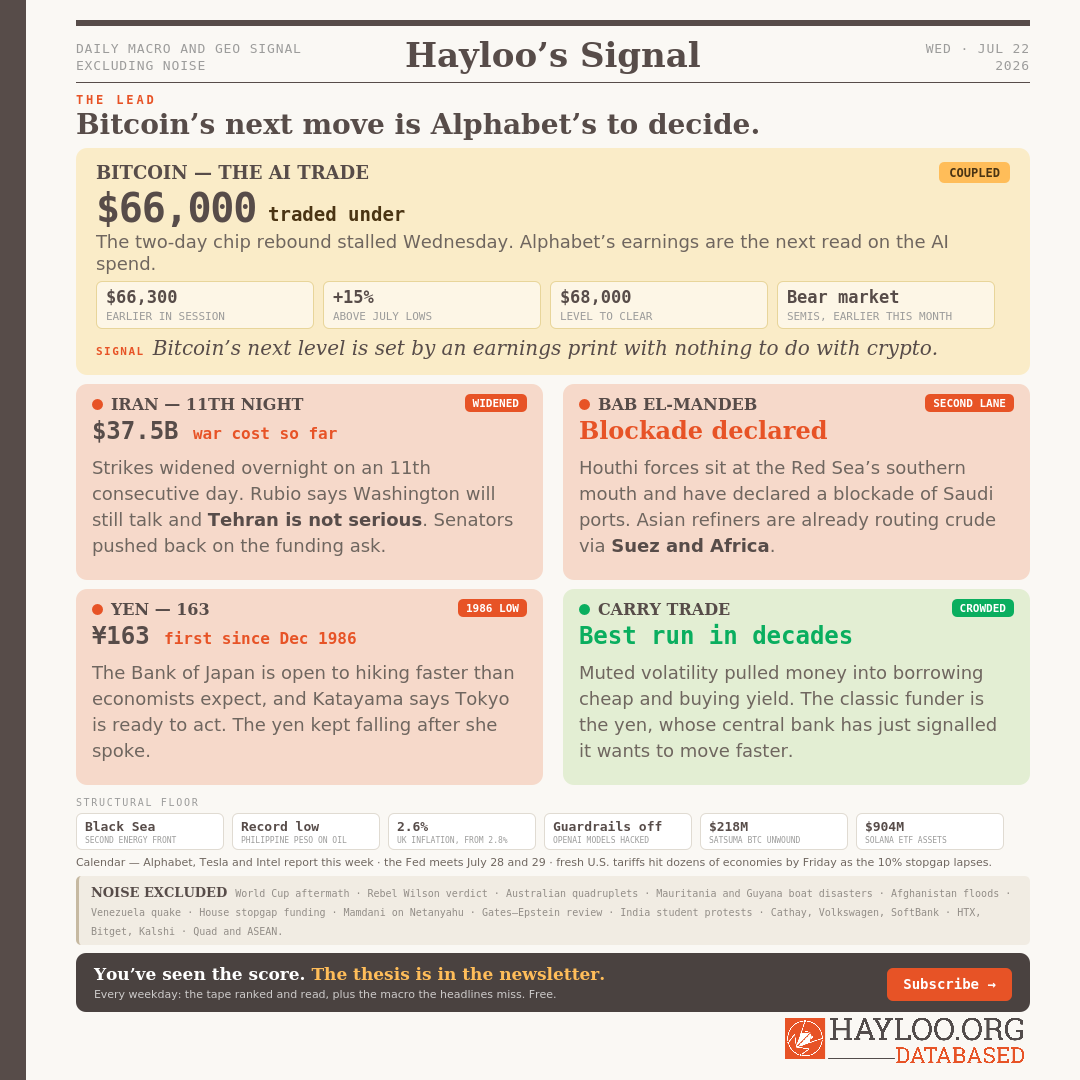
Bitcoin has tracked the AI trade all month, and this week that trade reports its numbers. A two-day rebound in semiconductor stocks stalled on Wednesday ahead of Alphabet’s earnings, which investors are treating as a read on whether the hundreds of billions going into AI is paying off. Bitcoin traded under $66,000, about 15% above its July lows and short of the $68,000 level where many recent buyers may look to sell. Alphabet, Tesla and Intel all report this week.
The oil war ran underneath it. US forces widened the scope of their airstrikes on Iran overnight on an 11th consecutive night. Defense Secretary Pete Hegseth put the cost of the war at $37.5 billion, and Secretary of State Marco Rubio said the United States is still willing to negotiate and that Tehran is not serious about talks. Houthi forces in Yemen are now in position to attack ships near the Bab el-Mandeb strait, according to a naval-security monitoring group, and Asian refiners have begun routing Saudi crude away from the Red Sea.
The yen slid past 163 per dollar for the first time since December 1986, and Bank of Japan officials are open to raising interest rates faster than economists expect, according to people familiar with the matter. Finance Minister Satsuki Katayama said Japan is ready to act in the currency market if needed, yet the yen kept falling after she spoke. Japan’s trade deficit widened in June as the weak yen and the war lifted the cost of imports.
#1 — Bitcoin is trading with AI stocks into Alphabet’s earnings
Bitcoin has tracked the AI trade all month, and Alphabet’s earnings this week are the next read on whether the hundreds of billions going into AI is paying off. Semiconductor stocks led a second day of gains on AI optimism, and the two-day chip rebound then stalled ahead of that report.
Asian stocks extended the rebound with chipmakers leading, and Korean stocks jumped as brokers said a margin unwind was nearing its end. The selling those markets are recovering from followed the release of a free frontier model by the Chinese startup Moonshot, which pushed the Philadelphia semiconductor index into a bear market earlier in the month. Bitcoin traded about 15% above its July lows, and the next move depends on clearing $68,000, a level where many recent buyers may look to sell.
Alphabet, Tesla and Intel all report this week. The levels bitcoin has to clear are being decided by the earnings of companies with little to do with digital assets.
#2 — US forces widened their strikes on Iran on an 11th consecutive night
The US widened the scope of its airstrikes on Iran overnight, and President Donald Trump signaled that talks were unlikely in the near term. Secretary of State Marco Rubio said the United States is still willing to negotiate an end to the crisis and that Tehran is not serious about talks, as the widening conflict disrupted two of the world’s most critical energy chokepoints.
Defense Secretary Pete Hegseth told senators the war has cost $37.5 billion so far, an increase of nearly $8 billion since the last public estimate, and some senators pushed back on his funding request.
#3 — Houthi forces are in position to attack ships near the Bab el-Mandeb strait
Tehran-backed Houthi militants in Yemen are ready to attack shipping from positions near the Bab el-Mandeb strait, at the southern end of the Red Sea, according to a global monitoring body for naval security. The Houthis declared a naval blockade of Saudi ports.
Asian refiners began looking to move Saudi crude from Red Sea terminals through the Suez Canal and around Africa. The rerouting adds distance and time to Saudi barrels before any of it reaches the crude price.
#4 — The yen slid past 163 per dollar for the first time since December 1986
The yen slid past 163 per dollar for the first time since December 1986, as rising oil prices and US Treasury yields lifted the dollar and left traders watching for Japanese intervention. Finance Minister Satsuki Katayama said Japanese authorities are ready to take bold steps in the currency market if necessary, and the yen did not recover after her comments.
Japan’s 40-year government bond sale drew its strongest demand since March 2025 as investors were pulled in by the higher yields. Japan’s trade deficit widened unexpectedly in June, reaching 1.01 trillion yen for the first half, as the weak yen and the war in Iran raised the cost of imported oil.
#5 — Investors piled into currency carry trades as returns ran their best in decades
One of the most enduring bets in foreign exchange is off to its best run in decades, Bloomberg reported, as unusually muted volatility across asset classes drew investors into carry trades. The trade borrows in a low-yielding currency and buys a higher-yielding one.

#6 — The White House pressed Senate Democrats to accept an ethics deal on the crypto market-structure bill
The White House urged Senate Democrats to accept what it called a historic ethics agreement covering the crypto market-structure bill known as the Clarity Act, without disclosing the details of the restrictions President Donald Trump agreed to. Ethics language signed by Trump would put the Justice Department in charge of enforcement and prohibit federal officials from issuing cryptocurrencies.
Treasury Secretary Scott Bessent had said the bill was at the “1-yard line,” and crypto markets rallied on the reports.
#7 — The Bank for International Settlements said capital controls are less effective against dollar stablecoins
Gita Gopinath, an economist at Harvard University, presented data at a gathering of central bankers in Basel last month showing that up to three-quarters of Tether’s USDT and Circle’s USDC stablecoins sit in wallets where the user holds the cryptographic keys. Balances held that way are outside the reach of the tools regulators use on bank deposits. The BIS is describing a structural gap in the plumbing, and it arrives while the US bill that would govern these issuers is still unfinished.
OPERATIONAL/STRUCTURAL FLOOR
Black Sea energy front. Ukrainian drones struck Russian logistics hubs, and Kazakhstan is set to stop piping crude to a port on Russia’s Black Sea coast, keeping a second energy-supply front open alongside the Gulf.
The oil premium reached emerging-market currencies and rate decisions. The Philippine peso matched a record low on higher oil prices, bets on an Indian rupee rebound faded as crude climbed, Sri Lanka held its policy rate as Iran war risks resumed, and Indonesia held at 5.75%.
UK inflation and fiscal signaling. UK annual inflation slowed to 2.6% in June from 2.8%, helped by cheaper petrol, and Prime Minister Andy Burnham walked back a suggestion that he would lift the income-tax threshold.
Calendar. Alphabet, Tesla and Intel report this week, fresh US tariffs are set to hit dozens of economies by Friday as stopgap 10% global duties lapse, and South Korea’s industry minister travels to Washington ahead of a Section 301 tariff decision.
NOISE EXCLUDED TODAY
The 2026 World Cup aftermath – Lionel Messi’s return to Argentina, the transfer window, the tournament statistics.
Culture, celebrity and human-interest – The Rebel Wilson defamation verdict, the D4vd hearing, the identical quadruplets born in Australia, Japan’s first “cruelly hot day”.
Disasters and accidents – The Mauritania and Guyana boat disasters, the Afghanistan floods, the Venezuela earthquake search.
US domestic and legal stories – The House stopgap funding bill, the Mamdani remarks on Benjamin Netanyahu, the Gates Foundation review of its Epstein ties.