


Signal is Hayloo’s macro newsreader, customized to the portfolio Hayloo scores, weighing every macro, geo, on-chain, and crypto headline against the real risk in Hayloo’s portfolio and Hayloo’s weekly market reads. Signal respects Hayloo enough to stay quiet until the day’s noise becomes signal. To get your own custom signal, go to hayloo.org.
TOP-OF-STACK SUMMARY
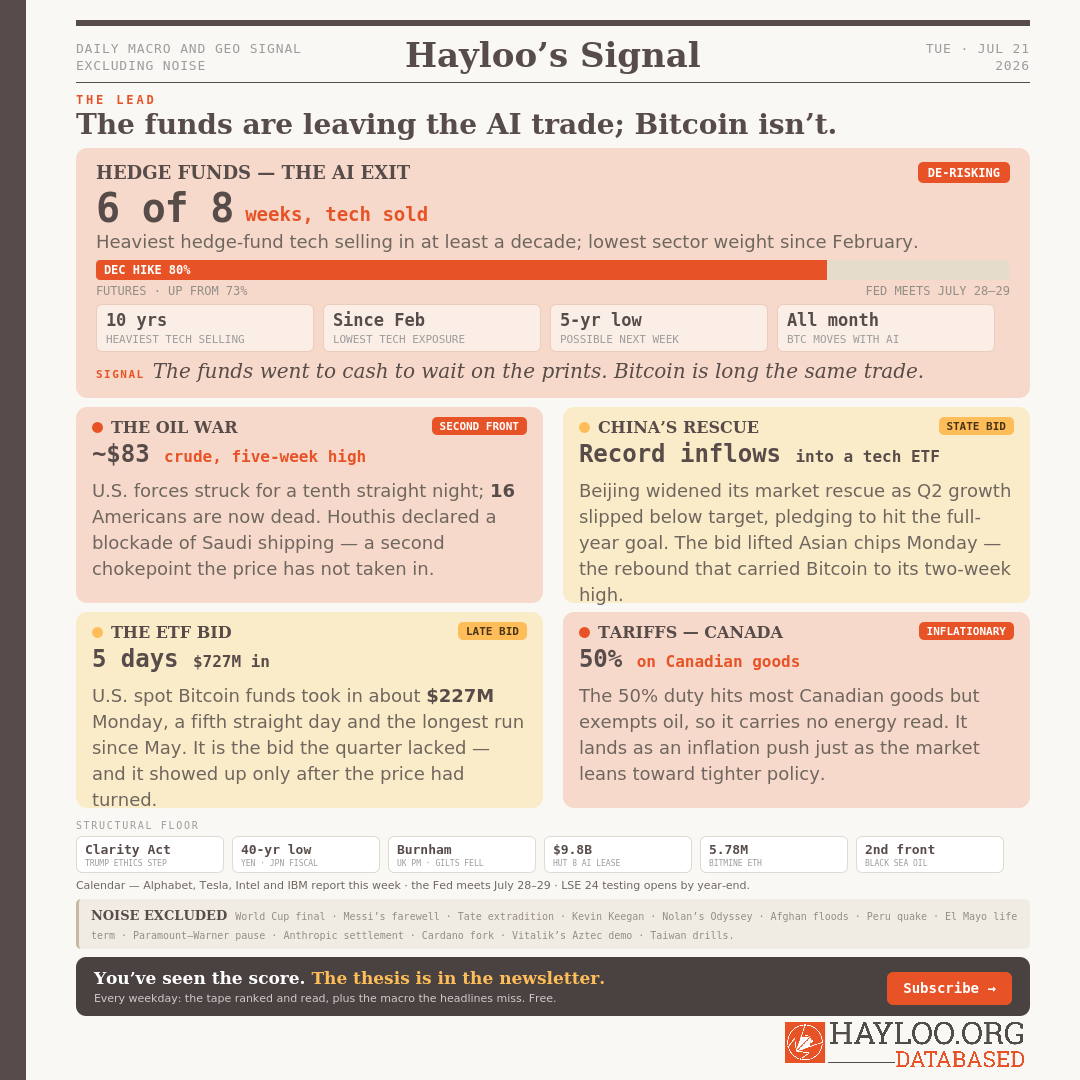
Hedge funds have sold US technology stocks in six of the last eight weeks, a stretch that prime-brokerage data cited by The Kobeissi Letter calls the heaviest in at least a decade, cutting the sector to its smallest share of fund exposure since February. The selling looks like money stepping back to cash while it waits, and it lands the same week Alphabet, Tesla and Intel report the capital-spending numbers that have driven the AI rally. Those numbers now double as a bitcoin input, because bitcoin has traded with the AI complex all month.
Monday’s tape ran the other way. A rebound in Asian semiconductor stocks pushed bitcoin to a two-week high near $65,500 and carried a broad risk rally with it, and US spot bitcoin ETFs drew about $227 million, a fifth straight day of inflows worth roughly $727 million over the run and the longest streak since early May. It is the first sustained ETF bid since an eight-week run of outflows defined the quarter. The buying showed up only after the price had already turned up, the momentum-chasing pattern of retail investors.
The oil war ran underneath all of it. US forces struck Iran for a tenth straight night, the Pentagon put the American death toll since the war began at 16 with more than 430 wounded, and Iran-backed Houthi fighters declared a maritime blockade of Saudi Arabia, opening a second chokepoint threat on the Red Sea while Hormuz traffic thinned. Crude held near a five-week high around $83 a barrel, and mediators floated a ten-day pause even as the strikes continued.
#1 — Hedge funds sold US technology stocks in six of the last eight weeks
Hedge funds have sold US information technology stocks in six of the last eight weeks, and prime-brokerage data cited by The Kobeissi Letter puts the eight-week total at the largest in at least ten years. Technology was the single most-sold US sector last week, which cut the group to its smallest share of hedge-fund market exposure since February, and at the current pace that share could reach a five-year low as soon as next week.
The Federal Reserve meets July 28 and 29, and Alphabet, Tesla and Intel report this week, with their capital-spending numbers set to show whether AI investment is still climbing.
Bitcoin has traded with that investment all month, so weak guidance this week is the clearest path left to a broad selloff, and that selloff would reach bitcoin as much as the equity market.
#2 — US forces struck Iran for a tenth straight night as the American death toll reached 16
US forces struck Iran for a tenth consecutive night, extending a campaign that began earlier this month. The Pentagon said 16 American service members have now been killed since the war began and more than 430 have been wounded, with nearly 100 of those injuries in the last two weeks.
Iran-backed Houthi fighters in Yemen declared a maritime blockade of Saudi Arabia, raising the risk to energy shipments through the Red Sea, while traffic through the Strait of Hormuz thinned sharply after Iranian attacks on ships over the weekend.
Iran said mediators had put forward proposals to ease the fighting, including a reported ten-day ceasefire, and crude oil held near a five-week high around $83 a barrel. The escalation and the mediation are running at the same time, so the market is being asked to price both tracks. The oil price already reflects the Gulf chokepoint, and a Houthi blockade of Saudi shipments would open a second one the price has not yet taken in.
#3 — Trump imposed 50% tariffs on most Canadian goods over autos, alcohol and dairy
Trump imposed 50% tariffs on most Canadian goods on Monday, saying Canada had unfairly discriminated against American autos, alcohol and dairy. An administration official said Trump signed three proclamations invoking Section 338 of the Tariff Act of 1930, a provision that has not been used before and is likely to draw immediate legal challenges.
The tariffs take effect in 30 days and exempt oil, which Canada exports in volume to US refiners. The official said Canada was one of the only countries other than China to retaliate against Trump’s earlier tariffs. The US and Canada are due to renegotiate the USMCA trade pact, which lapsed earlier this summer, though no face-to-face talks are scheduled, and the Canadian Chamber of Commerce called the move a regrettable escalation while noting both sides now have 30 days to make progress.
Futures markets are pricing roughly an 80% chance of a Federal Reserve rate increase in December, up from about 73% a week ago. A 1930 statute aimed at a G7 partner keeps an uncertainty premium on North American supply chains, and because it exempts oil it carries no direct energy read, but it cuts the wrong way on inflation at a moment when the market is already leaning toward tighter policy.
#4 — US spot bitcoin ETFs drew a fifth straight day of inflows, the longest run since early May
US spot bitcoin ETFs took in about $227 million on Monday, a fifth consecutive day of net inflows and the first such run since late April, according to data from SoSoValue. The five days have pulled in roughly $727 million, the most sustained buying since the record outflows of June, and the streak reduced year-to-date net outflows to below $5 billion and lifted total bitcoin-ETF assets back to about $79 billion from a July low near $75 billion.
Ether ETFs added about $38 million, led by BlackRock’s fund. This is the sustained bid the market had been missing all quarter, and it showed up in the way that confirms nothing, arriving wrapped in a dumb money retail-suit after the price had already turned up.
For the buying to signal more, it would need to broaden across issuers and line up with a turn back up in global liquidity, and so far only the first has happened.
#5 — China expanded its market rescue after second-quarter growth slipped below its target range
China broadened a campaign to support its stock market, drawing record inflows into a domestic technology ETF as the chip-heavy STAR 50 index extended gains. The move followed data showing second-quarter growth slipped below the government’s official target range, and Beijing’s cabinet pledged to hit its full-year growth target. The rescue is part of what lifted Asian semiconductor stocks on Monday, the same rebound that carried bitcoin to its two-week high.
#6 — Japan’s new government approved a fiscal plan built on higher spending as the bond market wobbled
Prime Minister Sanae Takaichi’s cabinet approved its first economic and fiscal blueprint, prioritizing aggressive spending with no clear path to deficit reduction and citing central-bank independence, while leaving a proposed cut to the food sales tax unresolved. Jitters in the government-bond market overshadowed the plan, and Japanese insurers bought the most super-long government bonds in three years in June.
Japan leaning harder into deficit spending while its long-bond market strains is the kind of pressure that lets one suspect that long-dated yields worldwide are set too low.
OPERATIONAL/STRUCTURAL FLOOR
- UK leadership and the gilt market. – Andy Burnham became UK prime minister, succeeding Keir Starmer, and British government bonds fell after Burnham’s comments about fiscal flexibility unsettled investors.
- US crypto market-structure bill. – Trump agreed to an ethics provision addressing his own crypto holdings, a step toward the Clarity Act, though negotiations over the bill remain unresolved.
- Miner-to-AI datacenter pivot. – Hut 8 fully commercialized a one-gigawatt Texas AI campus with a second $9.8 billion lease, and IREN signed $2.8 billion in new contracts.
- Exchanges chase around-the-clock trading. – The London Stock Exchange plans a near-continuous venue called LSE 24 for digital and algorithmic trading, with client testing due by year-end and products in the first half of 2027, and former New York Governor Andrew Cuomo joined the board of the crypto exchange OKX.
- Crypto banking and enforcement. – A UK parliamentary group opened an inquiry into banks that denied crypto firms accounts, a Washington state judge blocked Kalshi’s sports prediction markets under state gambling law, and the SEC charged a Florida man in an alleged $22 million crypto-mining fraud.
- Ether-treasury accumulation. – BitMine expanded its ether holdings to 5.78 million ETH, close to 4.8% of the supply, and repurchased 5.5 million shares under a $4 billion buyback.
- Product pipeline. – Grayscale filed with the SEC for a Worldcoin ETF.
- Black Sea energy front. – A Russian strike near Odesa killed civilians, and drone strikes again halted oil loading at the Caspian Pipeline Consortium’s Black Sea terminal, keeping a second energy-supply front open alongside the Gulf.
NOISE EXCLUDED TODAY
The 2026 World Cup – Spain’s win over Argentina, Lionel Messi’s farewell, the Madrid parade, the on-pitch brawl, the tournament retrospectives.
Culture, celebrity and obituary items – The Tate brothers’ Miami extradition hearing, Kevin Keegan’s death, the Luke Skywalker lightsaber auction, Christopher Nolan’s Odyssey.
Disasters and accidents – The Afghanistan floods, the Guyana ferry recovery, Tropical Storm Bertha, the Ohio river deaths, the Peru earthquake.
US domestic and legal stories – The anti-ICE veteran arrest, the El Mayo Zambada life sentence, the Paramount–Warner Bros merger pause, the Harvard financial-aid review, the daylight-saving bill.
Single-company color – Volkswagen’s India-unit stake sale, AliExpress’s EU fine, Ryanair’s profit drop, Adnoc’s $6.2 billion gas project, the Anthropic copyright settlement.
Crypto-industry color – The Cardano hard fork, the Vietnam trading fines, the Exodus workforce cut, Vitalik Buterin’s Aztec billboard demo, the drop in Kalshi and Polymarket World Cup open interest, the Robinhood price-target raise.