


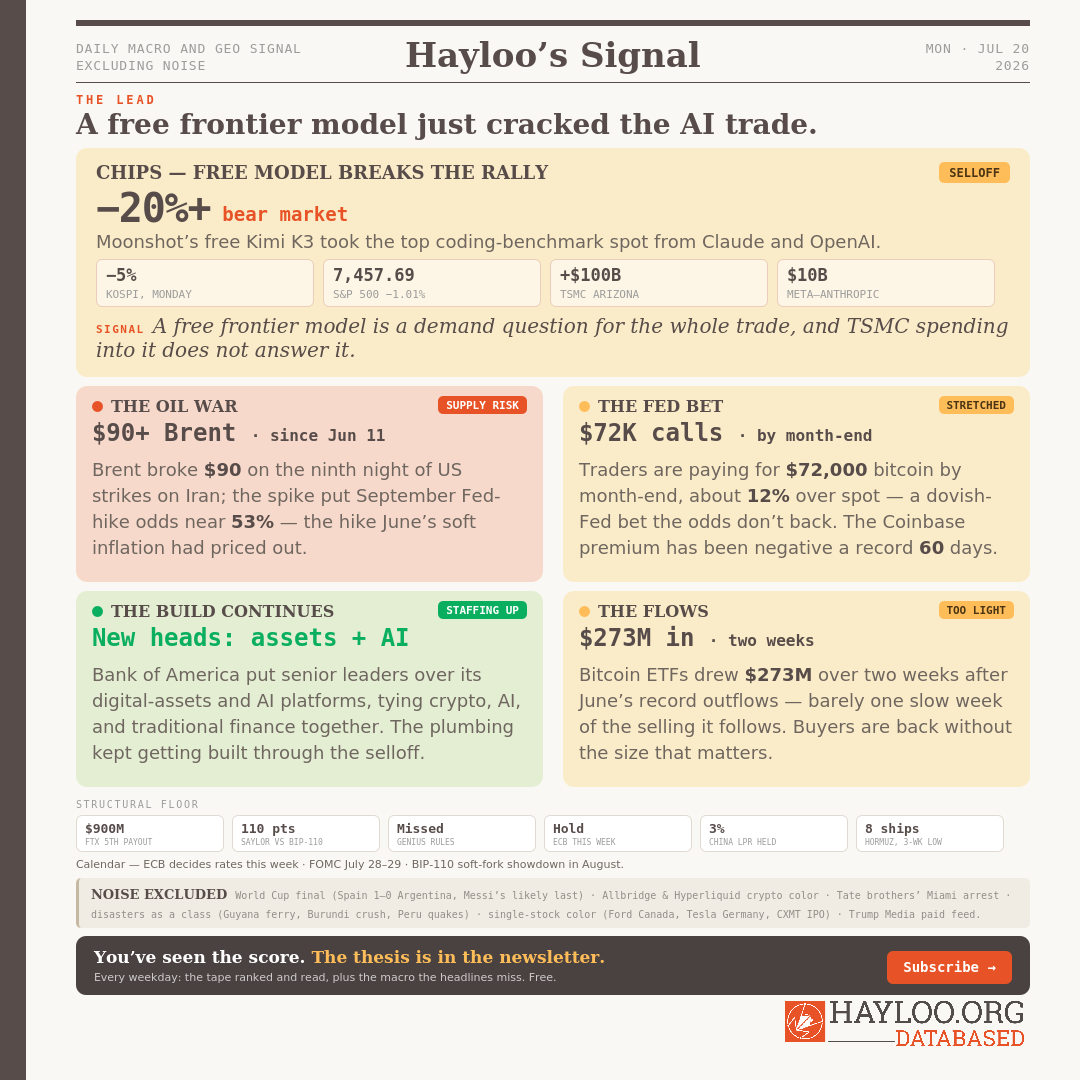
Signal is Hayloo’s macro newsreader, customized to the portfolio Hayloo scores, weighing every macro, geo, on-chain, and crypto headline against the real risk in Hayloo’s portfolio and Hayloo’s weekly market reads. Signal respects Hayloo enough to stay quiet until the day’s noise becomes signal. To get your own custom signal, go to hayloo.org.
TOP-OF-STACK SUMMARY
A free artificial-intelligence model from the Chinese startup Moonshot has pushed the AI rally’s biggest winners into a sharp selloff. Moonshot released Kimi K3 on July 17, and by Monday the Philadelphia semiconductor index had fallen into a bear market and South Korea’s Kospi had dropped nearly 5% as investors reconsidered whether hyperscalers will keep buying chips at the pace the rally priced in. TSMC affirmed strong multi-year demand and a further $100 billion Arizona buildout over the same weekend, which puts both sides of the capital-spending question in front of investors at once.
Institutions keep building the plumbing. Bank of America named new leaders for its digital-assets and AI operations, a Japanese company branded for bitcoin raised sixty million dollars to buy its first coins, and FTX began a fifth wave of creditor payouts worth about $900 million.
US forces struck Iran for a ninth straight night, Iran hit infrastructure in Kuwait and Bahrain and disabled two tankers in the Strait of Hormuz, and Brent crude topped $90 for the first time since June 11. The oil move lifted the odds of a September Fed rate hike to about 53% and pushed the 30-year Treasury yield back above 5%, while gold drifted toward nine-month lows.
#1 — Chip stocks fell into a bear market after a Chinese startup released a free frontier AI model
Moonshot AI, a Chinese startup, released its Kimi K3 model on July 17. The BBC reported the model claims to rival OpenAI and Anthropic, and CoinDesk reported it took the top spot in a frontend-coding benchmark away from Claude and OpenAI and is free to use. The release sent chip stocks toward their steepest weekly decline in more than a year, and the Philadelphia semiconductor index fell more than 20% from its late-June record into a bear market. South Korea’s Kospi dropped nearly 5% on Monday as investors sold AI-linked stocks.
The selloff prices in slower AI capital spending ahead, on the theory that a free model matching the paid frontier weakens the case for buying more chips, and TSMC’s demand guidance cuts the other way.
#2 — Bank of America named new leaders for digital assets and AI
Bank of America named Sonali Theisen head of its global digital-assets platform and Kevin Milsom head of AI transformation, The Block reported. The bank framed the appointments as an effort to connect its crypto, AI, and traditional-finance operations. One of the largest US banks putting digital assets and AI under named, senior leadership is a staffing signal that the institutional build is continuing regardless of current price action.
#3 — Large traders bought call spreads targeting $72,000 bitcoin by month-end
Bitcoin exchange-traded funds took in $273 million in net inflows over two weeks, CoinDesk reported, citing analyst Omkar Godbole, who called the sum barely enough to cover a single slow week of the recent selling. The inflows followed a record outflow month in June and resumed across issuers.
Large traders placed bets on bitcoin reaching $72,000 by the end of July through call spreads, CoinDesk reported, citing options-market flow. The positioning targets month-end, which coincides with the Federal Reserve’s July 28–29 meeting, and bitcoin traded near $64,000 at the time, about 12% below the strike zone.
CoinDesk separately reported that the Coinbase premium has stayed negative for a record 60 days, a sign of continued US spot selling. The call buyers are paying for a dovish surprise at the Fed meeting that the current rate-hike odds do not support.
#4 — An Amazon Japan supplier will pay 2,300 partners in the yen stablecoin JPYC
AZ-Com Maruwa, a Japanese logistics firm and Amazon Japan supplier, will use the yen-pegged stablecoin JPYC to pay about 2,300 partners, including truck drivers, CoinDesk reported.
The Block, citing Nikkei, reported the firm turned to JPYC to give contractors faster payments and attract partners amid labor shortages, and CoinDesk called it Japan’s first large-scale corporate stablecoin rollout.
A logistics firm paying thousands of contractors in a stablecoin is the kind of payments-rail adoption the long-term case for these assets depends on, and here it runs on a yen-denominated coin.
#5 — A Russian missile strike on a grain ship off Odesa killed 10
A Russian missile strike on a ship carrying corn near Ukraine’s southern port of Odesa killed 10 people on Monday, the deadliest attack in a weeks-long Black Sea escalation, Ukrainian officials said, per Reuters. Russian strikes have killed 28 people in the Odesa region in July, the regional governor said.
Russia launched what Ukraine called its largest ballistic-missile barrage on Kyiv since the war began over the weekend, killing at least eight, and a drone strike suspended loadings at the Caspian Pipeline Consortium’s Black Sea terminal, per the BBC and Bloomberg.
A second war is now hitting grain and energy shipping at the same time as the Gulf, so the supply threat sits on two fronts while the market prices mainly one.
#6 — US regulators missed the GENIUS Act’s one-year deadline for final stablecoin rules
The stablecoin-focused GENIUS Act reached its first anniversary, and US regulators missed the law’s one-year deadline for issuing final stablecoin rules, per The Block and CoinDesk. The delay does not move the law’s January 18, 2027 effective date, leaving a compressed implementation window.
CoinDesk reported that Tether’s USDT hit a two-year countdown that threatens its standing on US crypto platforms, with rules due in full effect by July 2028. Polymarket bettors cut the odds of the CLARITY Act market-structure bill passing this year to a record low as Senate negotiations over ethics provisions stayed unresolved, CoinDesk reported.
The framework the industry has been building toward keeps missing its own deadlines, and the regulatory clarity issuers were counting on keeps moving further out.
#7 — Brent crude topped $90 a barrel for the first time since June 11
Brent crude rose about 3% on Monday to pass $90 a barrel, its highest since June 11, and WTI traded near $83, per Reuters and Investing.com; oil has climbed more than 14% over the prior week on the Iran war. US average gasoline sat just below $4 a gallon, about 34% above the pre-war level, per AAA. The oil spike has revived expectations for a September Fed rate hike that the soft June inflation data had nearly priced out.
Spot gold traded near $4,000, drifting toward nine-month lows, as the dollar and Treasury yields took the haven bid, per FXLeaders and TradingEconomics.
The 30-year Treasury yield rose back above 5%, and markets priced about a 53% chance of a September Fed rate hike, up from 47% a day earlier, and roughly 82% by December.
Bitcoin traded near $64,000, roughly flat on the week, with ETH near $1,840, XRP near $1.09, and SOL near $75.
OPERATIONAL/STRUCTURAL FLOOR
The US struck Iran for a ninth straight night. US Central Command carried out a ninth consecutive wave of strikes on Iran on Sunday, and CENTCOM said three US service members have been killed since Friday, bringing the war’s US death toll to 17.
Michael Saylor urged Bitcoin to reject the BIP-110 soft fork. Saylor published a 110-point essay urging the network to reject the BIP-110 soft fork ahead of its August showdown, arguing that temporarily blocking “spam” data would undermine neutrality and set a censorship precedent, with a parallel fight running over default relay policy.
The ECB is expected to hold. The European Central Bank is expected to hold off on a second rate hike this week while keeping a September move open, per Bloomberg, ahead of the US July 28–29 FOMC.
India’s central bank intervened to support the rupee. The Reserve Bank of India stepped into the currency market as the rupee neared a record low on the crude surge, and hedge funds built their largest New Zealand dollar net short since 2006 on the oil rebound, per Bloomberg.
China’s loan prime rate held at 3%. China’s benchmark loan prime rate was unchanged at 3%, and South Korean banks said they will tighten lending standards in the third quarter, per Xinhua.
Andy Burnham became UK prime minister. Burnham took over as Britain’s seventh prime minister in a decade, pledging to “rewire” the country and dropping the digital-ID scheme, as Thames Water creditors threatened legal action over possible nationalisation.
NOISE EXCLUDED TODAY
The World Cup final – Spain beating Argentina 1-0, Torres’s winning goal, Messi’s likely last match, the half-time show, Trump presenting the trophy, a fatal fountain collapse in Spain.
Crypto-industry color – The $1.65M Allbridge flash-loan exploit, the Upbit/Dunamu sanction process, the Hyperliquid HIP-4 prediction-markets upgrade, Kraken’s USD-settled options, Zcash’s Zakura node, the bitcoin quantum-recovery tool, France blocking Polymarket, TD Cowen’s Smarter Web target cut, the UNI burn vote, tokenization-survey and digital-native-banking pieces.
Culture, Political Texture and Legal – The Tate brothers’ Miami arrest and extradition, India’s “Cockroach” protests, the Sonam Wangchuk hunger strike, the Singapore minister resignation, and the Syria/Lebanon security items, Trump Media’s paid-post-feed product and the 2020-election-interference claims.
Disasters and accidents – The Guyana ferry sinking, the Burundi crush, the Peru earthquakes, the Utah and Vietnam floods, the Tucson shooting.