


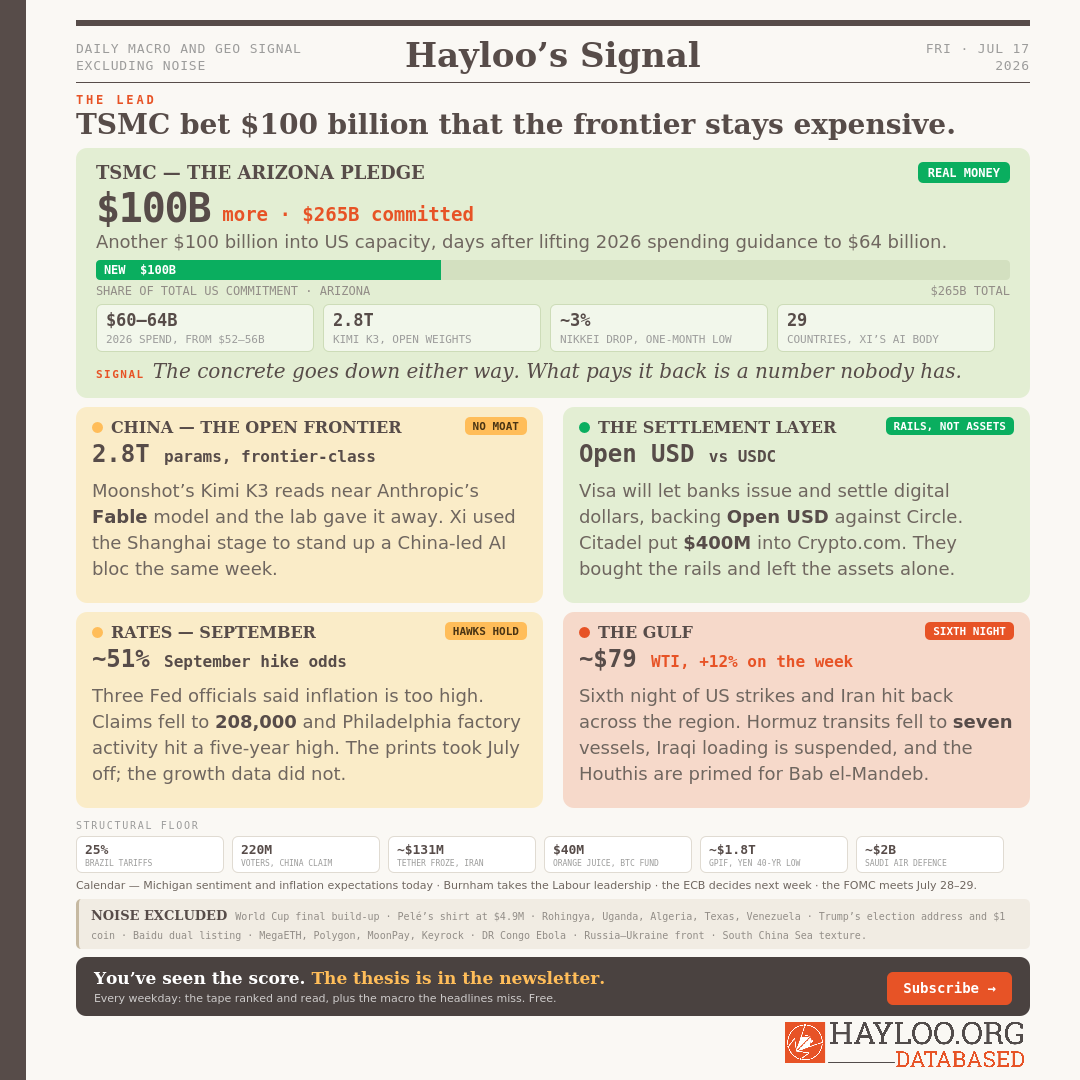
Signal is Hayloo’s macro newsreader, customized to the portfolio Hayloo scores, weighing every macro, geo, on-chain, and crypto headline against the real risk in our portfolio and our weekly market reads. Signal respects Hayloo enough to stay quiet until the day’s noise becomes signal. To get your own custom signal, go to hayloo.org.
TOP-OF-STACK SUMMARY
Taiwan Semiconductor Manufacturing said it will spend another $100 billion expanding its US plants, taking its total American commitment to $265 billion, days after raising its 2026 capital-spending guidance to as much as $64 billion.
China’s Moonshot unveiled Kimi K3, a 2.8-trillion-parameter model it calls the largest open-weight AI system built, at a Shanghai conference where Chinese President Xi Jinping announced a 29-country AI cooperation body headquartered in the city. Semiconductor stocks fell for a second straight day and Japan’s Nikkei dropped nearly 3%.
Visa launched a platform letting banks and fintechs issue, manage and settle stablecoins, backing the consortium-issued Open USD against Circle’s USDC, and Citadel Securities put $400 million into Crypto.com at a $20 billion valuation to fund its tokenization desk. Both are institutions buying the settlement layer and leaving the assets that settle on it alone. The bill that would change that calculus is still in the Senate.
The European Central Bank is expected to hold next week before a final quarter-point increase in September, three Federal Reserve officials said inflation is too high, and South Korea raised for the first time in three years. Two soft US inflation prints took a July hike off the table, and September sits near a coin flip with jobless claims falling and Philadelphia factory activity at a five-year high. In the Gulf, the US struck Iran for a sixth consecutive night, Iran fired back on American facilities across the region, and oil held near $79 through all of it.
#1 — TSMC pledged another $100 billion to expand its US plants
Taiwan Semiconductor Manufacturing said it plans to spend another $100 billion expanding its manufacturing capacity in the United States, centred on Arizona, raising its total US commitment to $265 billion. The company said the expansion would create high-tech, high-paying jobs. The pledge landed days after TSMC raised its 2026 capital-expenditure guidance to a range of $60 billion to $64 billion from a prior $52 billion to $56 billion, alongside a second-quarter earnings beat. Semiconductor stocks fell for a second straight day and Japan’s Nikkei dropped nearly 3% to a one-month low.
#2 — Visa launched a platform letting banks and fintechs issue and settle stablecoins
Visa launched a stablecoin platform that lets banks and fintechs issue, manage and settle digital dollars through its payments network, backing the consortium-issued Open USD as competition to Circle’s USDC, the dominant stablecoin in the US. Citadel Securities invested $400 million in Crypto.com at a $20 billion valuation, the exchange’s first institutional funding round, with the proceeds going to expand its tokenization and derivatives operations.
#3 — China’s Moonshot unveiled a 2.8-trillion-parameter open AI model, the largest open-weight system to date
Chinese AI startup Moonshot unveiled Kimi K3, a 2.8-trillion-parameter model it said is the world’s largest open-weight AI system, with performance approaching Anthropic’s frontier Fable model. The launch landed alongside the opening of the World Artificial Intelligence Conference in Shanghai, where Xi said AI should not be a solo performance by a single country and announced a China-led World Artificial Intelligence Cooperation Organization that 29 countries, including Russia, signed on to establish, with a headquarters in Shanghai.
#4 — Trump alleged China committed 2020 US election fraud, straining ties before the September Xi meeting
President Donald Trump said on Thursday that China carried out what he called the largest compromise of election data in history, beginning during the 2020 election cycle, and declassified an intelligence report alleging Beijing obtained records on 220 million American voters. The claim directly contradicts past US intelligence findings, and China’s embassy denied it in full. The allegation came the same week the US nationalised British Steel over its former Chinese owners, drawing a formal rebuke from Beijing, and as an adviser to Indian Prime Minister Narendra Modi urged India to seek more Chinese investment and trade on the view that the US is a less dependable partner.
#5 — UBS Asset Management’s Zhao is shorting Treasuries on the bet US growth erodes the haven bid
UBS Asset Management’s Kevin Zhao said he plans to short US Treasuries in a wager that a robust US economy will erode the safe-haven appeal of government debt. The bond market has bailed on Fed-hike bets after two benign inflation prints this week, and the dollar was set for a weekly decline as traders cut wagers on imminent rate increases. US jobless claims fell to 208,000 for the week ended July 11, below a 218,000 consensus, and the Philadelphia Fed manufacturing index soared to 41.4 for July, a nearly five-year high. June retail sales rose a modest 0.2% as gasoline-station receipts fell 5.3%. Traders put the odds of a Federal Reserve increase in September near 51%. The inflation prints this week took a July hike off the table, and the growth data underneath them points the other way.
#6 — The ECB is set to pause next week before a final rate hike in September, a poll shows
The European Central Bank will probably hold next week before delivering a final quarter-point rate increase in September, economists surveyed by Bloomberg said. Federal Reserve Vice Chair Philip Jefferson said US monetary policy is well positioned but that the central bank should consider raising rates if inflation does not cool soon. Kansas City Fed President Jeff Schmid and Dallas Fed President Lorie Logan both said inflation is too high and favoured higher rates. Bank of England Deputy Governor Sarah Breeden played down the risk of a wage-price spiral against a weak UK economy. South Korea’s central bank raised its benchmark rate to 2.75% on Thursday, its first increase since January 2023, as June headline inflation rose to 3.2%, its highest since 2023.
#7 — Japan’s Takaichi pressed the GPIF toward domestic assets as the yen sat near a four-decade low
Japanese Prime Minister Sanae Takaichi said encouraging households and the Government Pension Investment Fund to increase investment in Japanese financial assets is key, fuelling expectations of allocation changes at the roughly $1.8 trillion fund. Finance Minister Satsuki Katayama used her strongest language in weeks to warn of possible decisive action in the currency market, and the yen continued to hover near its lowest level in four decades against the dollar, with hedge funds still positioned for further weakness.
#8 — The crypto market-structure bill faces what backers call its final test over Trump conflict-of-interest provisions
Backers of the crypto market-structure bill voiced optimism it can pass as it faces what could be a final test over provisions addressing Trump’s conflicts of interest, with onlookers waiting to see how the ethics question resolves and some disagreement over timing. Summer Mersinger, chief executive of the Blockchain Association, argued that the Clarity Act is the most important consumer-protection effort in years and that consumers should not have to wait for another crisis to get the protections they deserve.
#9 — Iran launched fresh attacks on US facilities in the Gulf
US Central Command completed a sixth consecutive night of strikes on Iran, hitting dozens of military targets including logistics infrastructure and maritime capabilities. Iran’s Fars news agency said the strikes hit five bridges in southern Hormozgan province and a maritime control tower at Chabahar. Iran launched fresh attacks on US facilities in the Gulf on Friday, having earlier struck American bases in Kuwait and Jordan, and described the conflict as an existential war with the United States.
Yemen’s Houthis attacked Saudi Arabia this week, and Reuters reported that Pakistan fears being drawn into the conflict in a way that would complicate any future role it might play as a mediator.
Tehran instructed the Houthis to stand ready to close the Bab el-Mandeb route into the Red Sea if US forces carry out Trump’s threat to strike Iranian power infrastructure next week absent a diplomatic breakthrough.
Crude loading was suspended at all Iraqi export terminals on Thursday after a drone struck a tanker at the Basra terminal. Shipping traffic through the Strait of Hormuz fell to two-month lows, with seven vessels transiting on Wednesday against thirteen the prior day.
WTI held near $79 a barrel, roughly flat on the day and up about 12% on the week, and Brent was set for its sharpest weekly rise in three months. IEA Executive Director Fatih Birol warned that the crisis threatens global energy security and said the world should be worried if it does not improve.
OPERATIONAL/STRUCTURAL FLOOR
US tariffs on Brazil. The US imposed new 25% tariffs on some Brazilian imports on Wednesday, and Brazil’s government convened top ministers at the presidential palace on Thursday to prepare a response that could include non-tariff measures affecting the audiovisual sector and pharmaceutical and agricultural patents.The tariffs land three months before Brazil’s October presidential election, and candidates are already trading blame. The Trump administration is separately racing to rebuild the US tariff wall struck down by the Supreme Court.
Saudi air defence. The US approved nearly $2 billion in weapons sales to Saudi Arabia to bolster the kingdom’s air defences as it risks escalation with the Iran-backed Houthis.
Britain’s incoming government. Andy Burnham becomes leader of Britain’s governing Labour Party on Friday, the final step before becoming prime minister, and is preparing to announce new North Sea oil and gas drilling and public control of Thames Water within days of taking office.
Iran sanctions and on-chain enforcement. The US added four Iranian central-bank crypto wallets to its sanctions list.
Calendar. University of Michigan consumer sentiment and inflation expectations print Friday.
NOISE EXCLUDED TODAY
FIFA World Cup – Argentina-Spain, Messi and Yamal, the Falklands-banner probe, Pelé’s shirt selling for $4.9M, Trump attending.
Disasters and accidents – more than 500 Rohingya feared dead off Myanmar, at least 20 Uganda schoolchildren killed in a crash, the Algeria orphanage fire, Texas floods, the Venezuela earthquake toll near 5,000, Canadian wildfire smoke. US domestic and legal items – Trump’s primetime election-security address, the White House teleprompter-operator Kalshi probe, visa-duration changes, the Ben & Jerry’s Foundation shutdown, ICE items, the Merck cholesterol-pill approval. Single-company and sector colour – Volvo Cars’ Q2, Aston Martin creditors tapping Jefferies, Baidu’s dual listing, JERA’s US-listing study, the MegaETH/Polygon/MoonPay/Keyrock crypto-industry items, the UK crypto-scam jailing and the South Dakota fraud indictment.
Public health and culture – The Pakistan Sindh child-HIV outbreak, DR Congo Ebola, Taco Bell’s lettuce recall, Japan’s imperial-succession and flag-desecration laws, Lolita fashion in China.
Russia-Ukraine – The detained Putin-critic blogger, the Zelensky defence-minister reshuffle protests, Russian/Ukrainian strikes killing 13.
TSMC's Arizona expansion looks meaningful. It adds domestic chip capacity and creates high skilled jobs, which is a real win for the local economy.
I also had to think through what "shorting Treasuries" means. It's not betting against the U.S. government. It's betting that Treasury bond prices fall and yields rise. If the economy stays strong, investors may move away from safe haven assets, putting downward pressure on bond prices.