


TOP-OF-STACK SUMMARY
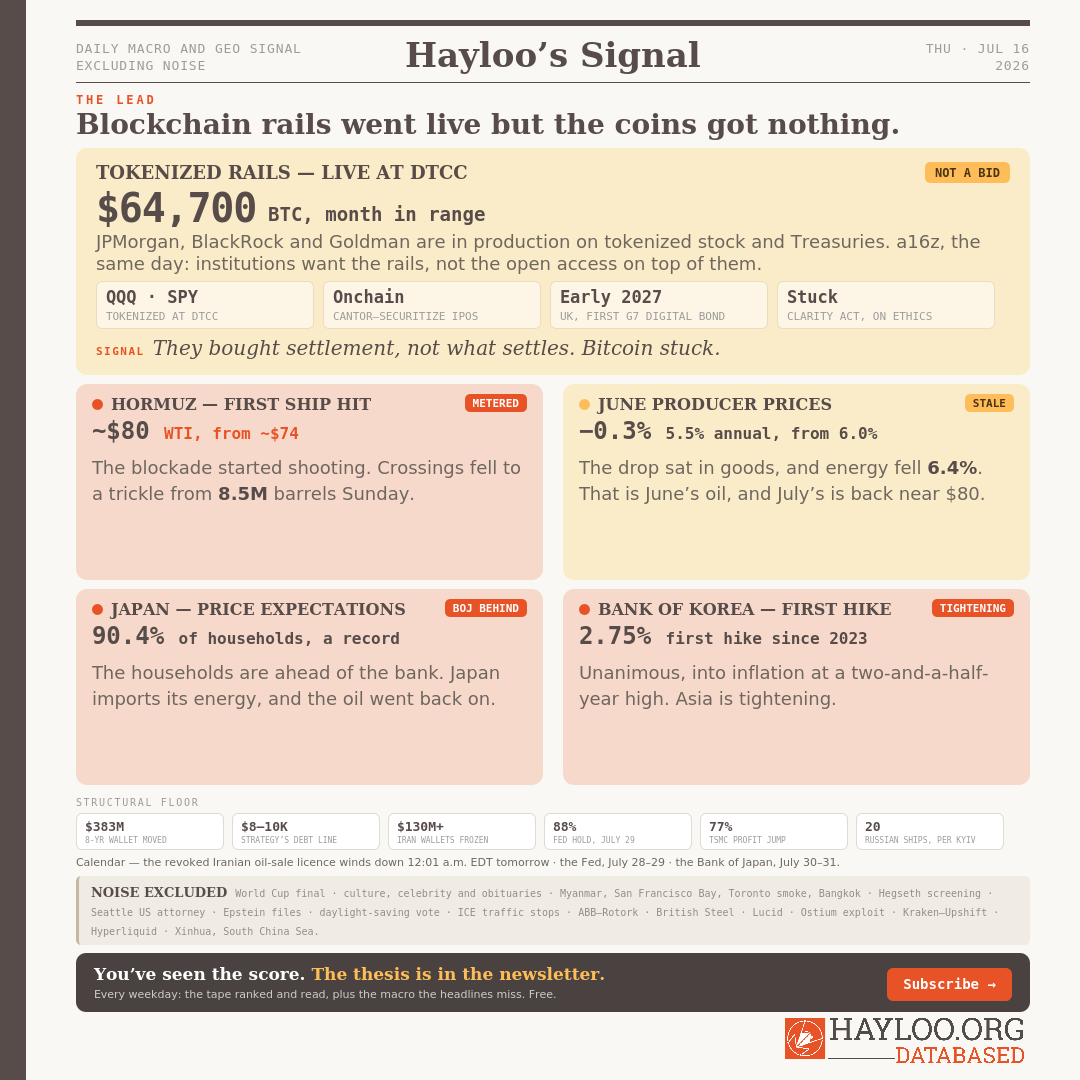
The venture firm a16z published a piece on July 15 arguing that institutions are taking the parts of blockchain that cut costs and speed settlement while discarding the open-access and trustless features that define decentralized finance. It landed the same day DTCC put its first tokenized stock and Treasury trades into live production with JPMorgan, BlackRock and Goldman. The bill that would make it easier for institutions to touch open blockchain systems is still stuck in the Senate.
June’s producer prices fell because oil fell in June, and the index only says so a month later. The disinflation now in the price was built on an input that has already reversed, and oil settled this week at one-month highs. US Central Command struck Iran for a fifth straight day and disabled a sanctioned oil supertanker deep inside the Persian Gulf. The Strait of Hormuz is still nominally open and running on Iran’s terms, with crossings down to a trickle. Iran said it hit military bases in Kuwait and Jordan, and the US Treasury froze more than $130 million in Iran-linked crypto wallets.
#1 — a16z said institutions are adopting blockchain and discarding the features
The venture firm a16z crypto published a piece on July 15 arguing that institutions are selectively adopting the parts of blockchain infrastructure that cut costs, improve settlement and expand distribution while discarding the open-access, pseudonymous and trustless features that define native DeFi. The authors described an emerging category they called “programmable financial infrastructure,” meaning blockchain rails built for institutional compliance and control instead of permissionless finance, and cited JPMorgan’s permissioned deposit chain, tokenized money-market funds at BlackRock and Franklin Templeton, and Circle’s Arc as examples.
The same day, DTCC began its first tokenized stock and Treasury production trades involving JPMorgan, BlackRock and Goldman. JPMorgan is tokenizing part of its Invesco QQQ Trust holdings held at DTCC, and Microsoft, Circle and SPY shares are being tokenized as well. Cantor Fitzgerald and Securitize announced a partnership to support blockchain-based IPOs and secondary offerings, creating a pathway for public companies to raise capital onchain and issue tokenized securities. The UK said it plans the first G7 digital sovereign bond by early 2027, launching on HSBC’s Orion platform inside the Bank of England and FCA’s Digital Securities Sandbox to test faster and cheaper settlement.
The a16z authors framed the CLARITY Act as something that could eventually make it easier for institutions to touch permissionless systems, while arguing that their risk posture will not reset overnight. The most contentious piece of that bill is unresolved with a few weeks of Senate runway left. If risk posture is the binding constraint, the bill unlocks a door institutions are not trying to walk through, and the rails did not wait for it. What this money buys is settlement, and none of it is a bid for the coins that settle on it. Bitcoin has spent the month in a range while all of this shipped.
#2 — US forces disabled a sanctioned oil supertanker deep inside the Persian Gulf
Bloomberg reported that US forces hit a sanctioned oil supertanker deep within the Persian Gulf near Iran’s main export terminal, the first strike on a vessel since Washington reimposed its naval blockade on July 14. The Associated Press reported that American forces fired on a ship the US accused of trying to break the blockade. US Central Command carried out another wave of strikes on Iran overnight. Iran said it targeted military bases in Kuwait and Jordan in response, and sirens sounded in Bahrain and Kuwait. Iran warned that the Strait of Hormuz is an inviolable red line and said it would strike all infrastructure across the Gulf if the US carried out its threat to attack Iran’s own.
US Treasury Secretary Scott Bessent said the Office of Foreign Assets Control had sanctioned multiple Iran-linked crypto wallets and frozen more than $130 million. WTI and Brent settled at one-month highs and the US Energy Department put Sunday’s flow through the strait at 8.5 million barrels, and by July 16 ship-tracking firms reported crossings had fallen to a trickle. IEA Executive Director Fatih Birol warned that the global economy faces a renewed challenge if the crisis is not resolved within weeks.
#3 — US producer prices fell seasonally
The Bureau of Labor Statistics reported on July 15 that the producer price index for final demand fell 0.3% in June, seasonally adjusted, against a consensus of no change and after a downwardly revised 0.6% rise in May.
On an annual basis producer prices rose 5.5%, down from a revised 6.0% and below the 6.2% consensus, the first annual easing in five months. Core producer prices, which strip out food and energy, rose 0.2% on the month against a 0.3% forecast, and the annual core rate eased to 4.7% from 4.9% against a 5.2% forecast.
The entire monthly decline sat in goods, which fell 1.4%. Energy fell 6.4% and gasoline fell 12.0%, with diesel, jet fuel and crude petroleum also lower.
Final-demand services rose 0.2% after falling 0.1% in May, with more than 60% of the advance traced to trade margins, which rose 0.4%. Pipeline pressure fell alongside it, with processed goods for intermediate demand down 1.2% and unprocessed goods down 4.1%.
The print landed a day after June consumer prices fell 0.4% on the month, the biggest monthly drop since April 2020, taking the annual rate to 3.5% from 4.2%, with core CPI flat on the month and 2.6% higher on the year. CME futures put the odds of the Fed holding its target range at 3.50% to 3.75% on July 29 near 88%.
June’s producer prices are June’s oil price arriving a month late, and that oil price is already gone. The curve already has a full hike back by December.
#4 — +90% of Japanese expecting higher prices
The Bank of Japan’s quarterly opinion survey showed 90.4% of households expect prices to rise a year from now. The survey followed a separate poll showing corporate inflation expectations at record levels. Bank of Japan Executive Director Koji Nakamura told parliament on July 16 that when upside price risks are as high as they are now, delaying necessary adjustments to the degree of monetary support could bring those risks about and weigh on the economy. The bank raised its policy rate to a 31-year high of 1% in June against a 2% inflation target, and its next meeting is on July 30 and 31, with sources telling Reuters it is set to hold this month while staying guarded against inflation risk.
Former Bank of Japan board member Seiji Adachi told Reuters he expects a further increase to 1.25% at some point between October and January, on the view that rising import prices will reach consumer inflation around autumn to winter.
#5 — The Bank of Korea raised rates for the first time in three and a half years
The Bank of Korea raised its seven-day repurchase rate by a quarter point to 2.75% on July 16 in a unanimous vote, its first increase since January 2023 and the start of a new tightening cycle after four cuts since late 2024. Governor Shin Hyun-song said the bank must act decisively against inflation running at a two-and-a-half-year high of 3.2% in June, named second-quarter GDP and July inflation as the indicators to watch, and flagged more hikes without guiding on timing. The bank said growth would considerably exceed its May forecast of 2.6% on a semiconductor boom, with the government projecting 3.0%, and that inflation would stay high for a considerable time. A majority of analysts see at least one more hike, to 3.00%, this year. The move aligns Korea with the Bank of Japan and with Australia, New Zealand, Indonesia and the Philippines, all of which have tightened. The won strengthened toward 1,485 per dollar from a 17-year low near 1,561 in early June.
#6 — Strategy’s chief executive put the level that would raise debt concerns at $8,000 to $10,000
Strategy chief executive Phong Le said the company would begin considering risks tied to its debt only if Bitcoin fell to around $8,000 to $10,000, and that Strategy is not going anywhere as a Bitcoin buyer, per The Block and CoinDesk.
The comments follow the company’s first substantial Bitcoin sale, about 3,588 coins for roughly $216 million in late June and early July, which took its holdings to 843,775 BTC at a $74,476 average. That sale worked out below the average cost Strategy carries on what is left, which is what raising dollars under pressure looks like.
Le is answering the solvency question, and the sale already answered the supply one. Whether it sells again is the thing to watch.
OPERATIONAL/STRUCTURAL FLOOR
Ukraine–Russia energy war. Ukrainian drone and rocket strikes killed and injured people across at least three Russian regions overnight and Kyiv said it hit 20 Russian vessels in the Black Sea, while Russian missiles struck Kyiv. The EU and Ukraine signed a drone-production deal, and Kyiv named an energy-company chief as prime minister ahead of winter.
Calendar. The Treasury’s revoked Iranian oil-sale licence winds down at 12:01 a.m. EDT on July 17.
NOISE EXCLUDED TODAY
FIFA World Cup – Argentina’s comeback over England to reach the final against Spain, the Falklands-banner controversy, Yamal colour.
Culture, celebrity and obituaries – Japanese Nobel laureate Susumu Tonegawa’s death, a Cold War bunker turned “doomsday” condos, a new DRC monkey species.
Disasters and accidents – More than 500 feared dead off Myanmar, the San Francisco Bay boat capsizing, Toronto wildfire smoke, the Bangkok bar fire toll, an Indian town’s extreme heat.
US domestic and legal items – Hegseth’s military testosterone screening, Trump firing the newly appointed Seattle US attorney, the Blanche and intelligence-chief confirmation hearings, ICE traffic-stop policy, the Epstein-files disputes, the daylight-saving vote.
Single-company and sector colour – ABB’s $5.5 billion bid for Rotork, British Steel nationalisation, Lucid bankruptcy rumours, the Ostium $18 million exploit, Kraken–Upshift vaults, Hyperliquid treasury bond deals, a California darknet-fentanyl crypto case. Xinhua CPC-governance and South China Sea items.