


TOP-OF-STACK SUMMARY
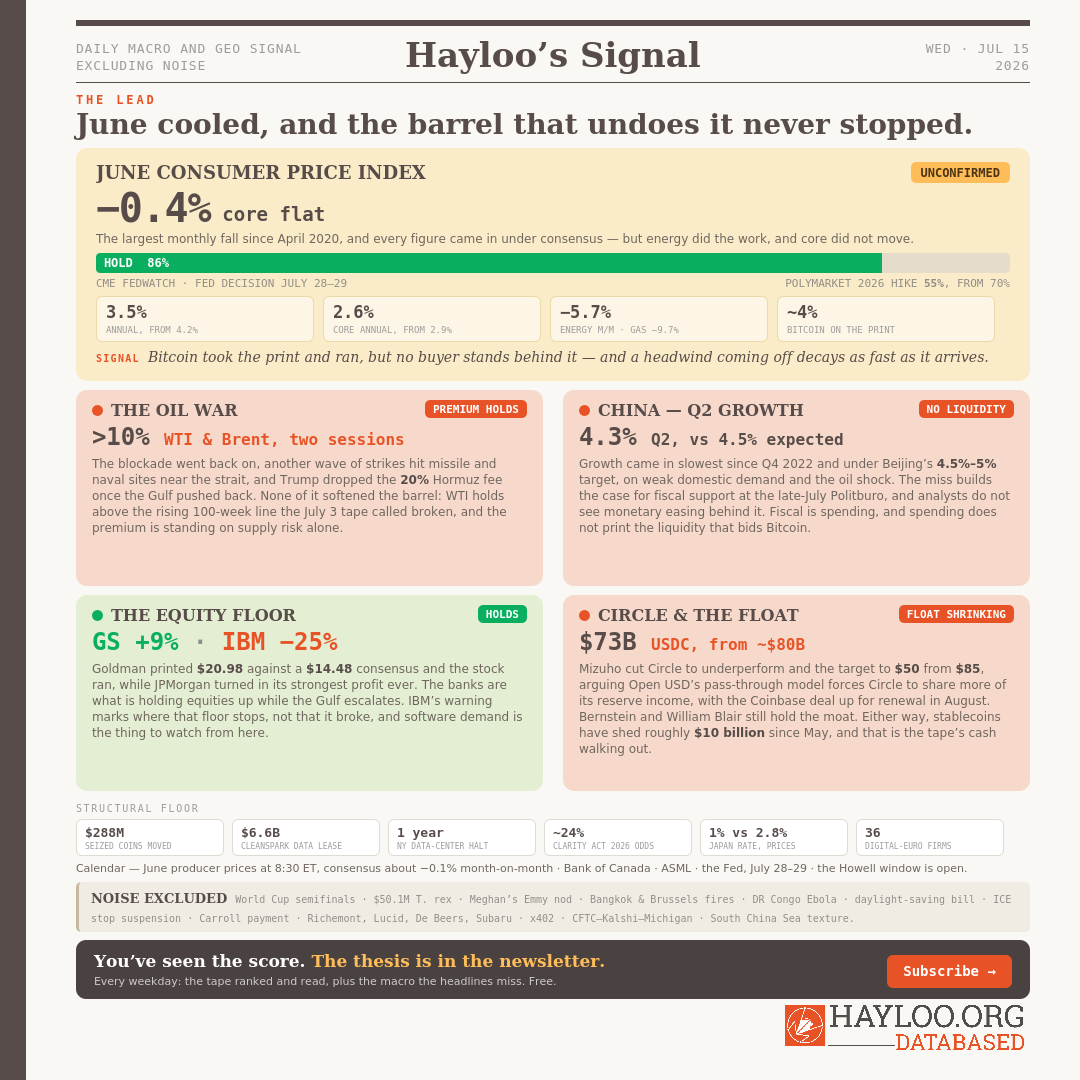
June CPI fell 0.4% month-on-month, the largest drop since April 2020, with the annual rate slowing to 3.5% from 4.2% and core flat at 2.6%. That gutted the near-term Fed rate-hike trade that had weighed on risk assets all week: Bitcoin rallied about 4% on the print, equities and Treasuries firmed, and the dollar softened. The disinflation that cooled June is already contradicted by the energy the CPI has not yet captured. The oil war ran the other way underneath it: the US reimposed its Iran blockade and struck again overnight, President Donald Trump dropped the 20% Hormuz fee, and WTI held above its rising 100-week average.
#1 — June CPI fell 0.4% on the month, the largest decline since April 2020
The Bureau of Labor Statistics said the consumer price index fell a seasonally adjusted 0.4% in June, the largest monthly decline since April 2020. The annual rate came down to 3.5% from 4.2% in May. Core CPI, excluding food and energy, was unchanged on the month, leaving the annual core rate at 2.6% from 2.9%. Every figure came in below the Dow Jones consensus. However, both annual rates remain above the Fed’s 2% target, which it has not hit in five years.
The energy index fell 5.7%, its biggest monthly drop since April 2020, with gasoline down 9.7%. The BLS said energy was the largest contributor to the all-items decline, more than offsetting gains in shelter and food. Shelter rose 0.1%, its smallest monthly gain since early 2021.
Federal Reserve Chairman Kevin Warsh responded: “There might be some that look at this morning’s data and say, ‘Oh, mission accomplished, everything is swell.’ That is not my view.” Money markets moved to price a Fed hold on July 28–29 at about 86% on the CME FedWatch tool. Polymarket odds of any 2026 hike fell to about 55% from 70%. Bitcoin climbed from about $62,900 before the report toward $65,000 within the session. Equities and Treasuries firmed and the dollar eased. Oxford Economics said May may prove to be this year’s peak inflation reading, and noted that the June relief predates the renewed oil rise now working through the pipeline.
Bitcoin took the CPI and ran. Nothing in the print puts a buyer on the other side, and a buyer is the only thing that would hold the move. What lifted it was a rate-sensitive asset losing a headwind, and that decays as fast as it arrives.
#2 — The US reimposed its naval blockade of Iranian ports
The US reimposed its naval blockade of Iranian ports at 4 p.m. Eastern. US Central Command said it carried out another wave of strikes against Iran late Tuesday, hitting missile and drone facilities, naval assets, and coastal defenses near the Strait of Hormuz.
Trump abandoned his demand that ships pay a 20% fee on cargo transiting the strait after Gulf allies urged him to drop it. He told Fox News the US will keep striking Iran and may hit power plants and bridges next week unless Tehran negotiates. Iran’s Islamic Revolutionary Guard Corps threatened to close “all other export corridors that benefit the U.S. and its allies.” Tehran attacked Jordan, which said it shot down three missiles, following earlier strikes on US forces in Kuwait and Bahrain.
WTI and Brent gained more than 10% over the prior two sessions. The US Energy Department said 8.5 million barrels transited Hormuz on Sunday despite the fighting, though ship-tracking firms reported crossings falling to a trickle. Western fuel markets hit record tightness.
Oil held its gains through a soft CPI day. That premium is standing on supply risk alone, and a disinflation print has nothing to say to it. The strait is the only variable that prices this barrel now.
#3 — Mizuho downgraded Circle
Mizuho downgraded Circle to underperform from neutral and cut its price target to $50 from $85. It cited competition from Open USD, the consortium-backed stablecoin launched June 30 by more than 140 companies including Visa, Mastercard, and Coinbase. Open USD’s pass-through model charges a small operating fee and distributes most reserve income to issuers and distributors. Mizuho said that could force Circle to share more of its own reserve income and compress margins, and flagged that Circle’s revenue-sharing agreement with Coinbase, its largest distribution partner, comes up for renewal in August.
JPMorgan lowered earnings estimates for both Circle and Coinbase the same day. It pointed to Circle’s revised USDC arrangement with the Hyperliquid exchange, under which Coinbase collects reserve income on Hyperliquid’s roughly $6 billion of USDC and returns about 90% of the yield to the venue. JPMorgan called the structure a “prisoner’s dilemma” that pushes Circle and Coinbase to compete for distribution at the expense of each other’s economics.
USDC circulating supply has fallen to about $73 billion from nearly $80 billion in March, part of a roughly $10 billion contraction in the total stablecoin market since May. Bernstein and William Blair remain bullish, arguing Circle’s network effects and regulatory lead preserve its moat.
#4 — China’s Q2 GDP grew, below Beijing’s annual target
China’s National Bureau of Statistics said the Chinese economy grew 4.3% year-on-year in the second quarter, below Beijing’s 4.5%–5% annual target and the slowest pace since the fourth quarter of 2022. Weak domestic demand and the oil shock tied to the Iran war outweighed stronger production and exports.
Factory output rose 5.3% in June on AI-related export demand, and retail sales rose 1.0% after a 0.6% May decline. Fixed-asset investment fell 5.7% in the first half and property investment fell 18%. China cut monthly crude imports to near decade lows, down 41.3% year-on-year. Imports overall rose 36% to a five-year high, and the June trade surplus widened to $125.62 billion.
Analysts said the miss strengthens the case for fiscal support at the late-July Politburo meeting, and expect Beijing to favor fiscal measures over aggressive monetary easing.
Fiscal support is spending, and spending does not print the liquidity that bids gold or Bitcoin. A monetary response would, and analysts do not see one coming out of the late-July meeting.
#5 — Ukraine said it struck Russian oil and gas tankers in the Black Sea overnight
Ukrainian forces hit multiple Russian vessels in the Black Sea overnight, Kyiv said, expanding the scope of its naval attacks against Moscow. A Russian attack on the Black Sea port city of Odesa killed three.
Ukraine’s Special Operations Forces said their “Birds” drone unit had targeted 116 vessels in the Sea of Azov over the past nine days. Russia said it is preparing to reroute grain and oil exports away from the Azov, a route that handles about a quarter of its grain exports. Russia is struggling to sell all the oil it is exporting, and the volume of Moscow’s crude at sea is back near the year’s highs. A revised US Russia-sanctions bill backed by Trump would use tariffs to pressure China and India, the top buyers of Russian crude, to cut their dependence.
#6 — Goldman Sachs, JPMorgan Chase, Bank of America and Wells Fargo all beat second-quarter estimates
Goldman Sachs reported earnings of $20.98 per share against a $14.48 consensus, on revenue of $20.34 billion against $16.13 billion expected. The stock rose about 9%. JPMorgan Chase reported its strongest profit ever, and Bank of America and Wells Fargo also beat. JPMorgan and Wells Fargo shares fell about 2% on the results.
IBM fell about 25% after warning that second-quarter profit will come in below expectations on soft demand in its software and infrastructure businesses.
The banks are what’s holding equities up while the Gulf escalates. That floor only reaches as far as the banks, and IBM just showed where it stops. Software demand is the thing to watch next.
#7 — New York imposed a one-year moratorium on new large data centers, the first statewide halt in the US
The state cited concerns that the facilities driving the AI boom are raising power costs and straining water supplies and the grid. CleanSpark signed a 20-year, $6.6 billion data-center lease with an unnamed global tech firm the same week. Australia proposed an AI framework requiring large data-center operators to underwrite new power supplies.
OPERATIONAL/STRUCTURAL FLOOR
Transatlantic digital-money rulemaking. A US–UK taskforce unveiled a digital-asset roadmap to align stablecoin and tokenized-finance rules across the world’s two largest financial markets. The ECB tapped 36 payment providers including Deutsche Bank and Revolut for a yearlong digital-euro pilot beginning in late 2027.
Clarity Act stalls. Some Senate Democrats came out against the crypto market-structure bill, calling it “corrupt” over stablecoin and illicit-finance provisions. US banking groups urged the Senate to strengthen stablecoin safeguards against deposit flight. Polymarket odds of 2026 passage sit near 24%.
Ark Invest positioning. Ark Invest bought $14 million of Circle and $1.5 million of Block while selling $3.2 million of Robinhood.
US seized-coin movement. The US government moved over $288 million of seized bitcoin and ether to Coinbase Prime, per Arkham, despite the standing no-sell reserve order.
BoJ tightness. A Kyodo opinion piece flagged Japan’s policy rate holding at 1% against 2.8% projected fiscal-2026 inflation.
Calendar. Wednesday: June PPI at 8:30 ET (consensus about −0.1% month-on-month), the Bank of Canada rate decision, ASML earnings.
NOISE EXCLUDED TODAY
FIFA World Cup semifinals – Spain past France, England-Argentina, referee and player color.
Culture and celebrity – a T. rex skeleton selling for $50.1 million, Meghan’s Daytime Emmy nomination, the “Miracle on the Hudson” pilot’s Alzheimer’s disclosure, a Tom Cruise promotional tour.
Disasters and accidents – the Bangkok pub fire death toll, Brussels tower fire, an American marine biologist shot in the Philippines, DR Congo Ebola, a Ryanair depressurization.
US domestic and legal items – the daylight-saving-time House bill, ICE vehicle-stop suspension and related shootings, the Trump–E. Jean Carroll payment, Warren’s SVB-review probe, Musk’s Wisconsin voter-payout finding, the Writers Guild suit against the Paramount–Warner deal.
Single-company and sector color below threshold – Richemont jewellery sales, Lucid’s restructuring adviser, De Beers halting a South African mine, Subaru’s recall, a Bloomberg Singapore defamation ruling.
Crypto-industry color below threshold – The x402 agent-payments standard, EthSystems’ spin-out, the CFTC–Kalshi–Michigan clash, Galaxy’s GOFR product, Nous Research’s raise, Tether’s Pact Labs and Velocity rounds, RLUSD and JCB explainers, the LASD-deputy sentencing.
South China Sea and Taiwan Strait diplomatic texture, and Xinhua CPC-governance items.