


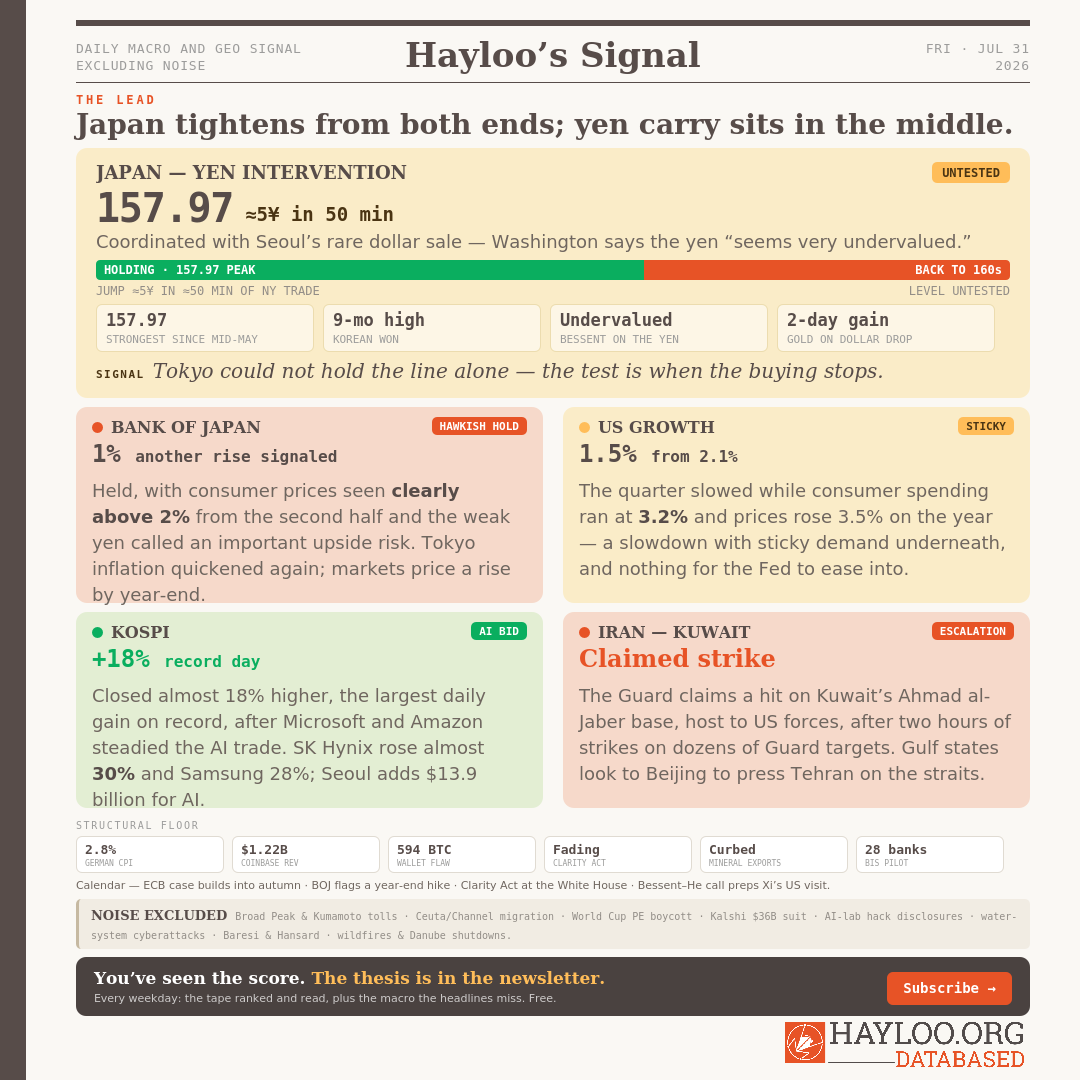
Signal is Hayloo’s newsreader, customized to the portfolio Hayloo scores, weighing every macro, geo, and on-chain headline against the risk in Hayloo’s portfolio and Hayloo’s market positioning. Signal respects Hayloo enough to stay quiet until the day’s noise becomes signal. To customize your own newsreader, go to hayloo.org.
TOP-OF-STACK SUMMARY
Japanese authorities stepped into the currency market on Thursday to buy the yen, a government source said, and the currency jumped nearly five yen in about fifty minutes to 157.97 per dollar before easing back toward 160. South Korea sold dollars the same day in what market sources called a coordinated move, and US Treasury Secretary Scott Bessent said the yen seems very undervalued. The Bank of Japan held its rate at 1% on Friday, said it expects consumer prices to run clearly above 2% from the second half of the fiscal year, and signaled another rise this year.
The US economy grew at a 1.5% annual rate in the second quarter, down from 2.1%, while consumer spending ran at a 3.2% pace and prices rose 3.5% in the year to June. Federal Reserve Chair Kevin Warsh suggested the central bank could change how it assesses inflation, mortgage rates hit a one-year high, and a record set of hedges against a rate rise unwound after Wednesday’s hold.
South Korea’s Kospi closed almost 18% higher on Friday, a record daily gain, after earnings from Microsoft and Amazon steadied the AI trade. Iran’s Revolutionary Guard claimed a strike on a US air base in Kuwait, and China’s factory activity contracted for the first time in five months. Bitcoin held near $64,000 through all of it.
#1 — Japan intervened on Thursday to pull the yen off four-decade lows
Japanese authorities intervened in the foreign exchange market on Thursday to buy the yen and sell the dollar, a government source told Kyodo, after the currency had slumped to four-decade lows. The yen surged nearly five yen in about fifty minutes of overnight New York trading to 157.97 per dollar, its strongest since mid-May, and the dollar rebounded to the lower 160-yen range in Tokyo early Friday.
Analysts said the move bore the hallmarks of official intervention, and market sources told Reuters the New York buying was coordinated with South Korea, whose authorities conducted a rare dollar-selling intervention of their own on Thursday that sent the won to a nine-month high.
US Treasury Secretary Bessent said the yen “seems very undervalued,” that market players will realize the currency “should strengthen,” and that excessive volatility in the yen “isn’t healthy.”
Japan’s top currency diplomat, Atsushi Mimura, declined to confirm a market foray but said authorities “are gaining U.S. assistance beyond psychological support.” Gold held a two-day gain as the intervention knocked the dollar sharply lower on Thursday.
#2 — The Bank of Japan held at 1% while signaling another rate rise this year
The Bank of Japan kept its benchmark rate at about 1% on Friday after a two-day meeting, having raised it in June to the highest since 1995, and signaled that more tightening is likely. Governor Kazuo Ueda vowed a further hike while conditions remain accommodative, and the bank’s quarterly outlook said consumer prices should accelerate to clearly above 2% from the second half of fiscal 2026 on wage pass-through, high crude prices and the weak yen, which supports market views of another rise by year-end.
Ueda said the yen’s depreciation is “likely to lead to an increase in prices, mainly of durable goods,” called the currency’s weakness an “important” factor in assessing upside risks to inflation, and said the bank will “meticulously monitor” its effects. The bank also revised up its economic outlook for the current fiscal year.
A central bank raising its inflation call while the government props up its currency is tightening from both ends at once, and the carry trades funded in yen sit in the middle.
#3 — US growth slowed to a 1.5% rate in the second quarter
The Commerce Department said on Thursday that the economy grew at a 1.5% annual rate in the second quarter, down from 2.1% in the first three months of the year. The Associated Press tied the slowdown to rising imports, and lower government spending, investment and exports offset a jump in consumer spending.
Consumer spending, which accounts for more than two-thirds of US activity, grew at a 3.2% rate after a 0.5% pace earlier in the year, with Americans still buying motor vehicles, particularly light trucks, along with furniture and prescription drugs, while prices rose 3.5% in the year to June.
Michael Pearce, chief US economist at Oxford Economics, said the headline underplayed the economy’s strength and suggested growth would return above 2% later this year, adding that “surging AI-related investment is still the biggest game in town.”
Reuters framed the print the same way, pointing to accelerating consumer spending and robust business investment in AI-related equipment as signs of underlying strength. A miss on the headline with spending and prices both running hot is a slowdown with sticky demand underneath it, which leaves the Fed nothing to ease into.
#4 — South Korea’s Kospi closed almost 18% higher in a record rebound
South Korea’s Kospi closed almost 18% higher on Friday, its largest daily gain on record, partly reversing a three-day rout that wiped hundreds of billions of dollars off the country’s stock market. CoinDesk put the day’s surge at 17%. SK Hynix rose almost 30% and Samsung Electronics 28%, after earnings updates from US technology giants Amazon and Microsoft lifted optimism about the money being poured into artificial intelligence.
Microsoft rose 9.8% on Thursday on its cloud results, and semiconductor names including Micron and Nvidia rallied with it, lifting US futures. Asian markets rallied broadly with Wall Street on Friday, stirring hopes that the selloff in AI-linked assets may be running out of steam.
South Korea separately plans to inject 20 trillion won, about $13.9 billion, into its sovereign wealth fund for investments in AI, data centers and infrastructure, expanding its mandate to domestic assets for the first time after the rout.
#5 — Iran’s Revolutionary Guard claimed a strike on a US air base in Kuwait
Iran’s Revolutionary Guard claimed a “retaliatory attack” on Kuwait on Friday, and Iranian state media said the army struck Kuwait’s Ahmad al-Jaber Air Base, which hosts American forces. The claim followed the heavy wave of US strikes on Iran this week, which US Central Command said on Thursday hit dozens of Revolutionary Guard targets over two hours.
Gulf Arab states are looking to China to use its economic leverage over Iran to reopen the Strait of Hormuz and the Red Sea, Reuters reported on Thursday, testing how far Beijing is able and willing to pressure Tehran.
Petrobras is producing above the designed capacity of its offshore platforms at Buzios and other deep-water fields, pushing Brazil’s output to a record high as the war squeezes global supply, Bloomberg reported on Thursday.
#6 — Warsh suggested the Fed could change how it assesses inflation
Tucked into Warsh’s press conference on Wednesday was a suggestion that the central bank could shift its approach to assessing inflation, Bloomberg reported on Thursday, a remark sowing angst among some investors.
The average long-term US mortgage rate rose for a fourth consecutive week to 6.66% from 6.58%, its highest level in a year, the Associated Press reported on Thursday, as home prices soar. The 10-year Treasury yield stood at 4.66% at midday Thursday, up from 3.97% in late February before the war began, with crude driven higher by the fighting feeding expectations of hotter inflation.
A record raft of wagers placed to hedge the possibility of a rate rise at this week’s meeting unraveled on Thursday after the hold. Reframing the inflation yardstick mid-cycle adds a premium at the long end without any change to the policy rate, and the mortgage market is where that premium lands first.
#7 — Strategy posted an $8.2 billion second-quarter loss on bitcoin’s decline
Strategy, the largest corporate holder of bitcoin, posted an $8.2 billion second-quarter loss on the decline in the coin’s price, The Block and CoinDesk reported on Thursday, with bitcoin ending the quarter more than 40% below its level a year earlier. The company’s holdings rose 11% during the quarter. It said it has built a cash reserve covering more than two years of dividend payments, after investors questioned its growing stack of preferred securities. Bloomberg reported that Executive Chairman Michael Saylor has investors wondering what comes next, after a sweeping overhaul of the financing model behind the company’s bitcoin buying roiled crypto markets.
#8 — China’s factory activity contracted for the first time in five months
China’s factory activity unexpectedly contracted in July, an official survey showed on Friday, the first slump in five months. Reuters said the reading adds to concern that growth is losing steam amid persistently weak demand and elevated production costs.
---
#9 — Wintermute said institutions now account for a record 72% of crypto trading
Institutions now account for a record 72% of crypto trading, the market maker Wintermute said in a report on Thursday, driving lower volatility, selective altcoin flows and growth in tokenized assets. Bitcoin’s daily price swings have tightened to their narrowest since January.
OPERATIONAL/STRUCTURAL FLOOR
- French and German inflation accelerated on the war’s energy channel. French inflation unexpectedly quickened in July on services and energy, supporting the case for another European Central Bank rate rise, and German inflation rose to 2.8% on higher energy prices while core eased slightly.
- The Bank of England’s governor flagged youth unemployment. Governor Andrew Bailey warned on Thursday that Britain’s static labor market is behind the surge in youth joblessness, and UK house prices edged higher in July despite war-linked borrowing costs.
- Milei moved to bar Argentina’s central bank from financing the state. Argentine President Javier Milei presented a bill in a national television address on Thursday to reform the bank’s charter and prohibit it from financing government spending.
- Trump signed export curbs to retain critical minerals. The Thursday order gives officials authority under the Defense Production Act to restrict exports of some industrial waste to keep critical minerals and rare elements in the country.
- The Swiss National Bank posted a 25.17 billion-franc first-half profit. The gain came mainly from its foreign-currency holdings, while its gold reserves weighed on the result.
- Coinbase’s revenue fell for a third straight quarter. The exchange reported $1.22 billion in revenue on Thursday, down from $1.5 billion a year earlier, its shares fell 5%, and 88% of net revenue now comes from sources other than bitcoin spot trading.
- The crypto bill’s revised ethics language went to the White House. Senators Thom Tillis and Ruben Gallego sent the compromise on Thursday, and JPMorgan analysts said the Clarity Act’s fading odds of passing the Senate this year weigh on the crypto outlook.
- A hardware-wallet flaw drained 594 bitcoin. A randomness bug turned supposedly unguessable seeds into guessable ones in a 25-minute sweep worth about $38 million, and Coinkite warned Coldcard Mk3 users to move funds.
- Twenty-eight banks tested tokenized money for cross-border payments. JPMorgan, Citi and UBS were among those moving real money in a $1 million Bank for International Settlements pilot of blockchain-based settlement.
NOISE EXCLUDED TODAY
The Nirmal Purja and Broad Peak avalanche and the Kumamoto earthquake death toll reaching 34; the migrant surge of roughly 49,000 into Ceuta and the Channel and Libya migration items; the FIFA and UEFA World Cup private-equity boycott coverage; New York’s $36 billion suit against Kalshi and the Telegram-Australia and BitRiver-Luno items; the Anthropic and OpenAI disclosures on hacked firms and the US-China AI-distillation flashpoint; Amazon’s Zoox robotaxi approval, Sony’s and Kioxia’s earnings; the US water-system cyberattacks possibly tied to Iran; the deaths of Franco Baresi and Glen Hansard, the Yung Filly verdict and the Tony Romo arrest; the European wildfires and the Clooney evacuation, the Danube nuclear shutdowns and Kenya’s elephant deaths.
On our use of AI:
Measuring AI to value writing is like rating a restaurant by whether the chef used a food processor.
Humans have written machine-assisted for centuries. What never changes is who decides.
Nothing at Hayloo INC. was ever decided by a machine.
There’s no meter, no word count, no hour count, no token that tells you how much of us is in our work. We use AI, we run scripts, we process data, we ask questions, and we debate what the machine contributes.
What survives is what we defended as a team.
When it’s wrong, it’s wrong because us, the humans, signed it.
Jordi Federer, Founder, Hayloo INC.