


TOP-OF-STACK SUMMARY
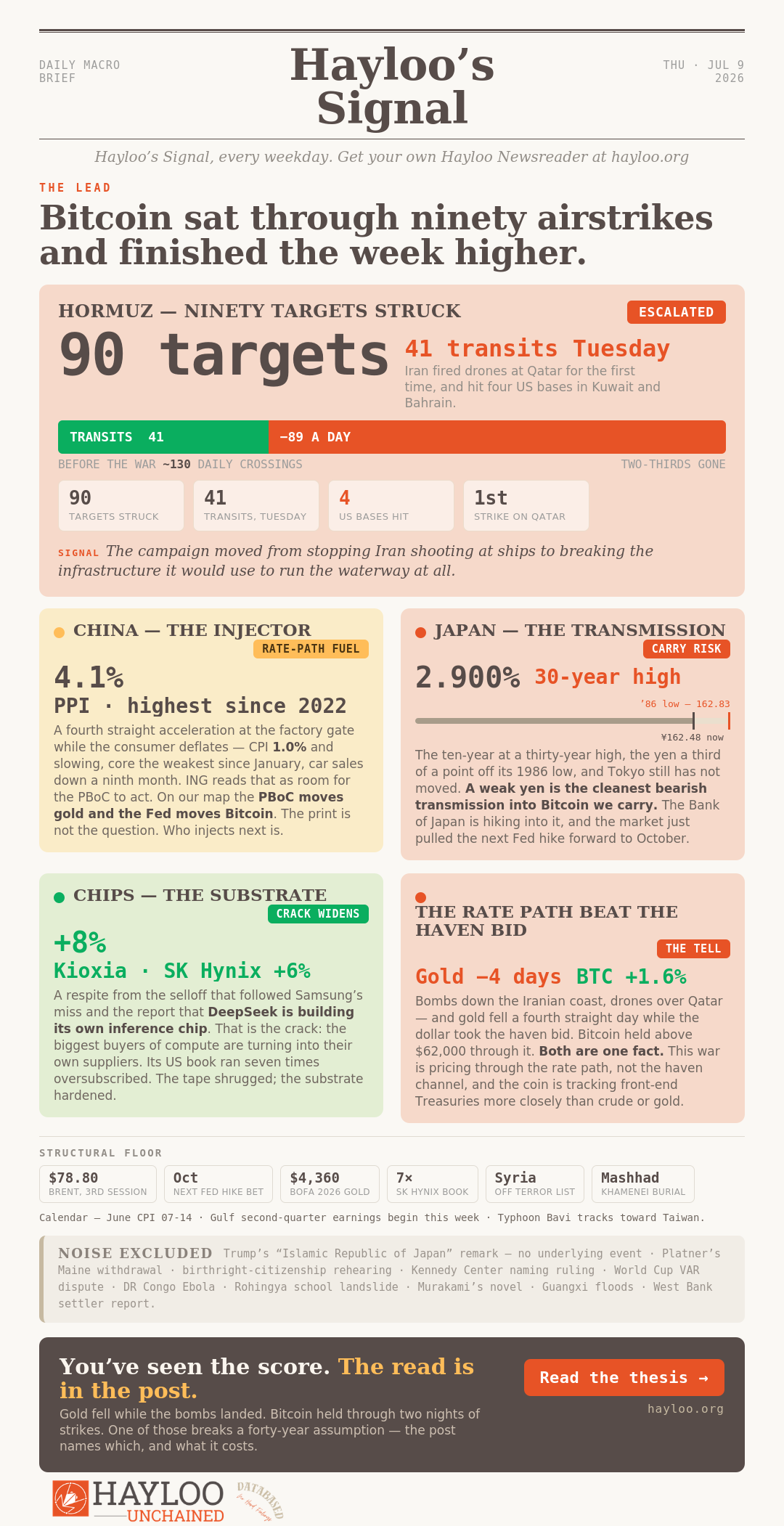
US Central Command said it struck roughly 90 targets along Iran’s coastline overnight to further degrade Tehran’s ability to threaten navigation through the Strait of Hormuz.
Iran fired drones at Qatar for the first time alongside missiles and drones at four US bases in Kuwait and Bahrain.
Japan’s 10-year yield hit 2.900%, a 30-year high, as the global bond selloff extended into Asia. Gold fell a fourth straight day while the dollar took the haven bid.
Bitcoin held above $62,000 and finished the week higher through two nights of bombing, with Oil rising a third straight session above a rising hundred-week average and Goldman warning the flare-up delays the Middle East supply recovery.
RANKED ITEMS
#1 — US said it further degraded Iran’s ability to threaten navigation through the Strait of Hormuz
The U.S. campaign in Iran has moved from suppressing Iran’s ability to shoot at ships in the Strait of Hormuz to breaking the infrastructure Iran would use to run the waterway at all.
The U.S. on Thursday reported hitting some 90 targets across Iran, while Iran’s Revolutionary Guards said they struck “key infrastructure and facilities” at US bases in Kuwait and Bahrain with missiles and drones.
Iran also launched drones toward a site in Qatar, the first time it has fired on the state mediating the talks.
Qatari Prime Minister Sheikh Mohammed bin Abdulrahman al-Thani condemned the attack and told Iranian Foreign Minister Abbas Araqchi by phone on Thursday that Washington and Tehran should commit to diplomacy. Iranian Deputy Foreign Minister Kazem Gharibabadi wrote on X that Trump’s remarks “are not a sign of power but an admission of the failure” of US policy. Trump posted videos of what he said were explosions in Iran after leaving the NATO summit, and Netanyahu criticised his willingness to sell Turkey F-35 fighter jets, saying it would “destroy” the regional balance of power.
#2 — Japan’s benchmark 10-year government bond yield highest since November 1996
The yield on Japan’s 10-year government bond briefly touched 2.900 percent on Thursday afternoon, a 30-year high, per Kyodo. Reuters reported that rising oil prices rekindled inflation concerns while investors remained wary of Japan’s fiscal health. Demand at Japan’s five-year bond sale on Thursday was broadly in line with recent auctions, Bloomberg reported, showing that elevated yields are attracting some buyers. A former Bank of Japan official told Bloomberg the bank may pick up the pace of its rate hikes late this year and eventually push the benchmark above 2%; the BOJ raised its policy rate to around 1.0% on June 16. The dollar bought 162.48 yen on Wednesday, sitting near the 1986 low of 162.83, with Tokyo yet to intervene. CoinDesk reported that money markets moved their bet on the next Federal Reserve increase to October from December.
#3 — Oil rose for a third straight session
Brent crude climbed to $78.80 a barrel on Thursday, a third consecutive session of gains. Goldman Sachs said a recovery in Middle Eastern oil supplies could be set back if the renewed tensions disrupt shipping through the strait. Bloomberg reported that Saudi Arabia’s attempts to revive flows from its reopened Ras Tanura terminal are running into caution from customers reluctant to load because of renewed threats to shipping.
Reuters reported that Asian equity gains were capped by the oil surge, which reignited inflation fears and hammered bonds. Maritime intelligence platform Kpler counted 41 verified transits through the strait on Tuesday against roughly 130 daily crossings before the war. Reuters said Gulf companies begin reporting second-quarter earnings this week, giving the clearest read so far on the war’s regional financial impact.
#4 — Gold fell while the dollar took the haven bid
Gold fell for a fourth straight day. It closed Wednesday down 0.9% after the Fed minutes. Reuters reported that the US strikes on Iran pushed both oil and the dollar higher, and that traders took the oil move as a reason the Fed may hold rates up for longer — which hurts gold, because gold pays no interest. The dollar held its highest level of the week against most major currencies. Silver fell 2.42% to $58.5681 on Wednesday and slipped again Thursday. Platinum and palladium also fell. Bank of America cut its forecast for average gold prices in 2026 by 14%, to $4,360, blaming a more hawkish Fed. It still expects $5,000 once the Fed stops tightening.
Two days ago we said the gap between gold and oil was closing from the oil side only — crude rising, gold refusing to fall. Gold is falling now, while bombs land down the Iranian coast and drones fly over Qatar. That is not what gold is supposed to do in a war. The money that wanted safety bought dollars instead. Which means the rate path is now setting gold’s price.
#5 — Bitcoin up through nights of strikes on Iran
Bitcoin traded up 1.6% over the same week oil rose, gold fell and bond yields climbed, and two-year Treasury yields pushed toward their 2026 high in Thursday’s session. CoinDesk’s Thursday market coverage carried the characterization that participants are pricing war-related shocks through the rates channel rather than the haven channel, and that bitcoin has recently moved with front-end Treasury yields more closely than with crude or gold.
#6 — China’s producer price index highest since 2022
China’s producer price index rose 4.1% year-on-year in June, National Bureau of Statistics data showed Thursday, a fourth straight monthly acceleration from May’s 3.9% and matching the forecast in a Reuters poll. It is the highest reading since July 2022.
On a monthly basis PPI fell 0.3%, a one-year low, following the drop in global oil prices after the June ceasefire. The NBS said higher prices in coal mining, electrical machinery, electronics and ferrous metals drove the annual gain.
Capital Economics said output prices fell in most industries, especially fuel processing and chemicals, and that electronics was the only sizeable industry with meaningful price rises, reflecting memory-chip shortages from AI demand. The consumer price index rose 1.0% year-on-year, slowing from 1.2% in May and below the 1.1% expected, as prices for industrial consumer goods including gold jewellery and gasoline eased.
CPI fell 0.3% on the month, core CPI rose 1.0%, its slowest pace since January, and food prices fell 1.6%. Lynn Song, ING’s chief economist for Greater China, said the data is moving from near-deflation to low positive inflation and that this level would not impede the PBoC from acting if it deemed action necessary.
China’s auto sales fell for a ninth consecutive month.
#7 — Asian shares climbed on a chip rally
Asian shares rose on Thursday as semiconductors got a respite from heavy selling, though gains were capped by the surge in oil prices, which reignited inflation fears and hammered bonds, Reuters reported.
Kioxia rose over 8% and SK Hynix nearly 6%. The respite followed the selloff that took the Nasdaq down 1.16% on Tuesday after Samsung’s quarterly profit missed the most optimistic forecasts and Reuters reported DeepSeek is developing its own AI inference chip. Demand for SK Hynix’s US share offering was more than seven times the available shares, a person familiar with the matter told Reuters.
Bloomberg reported that South Korea received the biggest growth upgrade among the world’s 30 major economies in the IMF’s latest projections, adding to evidence that its AI-driven semiconductor boom is overpowering the economic hit from the Middle East conflict.
South Korean shares had fallen for a third straight session into Wednesday and sat about 20% below their peak on chipmaker volatility and concern over leveraged single-stock products.
#8 — Trump said he will remove Syria from the US state sponsor of terrorism list
Trump said Thursday that he will remove Syria from the state sponsor of terrorism list, per Al Jazeera. He met Syrian President Ahmad al-Sharaa on the sidelines of the NATO summit in Ankara on Wednesday, per AP.
#9 — Khamenei’s coffin reached last stop before burial in Mashhad
The coffin of Ayatollah Ali Khamenei was carried through a tightly packed crowd outside the Imam Hussein Shrine in Karbala early Thursday as mourners jostled to touch it, per AP, on the final stop of a procession through Iraq’s Shia holy cities before burial at the Imam Reza shrine in Mashhad, his birthplace.
AP photographs from Karbala showed mourners holding portraits of his son Mojtaba Khamenei captioned as supreme leader, above an image of his late father. Iranian state television released footage showing the ruins of the elder Khamenei’s compound, destroyed on the first day of the war.
OPERATIONAL/STRUCTURAL FLOOR
Global bond demand. Global inflows into Indonesian sovereign bonds are poised to extend on some of emerging Asia’s highest yields, with investors betting a bruising round of rate hikes is nearly over, per Bloomberg. New Zealand manufacturing expanded at its fastest pace in almost five years in June, which central bank Governor Anna Breman cited as underscoring this week’s decision to raise rates.
Trade and force posture. Trump and South Korea’s Lee Jae Myung agreed to deepen their partnership on military shipbuilding and to continue working-level talks, per Bloomberg.
Calendar. June CPI 07-14; Gulf company second-quarter earnings begin this week; Typhoon Bavi tracks toward Taiwan with Chinese landfall expected
NOISE EXCLUDED TODAY
Trump’s “Islamic Republic of Japan” remark and the wider run of gaffes at the NATO summit — checked against the record and excluded, because the carrier attack he described was an Iranian claim from February and March that Central Command denied at the time, so there is no underlying event; the Graham Platner withdrawal from the Maine Senate race; the birthright-citizenship rehearing request and the Kennedy Center naming ruling; the World Cup quarterfinal build-up and the VAR dispute; Ebola deaths in DR Congo reaching 600 and the misinformation attacks on health workers; the Rohingya school landslide in Bangladesh; Typhoon Bavi; Murakami’s new novel, Japanese AI deepfakes, a Tokyo data-theft arrest, South Korea’s “fake news” law, Fukushima security lapses and Japanese summer-holiday budgets; Modi’s award collection; the Mexico bronze-sculpture theft; Guangxi’s flood toll; a Bloomberg Opinion column on hedge-fund gilt exposure without a new data point; and The West Bank settler-violence report.