


TOP-OF-STACK SUMMARY
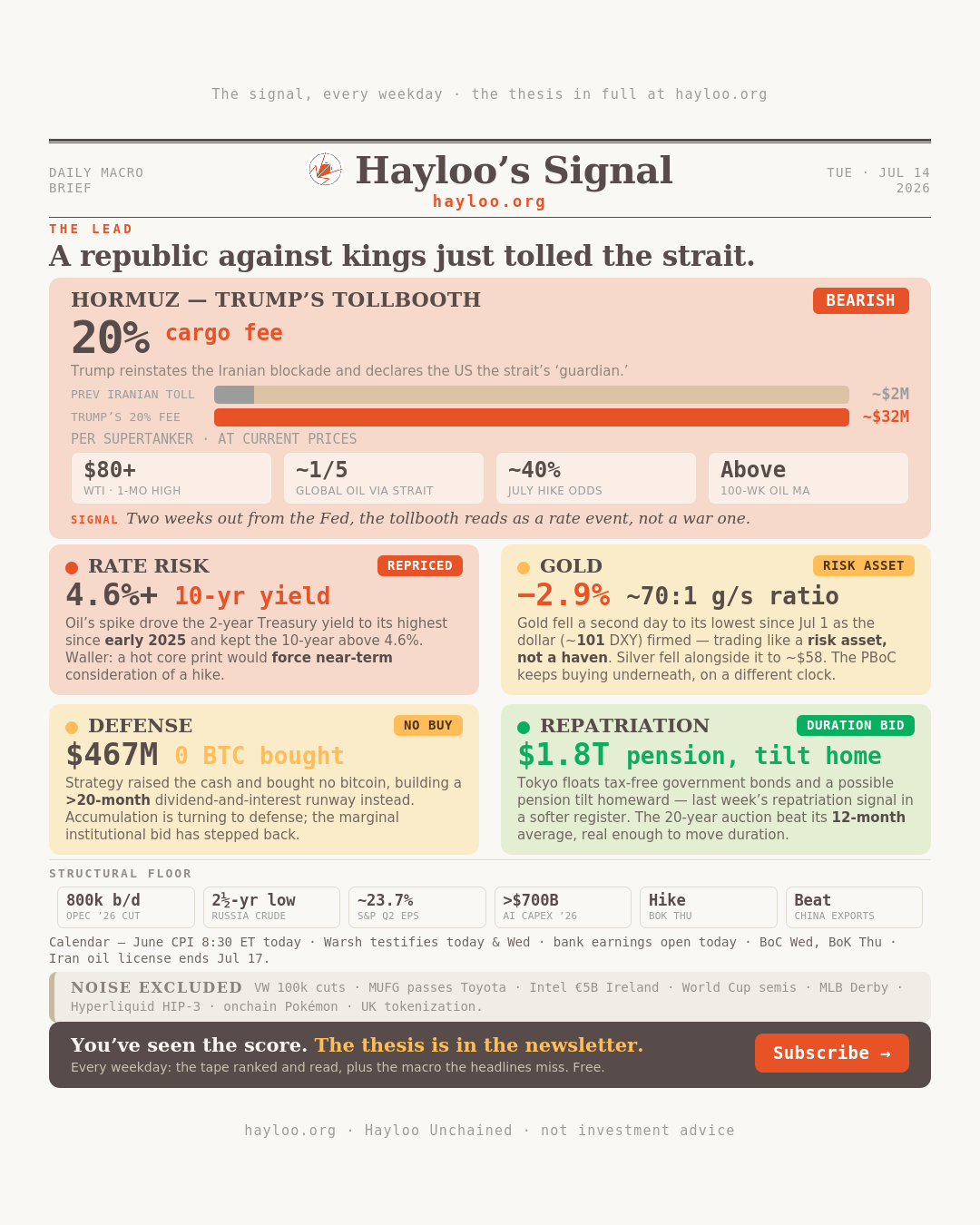
Trump declared the US the "guardian" of the Strait of Hormuz on Monday, reinstated the blockade of Iranian shipping, and demanded a 20% fee on all other cargo through the strait. Oil gapped up hard — WTI above $80, well clear of its rising 100-week average — and the bond market answered before the war did, pulling a July Fed hike onto the table with the two-year yield already at a multi-year high. Two counter-currents run under the premium: the demand side is softening, with OPEC marking down its 2026 forecast, and the tightening is going global, with Korea set to hike for the first time in three years. June CPI lands at 8:30 ET and Warsh testifies for the first time as chair — both after this brief closes.
#1 — Trump demanded a 20% fee on all cargo through the Strait of Hormuz
President Donald Trump said on Monday that the United States would reinstate its blockade of Iranian ships transiting the Strait of Hormuz and charge a fee “at the rate of 20% on all cargo shipped” through the waterway, describing the US as the “guardian” of the strait and saying it would be reimbursed for the cost of providing security. Trading Economics reported that at current prices the fee would run roughly $32 million for a supertanker, against previous Iranian transit charges of up to about $2 million.
There’s a grim comedy in a republic founded on the rejection of kings, run by the party of small government, that meets a diplomatic challenge by planting a taxable chokepoint into a free trade route and calling it security.
Trump’s announcement came a day after Iran’s Persian Gulf Strait Authority reiterated that vessels crossing without its preferred route would forfeit safe-passage guarantees. WTI soared to a one-month high above a rising 100-week moving average, and bond traders answered immediately. Two weeks out from the Fed, the toll reads as a rate event, not a war one. Iran said negotiations remain impossible until Washington honors prior commitments on Hormuz transit and the normalization of Iranian oil exports. Roughly one-fifth of global oil supplies passed through the strait before the war began on February 28.
#2 — The oil shock pulled a July Fed hike onto the table two weeks before the meeting
Money markets moved to price roughly a 40% chance of a Fed hike as soon as July on the CME FedWatch tool, up from the mid-30s a day earlier, with even stronger odds by September, as the oil spike revived inflation concerns. The two-year Treasury yield jumped to its highest since early last year and the 10-year held above 4.6%. Fed Governor Christopher Waller said a hot core inflation reading “would force near-term consideration of a rate hike” and that he would treat another high print as a signal, not noise.
Federal Reserve Chair Kevin Warsh gives his first Congressional testimony as chair before the House Financial Services Committee on Tuesday, and ING said he has “enough ammunition here to ride the rate hike risk and instead hold pat” by leaning on tame inflation expectations. The June CPI report is due at 8:30 a.m. Eastern — which, as CoinDesk noted, risks reading as backward-looking against an oil surge that postdates the month it measures. Warsh walks in holding the pen on which story wins, and the print an hour earlier decides how much room he has.
#3 — Strategy raised $467 million in stock and bought no bitcoin
Strategy raised about $467 million through sales of common stock and made no changes to its bitcoin holdings, lifting its US-dollar reserve to roughly $3 billion, per CoinDesk, The Block, and Bloomberg. The holdings remain at 843,775 bitcoin, about 4% of the 21 million cap and worth roughly $53 billion, and The Block reported the reserve now covers more than 20 months of preferred-stock dividends and debt interest. Benchmark and TD Cowen kept Buy ratings at $570 and $260. The move follows the company’s first substantial sale — about 3,588 coins for roughly $216 million — in late June and early July.
Building a dividend runway instead of adding coins is the treasury model shifting from accumulation to defense. The reflexive loop isn’t tripping, but the buyer that spent two years absorbing supply has stepped back from the institutional bid — and a market that leaned on it now has to find another.
#4 — OPEC cut its 2026 demand forecast, the counter-signal under the war premium
OPEC reduced its 2026 oil-demand-growth forecast to 800,000 barrels a day, a bearish demand-side signal the geopolitical premium buried this week. The war is pricing supply fear — a shut strait, a toll, a blockade — and the tape is paying it. But the cartel’s own math says the demand underneath that premium is thinning. That is the number that matters the day the shooting stops: strip the war bid and what’s left holding oil is a demand curve OPEC just marked down. This is the crack in the floor.
#5 — Korea is set to hike for the first time in three years as tightening goes global
South Korea’s central bank is expected to raise rates on Thursday for the first time in more than three years, the Bank of Canada is expected to hold at 2.25% on Wednesday, and New Zealand’s RBNZ flagged sticky inflation risking more hikes.
A Korean first-hike-in-three-years says the higher-for-longer turn is broadening across the developed world at once — the same regime that bids the dollar and drains the global liquidity risk assets run on. The Fed repricing has stopped being a US story.
#6 — Wall Street is organizing against the stablecoin it can't stop
Wall Street banks are mounting a coordinated pushback on the trillion-dollar stablecoin market, and Bolivia is weighing adding Tether’s USDT to its national payments system. The pushback is the tell: stablecoins have grown large enough to threaten the deposit franchise, and the banks are now lobbying against the rails rather than ignoring them.
#7 — Japan floats killing the tax on government bonds to pull cash home
Japanese Finance Minister Satsuki Katayama floated adding government bonds to a tax-free investment program for individuals, an effort to attract cash to domestic markets as the yen weakens, and said Japan may adjust the state pension fund’s allocation if the asset-management environment changes sharply.
The dollar steadied against the yen ahead of the US inflation data, with the yen soft amid intervention caution, and Tuesday’s 20-year JGB auction drew stronger-than-average demand after the remarks.
This is last week’s repatriation signal returning in a softer register — a conditional “if needed” rather than a directive — but the auction bid on it, treating it as real enough to move duration.
OPERATIONAL/STRUCTURAL FLOOR
Russia oil supply – Russia’s crude output fell to its lowest in at least two and a half years in June and refinery runs plunged to the lowest in more than 21 years after near-daily Ukrainian attacks on its oil infrastructure, deepening a domestic fuel crunch.
Bank earnings open – JPMorgan Chase, Goldman Sachs and Bank of America begin Q2 earnings on Tuesday, with aggregate S&P 500 Q2 earnings growth expected near 23.7% year-on-year, up from 19.2% estimated on April 1.
AI-capex inflation channel – AP reported that data-center buildout, likely topping $700 billion this year, is lifting prices for memory chips, processors and electricity, and TSMC is expected to notch a fifth straight record-profit quarter on AI demand.
China trade and growth – China’s June exports topped forecasts on semiconductor demand and a pre-tariff shipping rush, with green-tech exports up more than a third in the first half, while Q2 GDP is expected to have weakened toward the bottom of the official target range.
Calendar – June CPI at 8:30 ET Tuesday; Warsh testimony Tuesday and Wednesday; bank earnings begin Tuesday; South Korea rate decision and Bank of Canada Wednesday-Thursday; the Treasury’s revoked Iranian oil-sale license winds down 12:01 a.m. EDT July 17.
NOISE EXCLUDED TODAY
Obituaries and political-personnel items without a market read: actor Sam Neill, the ongoing Senator Lindsey Graham succession in South Carolina, Howard Lutnick’s Epstein-file links, Hungary’s parliament ousting its president.
Disasters and weather as a class: the Bangkok bar fire that killed 27, wildfires near Paris and in Spain, Typhoon Bavi, a US heat dome, a record El Niño warning.
Single-company and sector color below the structural threshold: Volkswagen’s reported 100,000 job cuts, the Paramount-Warner Bros. Discovery antitrust suit by 12 states, Intel’s €5 billion Ireland plant, MUFG passing Toyota as Japan’s most valuable firm, SK Hynix capital-raising rules.
Sport and culture in volume: the World Cup semifinals, the MLB Home Run Derby, the first women’s cricket Test at Lord’s.
Crypto-industry color below threshold: a solo miner’s block find, the Hyperliquid HIP-3 volume share, onchain Pokémon cards on Jupiter, Robinhood Chain memecoin activity, tweet-volume-at-lows commentary, the UK tokenization taskforce and roadmap, Progmat and SBI Solana/Avalanche tokenization moves.
US legal and domestic items without a market read: the voided Trump-IRS settlement, ICE-involved shootings in Maine, daylight-saving legislation, Cuba tourism sanctions.
South China Sea and Taiwan Strait diplomatic texture.
Anthropic’s Claude Mythos cited by Canada’s banking regulator.