


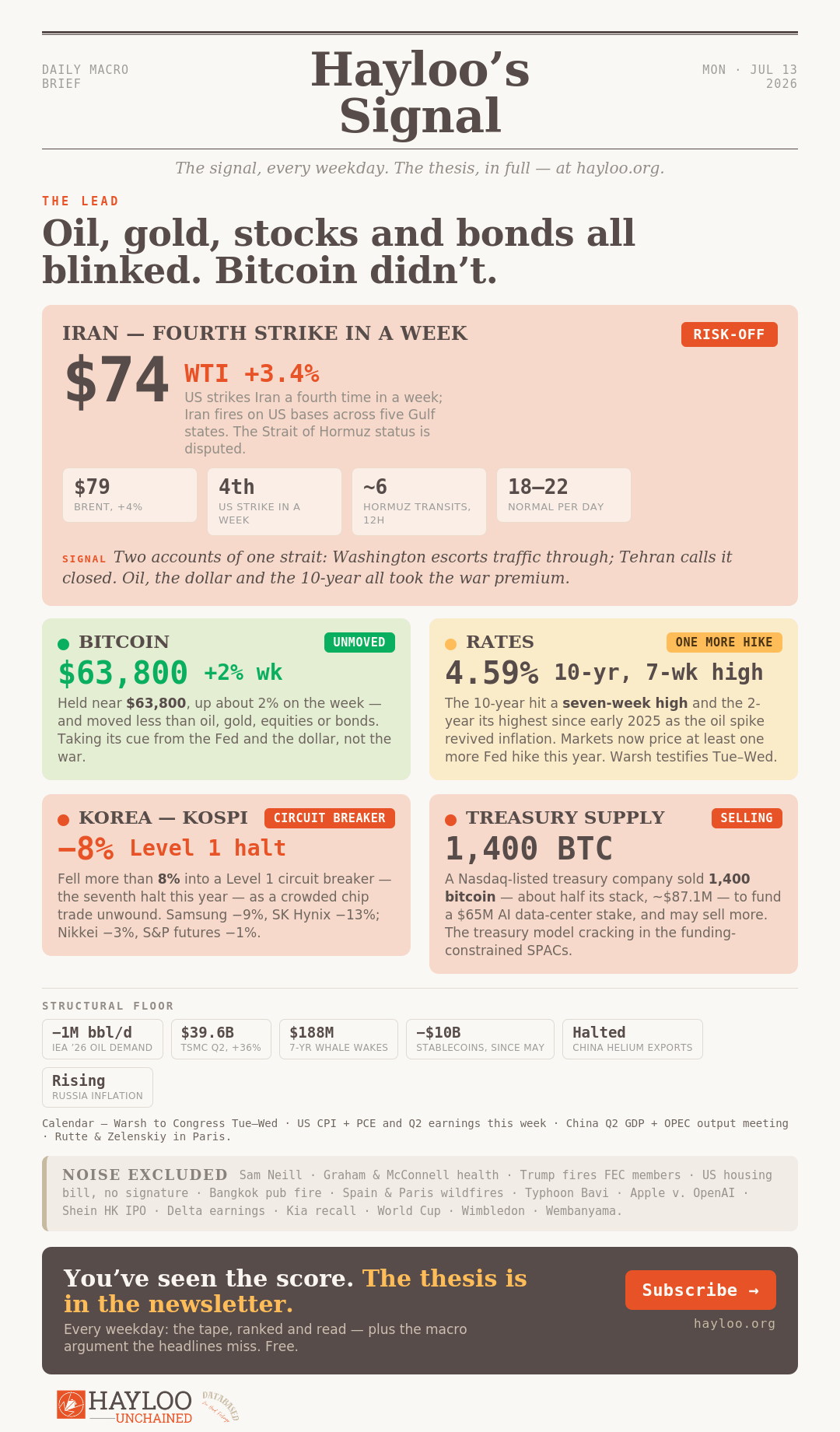
Signal is Hayloo’s macro newsreader, customized to the portfolio Hayloo scores, weighing every macro, geo, on-chain, and crypto headline against the real risk in our portfolio and our weekly market reads. Signal respects us enough to stay quiet until the day’s noise becomes signal. To get your own Signal, go to hayloo.org.
For the fourth time in a week, American bombs fell on Iran, and for the fourth time Iran fired back — missiles at six Gulf states, the Strait of Hormuz declared closed, tankers running dark past a US Navy now escorting them through by force. Oil jumped, gold sold off, Seoul’s market cratered 8% and tripped its circuit breaker before lunch, yields spiked, the dollar bid. But bitcoin didn’t move. It doesn’t trade the war headlines — it trades the Fed, and the Fed didn’t blink today. The Fed blinks later this week.
RANKED ITEMS
#1 — The US struck Iran and Iran retaliated
US Central Command said it struck dozens of Iranian targets overnight into Monday, the fourth round of US strikes in a week. Iran’s Revolutionary Guard fired missiles and drones at US bases. Iran’s Persian Gulf Strait Authority declared the Strait of Hormuz closed “until further notice” and said vessels not using its designated northern route would lose safe-passage guarantees. CENTCOM rejected the closure, said its forces were escorting commercial traffic, and said Iran does not control the strait. A naval advisory group said the Omani southern route remained open. Observable transits fell to roughly six vessels over one twelve-hour window against 18 to 22 a day earlier this month, with some ships turning off transponders. WTI rose about 3.4% to near $74 and Brent about 4% to near $79, the highest since June 22, while the dollar firmed against all its major peers. Iran said negotiations are impossible until the US meets its prior commitments on Hormuz transit and the normalization of Iranian oil exports.
#2 — Bitcoin held while oil, gold, equities and bonds all blinked
Bitcoin traded near $63,800 on Monday, up about 2% on the week. Gold fell about 1.6% to near $4,050 and silver dropped about 3%, US equity futures fell as much as 1%, and Treasury yields rose. Bitcoin is moving in line with Fed induced dollar liquidity but sits still through a shooting war, and a Korean circuit breaker. Bitcoin is taking its cue from the Fed and the dollar. Not the war directly.
#3 — The 10-year Treasury yield hit a seven-week high as the oil spike pushed markets to price one more Fed hike this year
The yield on the 10-year US Treasury note climbed to about 4.59% on Monday, near a seven-week high, and the two-year yield rose to about 4.23%, its highest since early 2025, as the oil spike revived inflation concerns. Money markets are pricing at least one more Federal Reserve rate increase before year-end, and minutes from the June meeting released last week showed some policymakers had seen a case for a hike while supporting an unchanged decision. Federal Reserve Chairman Kevin Warsh is scheduled to testify before Congress on Tuesday and Wednesday in his first appearance as chair, with new US inflation data due the same week. In its semiannual monetary-policy report on Friday, the Fed said it would deliver price stability with inflation still above its 2% target. New York Fed President John Williams has said he is most focused on AI-driven demand as a force behind inflation.
#4 — South Korea’s KOSPI fell 8% into a circuit breaker
South Korea’s KOSPI fell more than 8% on Monday and triggered a Level 1 circuit breaker that halted trading for 20 minutes, the seventh such halt this year, dropping from the prior session’s close of 7,475.94 to an intraday low of 6,861.40. Samsung Electronics fell about 9% and SK Hynix about 13%, a day after SK Hynix’s US-listed shares jumped on their Nasdaq debut, as investors took profits on a crowded chip trade and a downbeat memory-demand outlook. Foreign and institutional investors sold a net 2.8 trillion won while retail investors were net buyers. Japan’s Nikkei 225 fell about 3% and S&P 500 futures fell about 1%. The selloff followed the US strikes on Iran, higher oil, and a stronger won-dollar rate that amplified risk aversion.
#5 — Empery Digital sold 1,400 bitcoin, about half its treasury, to fund an AI data center pivot
Empery Digital, a Nasdaq-listed bitcoin-treasury company, disclosed in an SEC filing that it sold 1,400 bitcoin at an average of about $62,200, raising roughly $87.1 million, and now holds 1,514 bitcoin only. The company said $10 million of the proceeds repaid debt, most of the rest is going toward a $65 million stake in a Midwest AI data center venture with Hunt Properties, and it may sell more coins. That is the Bitcoin treasury model cracking in the funding-constrained SPACs.
#6 — Moscow faced a second day of mass drone attacks
Ukraine said it struck an oil refinery in Russia’s Samara region and a number of tankers in the Sea of Azov, part of a series of strikes on Russian vessels and energy infrastructure, and Russia’s defense ministry said it hit port infrastructure at Chornomorsk near Odesa. Moscow faced a second day of large-scale Ukrainian drone attacks, with hundreds of drones reported and three fatalities in the surrounding region, and Russia’s FSB said it foiled attempted drone attacks on two air bases deep inside the country. Bloomberg reported that Russian inflation accelerated sharply in June after earlier Ukrainian strikes on refineries triggered gasoline shortages. Four US senators said they reached agreement with President Donald Trump’s administration to advance updated Russia sanctions legislation.
#7 — China’s second-quarter GDP is expected to slow, raising expectations for fresh stimulus
China’s economy is expected to have slowed in the second quarter, with weak domestic demand offsetting resilient exports during the oil shock, and the data due this week has fueled market expectations for fresh policy stimulus. Reuters reported that June exports likely cooled but held up on AI-driven demand and aggressive pricing. Separately, China instructed major refiners to keep fuel output high to protect domestic consumers, halted helium exports to safeguard its own supply for chipmaking, and set up a new state-backed investment vehicle to expand its control of overseas minerals. The government’s second-quarter GDP release is scheduled for later this week.
#8 — Japan said it has no immediate plans to overhaul its state pension funds’ asset allocation
People familiar with the deliberations told Reuters that Japan’s government has no immediate plans to change the target asset allocations of its state pension funds, though it could direct more investment to domestic assets within existing allowable ranges. The comments followed last week’s signal from the government that it would push the roughly $1.8 trillion state pension system, about half of which is held abroad, toward domestic assets, a signal that had lifted the yen and long Japanese government bonds. The government’s main pension fund has made no allocation change.
#9 — The stablecoin supply suffered the largest monthly drop since the Terra-Luna collapse
CoinDesk reported that the total stablecoin market capitalization has shrunk by about $10 billion since May, including a $7.7 billion contraction in June, the largest monthly dollar decline since the Terra-Luna collapse in May 2022. The analyst cited said stablecoins would likely resume long-term growth. Separately, several Japanese firms advanced yen-stablecoin projects, with SBI Group set to launch a lending service and a Lawson convenience-store payments pilot, and the Bank of Thailand began auditing high-volume stablecoin trades focused on Tether’s USDT.
OPERATIONAL/STRUCTURAL FLOOR
Oil demand and logistics. The IEA expects global oil demand to fall about 1 million barrels per day in 2026, the first annual decline since 2020.
AI-chip cycle. TSMC reported second-quarter revenue up 36% to $39.63 billion on AI demand, the same crowded chip trade whose reversal drove the Korean rout.
Large-actor on-chain. A bitcoin whale moved about $188 million after seven years dormant, last active in 2018 near $6,475.
Calendar. Warsh testifies to Congress Tuesday and Wednesday, US CPI and PCE inflation data and the start of Q2 earnings land this week, China’s Q2 GDP and OPEC’s output meeting are scheduled, and NATO Secretary General Mark Rutte and Ukrainian President Volodymyr Zelenskiy join a Coalition of the Willing meeting in Paris.
NOISE EXCLUDED TODAY
Obituaries and political-personnel items without a market read
Sam Neill, Senator Lindsey Graham, former Qatari Emir Sheikh Hamad bin Khalifa Al Thani, Senator McConnell’s health, Trump firing federal election-commission members, the US housing bill becoming law without a signature.
Disasters and weather without market impact
The Bangkok pub fire, Spain and Paris wildfires, Bangladesh floods, Typhoon Bavi, a US heat dome.
Single-company and sector color below the structural threshold
Apple’s lawsuit against OpenAI, Meta pulling an Instagram AI feature, Volkswagen and German-carmaker China sales, Shein’s Hong Kong IPO approval, Delta’s earnings, a Kia recall.
Sport and culture as a class
The World Cup, Wimbledon, a Seahawks sale, Wembanyama’s contract.