


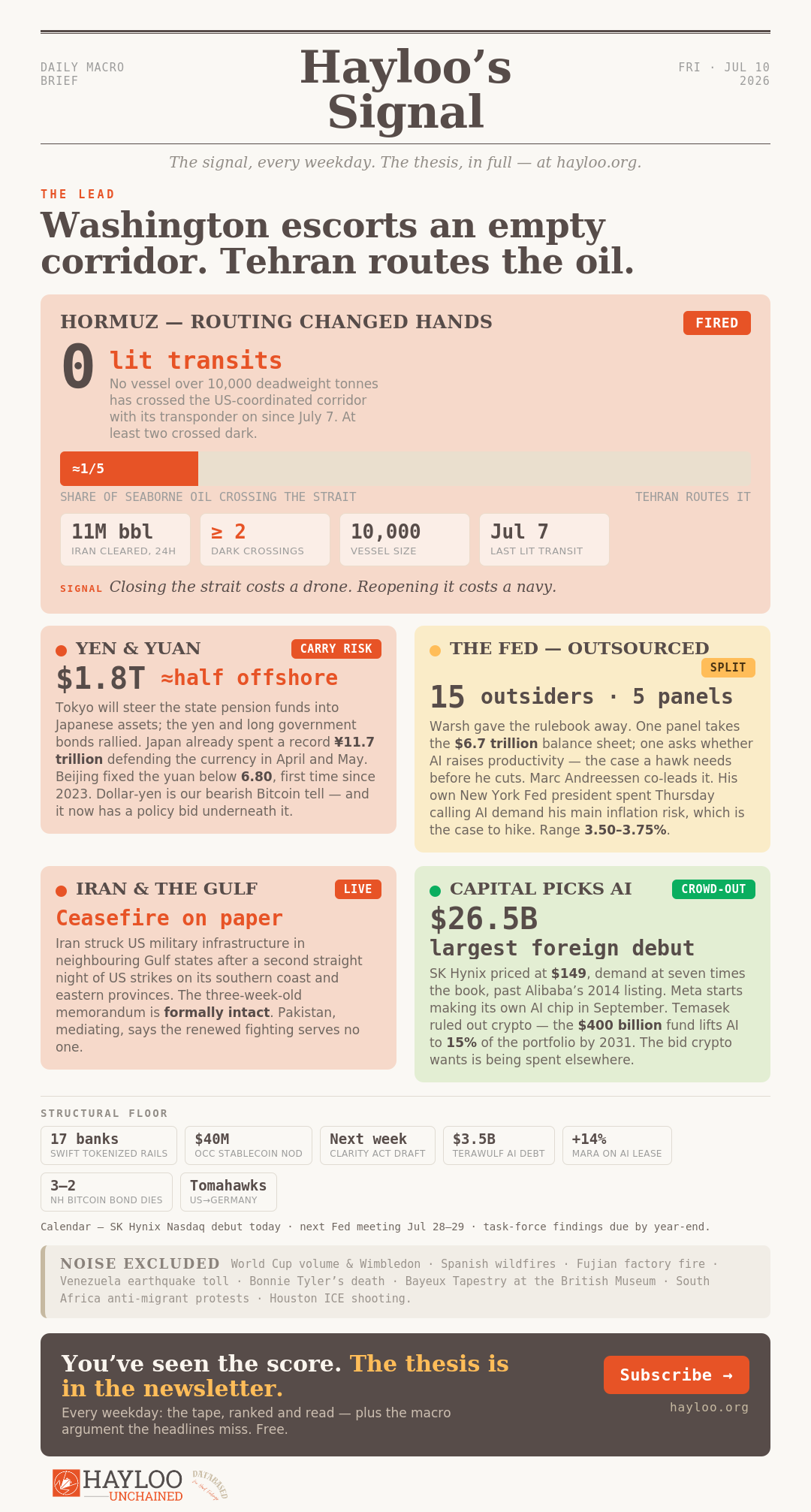
Signal is Hayloo's newsreader, customized to the portfolio Hayloo scores, weighing every macro, geo, on-chain, and crypto headline against the real risk in our portfolio and our weekly market reads. Signal respects us enough to stay quiet until the day's noise becomes signal. More info at: hayloo.org
TOP-OF-STACK SUMMARY
Control of Strait of Hormuz routing changed hands this week. Lloyd’s List Intelligence says no vessel above 10,000 deadweight tonnes has crossed the US-coordinated Omani corridor with its transponder on since July 7, and vessel tracking shows the traffic that still moves is moving on the routes Iran approves.
Tehran has said since early July that it would assert control over strait traffic, levy fees by force if necessary, and give friendly countries special passage.
That regime is now operating, and it was taken with drones. Iran shipped roughly 11 million barrels of crude out of its own ports in the 24 hours to Thursday, ahead of the blockade Trump has threatened.
Japan reached past currency intervention to its savings. Finance minister Katayama said the government will push the state pension funds, $1.8 trillion with about half of it held abroad, into domestic assets; the yen and long JGBs rallied on the statement.
Fed chair Kevin Warsh named fifteen outsiders to five panels reviewing Fed policy, one taking the $6.7 trillion balance sheet and one asking whether AI raises productivity, which is the case a hawk needs before cutting. His own New York Fed president spent Thursday arguing that AI demand may force hikes instead.
RANKED ITEMS
#1 — Hormuz traffic has moved onto the routes Iran approves
Lloyd’s List Intelligence said on Thursday that no vessel above 10,000 deadweight tonnes has transited the Oman-hugging corridor Washington calls the Southern Highway with its automatic identification system switched on since July 7, and that traceable crossings on that lane have effectively stopped, though at least two ships are believed to have crossed dark.
Vessel-tracking data showed the remaining visible traffic concentrated on Iran-approved routes, with limited movement on the US-backed corridor. Iran has said since early July that it will assert control over strait traffic and levy fees by force if necessary, and its envoy to China said Iran would give friendly countries special passage.
Roughly a fifth of seaborne oil crosses that strait, and Tehran now decides its routing. The escort mission Washington named after itself is carrying nothing.
The asymmetry in favor of Iran is this: Closing the strait costs a drone. Reopening it costs a navy.
#2 — Iran fired on American military infrastructure in Gulf states after a second straight night of US strikes
Iranian armed forces targeted US military infrastructure in neighbouring Gulf states on Thursday, Reuters reported, following US strikes on Iran’s southern coastal and eastern provinces. The three-week-old memorandum of understanding remains formally in place. Pakistan, acting as mediator, said the renewed conflict serves no one’s interest.
#3 — Japan’s finance minister said the government will steer its state pension funds into substantially more domestic assets
Finance Minister Satsuki Katayama said at a regular press conference on Friday that the government would pursue measures encouraging pension funds, including the Government Pension Investment Fund, to make “substantially greater investments in Japanese financial assets.”
GPIF managed ¥293.6 trillion, about $1.8 trillion, at the end of March, and maintains roughly equal allocations to domestic equities, foreign equities, domestic bonds and foreign bonds, with about half its strategic allocation offshore.
Katayama said Japan has entered a period of positive interest rates and higher stock markets under Prime Minister Sanae Takaichi, and that she wants to accelerate discussions on expanding JGB products aimed at retail savers.
Her remarks followed a JGB selloff driven by concern over the administration’s expansionary fiscal stance and the risk of political interference in monetary policy. Japan spent a record ¥11.7 trillion defending the currency in April and May.
Japanese institutions are the largest single source of the savings that fund carry trades everywhere. The government has just told the biggest of them to bring the money home.
The dollar-yen cross is a bearish Bitcoin read, and it now has a policy bid underneath it.
#4 — Warsh named 15 outside co-leaders for five task forces reviewing how the Fed makes policy
The Federal Reserve announced on Thursday the leadership and mandates of the five task forces Chairman Kevin Warsh proposed at his first FOMC meeting in June.
The 15 co-leaders are drawn from academia, business and foreign central banking, and include Marc Andreessen, former Walmart chief executive Doug McMillon, Microsoft’s Asha Sharma, former Bank of England Governor Mervyn King, former Reserve Bank of India Governor Raghuram Rajan, former Central Bank of Brazil President Arminio Fraga, and the economists Greg Mankiw, Thomas Sargent, Raj Chetty, Jeremy Stein, Karen Dynan, Kevin Murphy and Charles I. Jones.
The panels cover Fed communications, the $6.7 trillion balance sheet, the data the Fed relies on, inflation frameworks, and productivity and jobs. Andreessen co-leads productivity and jobs; King, Peter R. Fisher and Fraga lead communications; Chetty, McMillon and Murphy lead data; Sargent and Mankiw lead inflation frameworks.
Warsh said the groups will operate independently, follow the evidence, and deliver rigorous findings to the FOMC by year-end. He said before taking the chair that the institution was due for regime change. The Fed’s target range stands at 3.50% to 3.75% and the next FOMC meeting is July 28 and 29.
#5 — New York Fed President John Williams said AI-driven demand is now his main inflation concern
Williams said on Thursday that among the drivers of US inflation he is most focused on demand generated by artificial intelligence, and that if that demand persists it could force the central bank to raise interest rates, Bloomberg reported.
Minutes of the June FOMC meeting, released Wednesday, showed policymakers divided on the path of rates, with only a few favouring an increase, though officials expressed growing concern about inflation; the committee discussed both whether AI demand could raise prices and whether AI productivity could lower them.
Markets continue to price at least one hike by the end of 2026.
#6 — The People’s Bank of China set its yuan reference rate below 6.80 per dollar for the first time since 2023
The People’s Bank of China fixed the daily yuan reference rate below 6.80 per dollar on Friday, the first such fixing since 2023, and the currency advanced, Bloomberg reported. The move signals official comfort with a stronger currency. It follows the central bank’s June cut in government bond purchases to a nine-month low and its withdrawal of money-market liquidity in the past week, alongside a ¥1 trillion outright reverse repo operation.
#7 — SK Hynix raised $26.5 billion in the largest US stock market debut ever by a foreign company
SK Hynix priced its US offering at $149 a share, raising $26.5 billion, in what Reuters and the BBC called the largest first-time offering by a foreign firm in the United States, eclipsing Alibaba’s 2014 listing.
Demand ran at more than seven times the shares available, and the shares began trading on Nasdaq on Friday.
Commerce Secretary Howard Lutnick called on Samsung and SK Hynix to expand memory-chip production in the United States. Meta said it will start manufacturing its own AI chip in September as it moves to 14 gigawatts of computing capacity.
CoinDesk reported that the wave of AI listings is drawing billions of dollars from global investors, and that Singapore’s Temasek, a $400 billion fund, has ruled out crypto and plans to lift AI holdings to 15% of its portfolio by 2031 from 6%.
OPERATIONAL/STRUCTURAL FLOOR
Tokenized-deposit and stablecoin rails. Swift launched a blockchain-based ledger enabling 17 banks, including HSBC, UBS, Wells Fargo and Citi, to pilot 24/7 cross-border payments with tokenized deposits. Sony Bank’s US subsidiary Connectia Trust received conditional OCC approval to issue a dollar-backed stablecoin, capitalized at $40 million. PayPal began issuing PYUSD natively on Polygon, and Hyundai Card completed a stablecoin pilot with Avalanche and Tether.
Crypto market-structure bill. Sources told CoinDesk a new Clarity Act draft may circulate as soon as next week, though it lacks bipartisan buy-in. CFTC Chairman Michael Selig warned regulators will write the rules themselves if Congress fails to act, and The Block reported the Supreme Court removal-power ruling raises questions for the SEC and CFTC.
US derivatives-market plumbing. Polymarket applied to offer margin trading in the US, following Kalshi’s approval in March. North Carolina passed a law recognizing CFTC preemption over prediction markets. The CFTC has for now blocked CME’s plan for round-the-clock oil futures trading.
Bitcoin miners repricing on AI leases. MARA rose 14% on a 2-gigawatt Texas AI and mining campus structured as up to $600 million of milestone payments. TeraWulf is preparing about $3.5 billion of debt, including a first leveraged-loan issue, for the Kentucky campus leased to Anthropic.
State-government bitcoin bond blocked. New Hampshire’s executive council voted 3-2 against the first bitcoin-backed municipal bond at its final approval stage.
European force posture. Chancellor Merz told the Bundestag that Germany has agreed with Washington to acquire US Tomahawk cruise missiles and station them on German territory.
Chinese economic statecraft. Beijing is expanding its ability to retaliate against US and EU sanctions and export controls, raising compliance risk for foreign firms in China.
Calendar. SK Hynix’s Nasdaq debut today
NOISE EXCLUDED TODAY
World Cup 2026 in volume and Wimbledon; the Spanish wildfires that killed at least 12; the Fujian shoe-factory fire that killed 28; the Venezuela earthquake toll now 3,889; Bonnie Tyler’s death; the Bayeux Tapestry’s arrival at the British Museum; South Africa’s anti-migrant protests and the Houston ICE shooting