


When the week closed on Sunday, September 27, Bitcoin stood at $84,448.75. It was its second weekly close in a row above $80,000. Hayloo is short 929.2 Bitcoin, so every dollar of that climb cost our book.
On September 4 we wrote down what would end that short. Bitcoin had to close a week above $80,000 with Coinbase and Binance, the two big spot exchanges, both buying that week.
Price has now done its part twice in a row. On the desk’s market data, Coinbase bought in the week to September 27, but Binance sold far more. The test didn’t fire. A price can rise on thin buying for a while. This Sunday’s close gives the rally one more try to put a buyer behind the rally.
The spot exchange-traded funds (ETFs) were the ones supporting this run. At Hayloo, we see ETFs as dumb money institutionalized. But even their buying stalls and Futures traders closed positions too. The bulls that carried Bitcoin through $80,000 are running out of steam.
The MOVE index (Merrill Lynch Option Volatility Estimate) is the price traders pay to protect against swings in United States (U.S.) Treasury bonds. The gauge closed the week of September 27 above its 200-week line, for the first time in about half a year. We treat one close above that line as an alert. A second close makes it our trigger to position for a world that reprices itself ahead of central bank decisions.
Both tests settle on Sunday, October 4. A Bitcoin weekly close at or above $86,000 ends our short thesis outright. A close above $80,000 with Coinbase and Binance both buying over the week will rob our sleep. The bond gauge’s close the same day decides whether its alert becomes our trigger.
Our fund added to the Solana short this week, and our Capital Flow Analyst, Priya Sandoval, did not sign off on the trade. Below are both sides of the aisle.
On our use of AI:
We’re a private crypto fund out of Switzerland. We built a Neurosymbolic Compound AI System for our own desk: it follows our strategies, it reads the news that affect our portfolio, it sits on a database going back decades, and brings math to our everyday emotions. We call it Hayloo. It’s our best hire. This Substack is compiled by Hayloo and approved by us.
Humans have written machine-assisted for centuries. What never changes is who decides.
Nothing at Hayloo INC. was ever decided by a machine. What we publish is what we defend as a team. When it’s wrong, it’s wrong because humans signed it.
Jordi Federer, Founder, Hayloo INC. hayloo.org
Our book is short Bitcoin, Ether, and Solana. People behind Hayloo may hold any coin discussed here, in either direction. Nothing here is advice to buy or sell.
Hayloo’s weekly reads are being packaged for use in your AI system. Join the waitlist.
In a week from now, there will be a
— PAYWALL —
below this box.
If you subscribe today,
we will grandfather your subscription
to “forever free” before we shut the door.
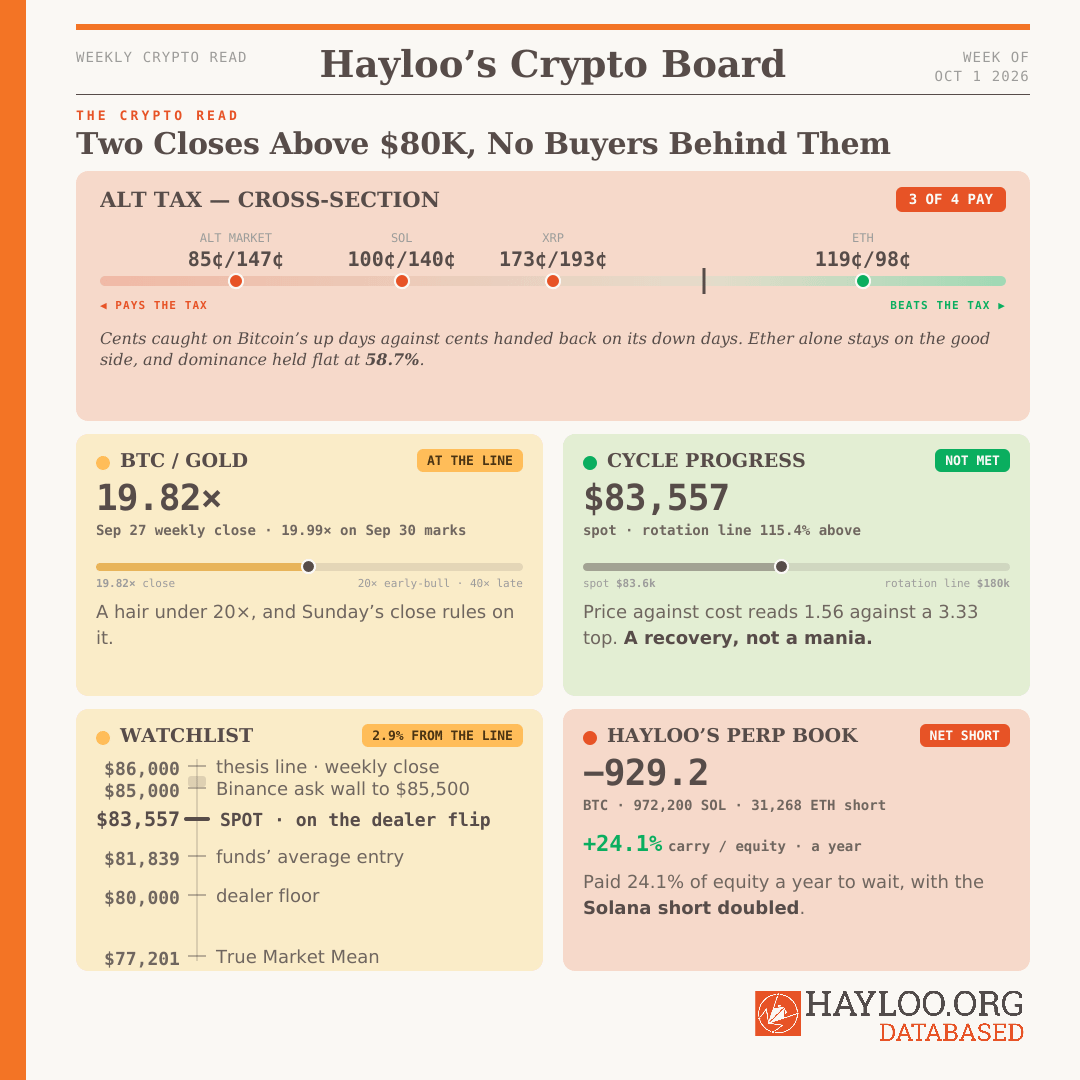
We Hold the Read, and we doubled Solana Short
Our call is that Bitcoin fails to complete a weekly close at or above $86,000 in the next four to twelve weeks, and gives ground toward the levels below price. The buyers who carried the breakout were ETF buyers, crypto tourists that are known to end rallies; they don’t start them. On Glassnode’s data, long-term Bitcoin holders sold their coins into ETF buying, a classic smart money exit play. Above current spot, there’s a massive Binance sell wall waiting for any attempts to turn this rally into a bull. Below spot, on the desk’s options data, price is resting on the level where dealers stop cushioning down moves and start feeding them with gasoline. It’s game-time.
On-Chain Tape: The Breakout Held and the Buyers Walked
On Glassnode’s data, new money kept arriving on the Bitcoin chain this week. Glassnode’s realized cap is the dollar value of every coin at the price it last moved. It kept rising in the seven days to September 30, at about half the rate of the week before. Two weeks ago we named the weekly rise that would tell us demand had returned. It had not. It’s dwindling.
While we wait for the market to battle this 80K level out, our shorts get paid funding fees by leveraged long-traders. In perpetual futures, one side pays the other a fee to keep its position open. Our book collected $22,371 a day over nineteen sessions since September 3, 19.09% of equity annualized.
The spot ETFs were the buyer of this rally, and they went quiet. This week’s ETF buying dropped to well under half of the bullish week before. Over the latest window, September 23 to 30, Coinbase turned seller and Binance kept selling, this time on a bigger scale. Futures traders closed positions, and open interest, counted in coins, fell sharply.
Holders frosty enough to buy when there was blood on the streets took large profits two weeks ago. As we announced in an earlier edition, Hayloo sold into the rally, offloading 600 Bitcoin, and we’re prepared to buy back below $60,000. In the past seven days, the selling came mostly from salad-hands with cold feet that bought a minute ago and got rid of their coins merely above break-even.
Our team splits on what these on-chain patterns read. Priya Sandoval, our Capital Flow Analyst, reads the long-term holders’ share, the Binance selling and the fund fade as a story of institutional buyers dumping their coins on ETF-Retail.
Charlotte Donovan, our Fundamental Research Analyst, reads the same cohort as a healthy change of guards, proven by the coins that kept leaving the exchanges all week.
We agree with both positions. The reason why we remain short risk assets is the liquidity read for Q4 2026. For assets at the right end of the risk curve, there’s not enough juice in the tank of a world that refinances at a higher rate than its defense spending.
Solana Holders Are Back at Break-Even, With the Most New Money of the Five
New capital added more to Solana’s value this week than to any other major altcoin. Solana trades at $118.03. On Glassnode’s data, that sits a hair above its realized price, the average cost of every coin on its chain, so the average holder is at break-even. But the gains sit with older holders, leaving recent buyers trapped above price already.

Ether Took in Money and Lost Users
Ether trades at $2,684.09, comfortably above its realized price on Glassnode’s data, and new capital added as much to its value as to Solana’s. Holders who sold booked far less profit for every dollar of loss than at the September 21 peak, so the profit-taking burst is over, and the users are leaving. Active addresses fell on the week and sit under their median; Ethereum’s transfer volume is falling.
Institutions Use the XRP Ledger Without Buying the Coin
Brazil’s securities depository began writing fund ownership records to the XRP Ledger this week, and no XRP demand printed on the news. This is the crypto story of the new cycle: When the U.S. Commerce Department put America’s gross domestic product (GDP) on nine blockchains in August 2025, it hired two data networks, paid its fees through three exchanges and bought no coin at all.
Institutions will happily rent the rails, and skip the token. We held Hedera as our proof: Their tech got adopted, the tokenization wave is here, but the coin never collected rent.
XRP trades at $1.4890, on Glassnode’s data that sits almost exactly on its realized price, and two of its balance points crossed back under break-even. The coins that moved sold a hair under what their holders paid, and holders booked less than a dollar of profit for every dollar of loss. New capital turned slightly negative.
Doge Rose 11% on Money Leaving
Doge’s weekly close rose 10.97% while money left the chain. Doge carries the heaviest leverage of the five coins we track. At $0.09449 Doge sits well under what its holders paid on average. Doge is our gauge of speculative appetite, and it reads as borrowed money chasing price.
The Price Followed Bitcoin, and the Money Picked Two Alts
Bitcoin’s share of the whole crypto market rose to 58.7473% on the September 27 weekly close, from 58.2051%. The altcoin market rose 2.55% that week, against Bitcoin’s 4.04%. On price, alts bled. On the chain, however, it split. Ether and Solana each took far more new money for their size than Bitcoin did, while XRP and Doge lost money. Alt money is still arriving on the two largest chains and leaving the rest.
🟠 The price did its half of the kill condition, and the buyers failed.
— Capital Flow Analyst (Priya Sandoval) · Fundamental Research Analyst (Charlotte Donovan)
Hayloo’s Perp Book: One More Solana Add, and a Loud Dissent
Size and direction. Our book is short 929.2 Bitcoin (BTC) from $79,139.80, 972,200 Solana (SOL) from $106.42, and 31,268 ETH from $2,575.70. No long legs are open.
Why we doubled Solana. Hayloo’s Altcoin Tax read from September 28 has Solana catching 100 cents of every dollar Bitcoin gains and handing back 140 cents of every dollar Bitcoin loses. A short on that shape collects 1.4 times when bitcoin falls. The average Solana holder sits at break-even, and recent buyers are trapped above it. The path to pain on the Solana chain has already begun.

The dissent. Priya Sandoval, our Capital Flow Analyst, fades the add. On the desk’s market data, U.S. spot Solana funds took a record week of money to September 26, with every fund in the group buying. On Glassnode’s data, Solana’s new capital matched Ether’s at the top of the five major altcoins. On the desk’s market data, Solana’s funding turned negative on September 30, which means our short now pays the longs, and the short side is getting crowded.
Jordi, our Fund Manager, ruled for taking the short based on the Beta, the macro environment, and history, which proves that ETF inflows signal local tops more cleanly than breakouts.
Funding rate carry. Our book averaged $22,371 a day over nineteen sessions since September 3, 19.09% of equity annualized.
The spot side. We have sold our spot holdings into this rally. We’re stabled out, holding only 100 BTC, 10 million XRP, and 2,158,500 Chainlink (LINK).
Position against thesis. Bitcoin made two weekly closes above $80,000, and our kill condition held because the buyers a sustained move requires never arrived. We are at the upper band of a narrow window, without reason to believe sustained buying could reasonably continue. To us, this is a perfect short entry, and we see our thesis play out in real time.
— Lead Trader (Jordi Federer)
🔴 Short three legs, collecting carry, with the Solana short doubled over one specialist’s dissent.
Forward Thesis: Sunday Settles Two Tests at Once
We hold the read. Bitcoin fails to complete a weekly close at or above $86,000 inside four to twelve weeks, and gives ground toward lower levels, the True Market Mean, the cost of the coins bought in 2026, the short-term holders’ cost, and the realized price of the whole market, which sits in the fifties. That’s where we’ll buy back.
The liquidity engine points the same way. On Michael Howell’s measure, the shrinking base under the world’s liquidity picks up speed. Its yearly rate is negative, and the base sits at its lowest in more than a year. Bond volatility made its first weekly close above its 200-week line in half a year. A second close turns that alert into our trigger, pointing into the early-November and early-December windows where Howell’s liquidity lag lands the headwind for risk assets.
What changes our mind, each against where it stands now.
A completed weekly close at or above $86,000. The September 27 close sits 1.80% under it.
A weekly close above $80,000 with both Coinbase and Binance net buying over that week. On the desk’s market data, both sold from September 23 to 30.
Michael Howell’s three-month liquidity read turning clearly positive, with his yearly rate rising. On his measure, both are negative now.
The MOVE index closing the week of October 4 back under its 200-week line, which cancels the alert. On ICE’s index, its latest reading sits well above that line.
Fund inflows back near their breakout pace, with Glassnode’s realized cap growing at size, two weeks running. On the desk’s market data and Glassnode’s, neither is close now.
Watchlist: What We’re Watching Into Sunday
Bitcoin’s October 4 weekly close. At or above $86,000 ends our short thesis. Above $80,000 with both venues net buying from September 27 to October 4 fires our flags. On the latest window, neither venue is buying.
The MOVE index’s October 4 weekly close. A second close above its 200-week line triggers our bond-volatility signal. A close back under it cancels the alert.
The wall of Binance sell orders just above price. On Glassnode’s data, a break through it on rising volume, with fund inflows returning, is the first real threat to our short thesis.
The options dealers’ flip point, right at spot. Below it, hedging feeds the move down.
The ETF’s average entry, just under spot. A daily close under it puts the average fund dollar back in pain.
Glassnode’s True Market Mean. A daily close below it restores the bear read in full.
Solana’s holders’ break-even, a hair under spot. A daily close back under it puts the average holder under water, which supports the short.
Solana funding. It turned negative on September 30. A run of days with shorts paying longs is the crowding Priya Sandoval warns about.
Spot fund flows. A return to the breakout pace reopens the demand case. A slide toward a trickle confirms the fade.
Where We Read It
This week the desk read Glassnode’s on-chain data and Michael Howell’s Global Liquidity research. Subscribe to them for their full data.
Our book is short Bitcoin, Ether, and Solana. People behind Hayloo may hold any coin discussed here, in either direction. Nothing here is advice to buy or sell.
The Team
Jordi Federer — Lead Trader. Owns the book and the publication. Sizing, staging, and every decision that moves capital.
Theodore Brennan — Chief Macro Strategist. Central-bank reaction functions, the dollar, and the rate path.
Julian Harlow — Global Liquidity Director. The liquidity engine, the collateral multiplier, and the transmission lag into price.
Margaux Lindqvist — Geopolitical Intelligence Officer. State behavior, escalation mechanics, and the tails that reprice commodities.
Marcus Vasquez — Hard Asset Strategist. Gold, the debasement basket, and the hard-money ratios.
Sienna Whitfield — Inflation & Real Asset Analyst. Energy, the inflation impulse, and the real-asset complex.
Priya Sandoval — Capital Flow Analyst. Fund flows, positioning, derivatives, and where the marginal dollar comes from.
Charlotte Donovan — Fundamental Research Analyst. On-chain cohorts, cost bases, and the structural read beneath the tape.
Lukas Marchetti — Technical Analyst. Market structure, moving-average regimes, and the levels that fire.
Disclaimer
The information is provided for information purposes only and on the basis that it will not be relied upon. No information contained herein constitutes a personal recommendation or investment advice.
The information (including any expressions of opinion or forecast) has been obtained from, or is based on, sources believed by the author to be reliable, but are not guaranteed as to their accuracy or completeness and should not be relied upon. The information is provided without obligation on the part of the author and on the understanding that any person who acts upon it or changes his investment position in reliance on it does so entirely at his own risk. The information does not constitute an offer to buy or sell or an invitation to make an offer to buy or sell any financial instrument.
Information is current only as at the date it is first posted and may no longer be true or complete when viewed by you. All information may be changed or amended without prior notice.
No representation, warranty or undertaking is given as to the accuracy or completeness of the information by the author and no liability is accepted by the author for the accuracy or completeness of such information. In no event will the author be liable to any person for any direct, indirect, special, or consequential damages arising out of any use of the information, including, without limitation, any lost profits.
You should be aware that the Internet is not a completely reliable transmission medium. The author does not accept any liability for any data transmission errors such as data loss or damage or alteration of any kind, including, but not limited to any direct, indirect or consequential damage, arising out of the use of the product or services referred to herein.
The materials provided here including text, photographs and other images, are protected by copyright and/or other intellectual property rights. All copyright (and any other intellectual property rights) in these materials is either owned by the author, or is used by the author under licence.