


Tape of the Week
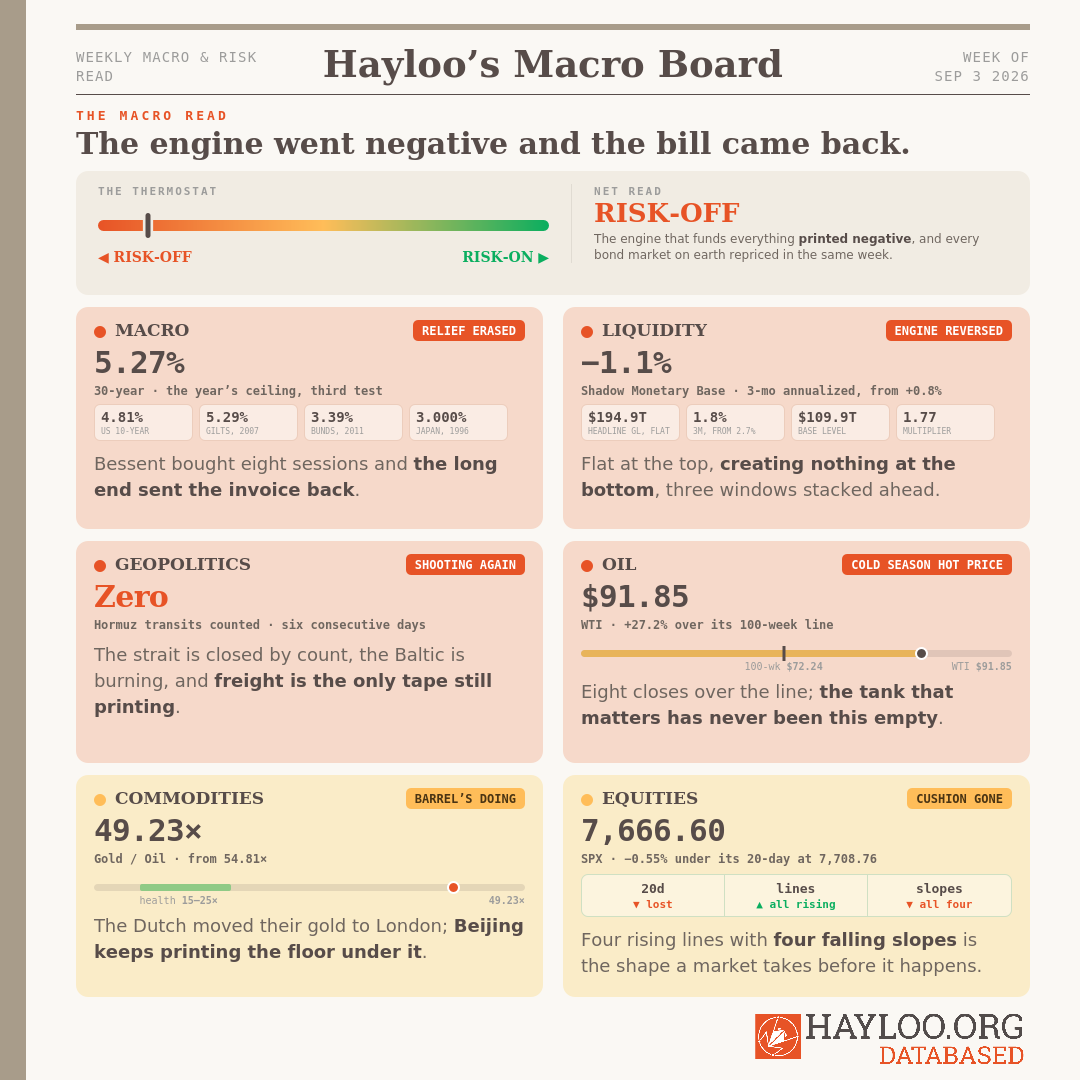
Michael Howell’s liquidity engine printed a negative three-month rate for the first time since the late-May trough, −1.1% from +0.8%, and Bitcoin was rejected at its local cycle top in the same week. Those two facts are not a coincidence. The Shadow Monetary Base, central-bank liquidity plus the collateral the system borrows against, has stopped creating money while the Global Liquidity Index (GLI) headline sits flat at a record $194.9 trillion. A stalled level with its rate going negative is an engine running out of gas.
What kept the gauge reading full was a bond market held quiet by the Treasury buying its own long debt, and the quiet lasted eight sessions. Scott Bessent hopefully got some sleep during them. Then the thirty-year returned to 5.27%, the exact level it held the moment before the buyback was announced and the year’s ceiling on its third test. The ten-year went to 4.81%. The selloff went global: gilts at 5.29%, the highest since 2007; Bunds at a 2011 level; Japan’s ten-year through 3.000% for the first time since 1996. Kevin Warsh, Donald Trump’s pick at the Fed, told Jackson Hole that policy is not restrictive enough. Central banks in Asia and Europe are already signaling higher rates. All the while US Treasury Secretary Scott Bessent admits to actively controlling the interest rates of the country of Japan.
Nothing on the ground says they can do otherwise. No ship has been counted through Hormuz in six consecutive days, two seafarers are dead on a Saudi hull in water Washington says it controls, and no insurer writes the next passage. Crude fell three sessions anyway, and American diesel set a four-year high at $5.783 a gallon on distillate stocks that have never been this low for the season. West Texas Intermediate (WTI) sits 27.2% above its 100-week line with heating season weeks away. The shortage is in the refinery, no reopened strait fixes it, and every central bank pricing energy into its rate path is pricing this.
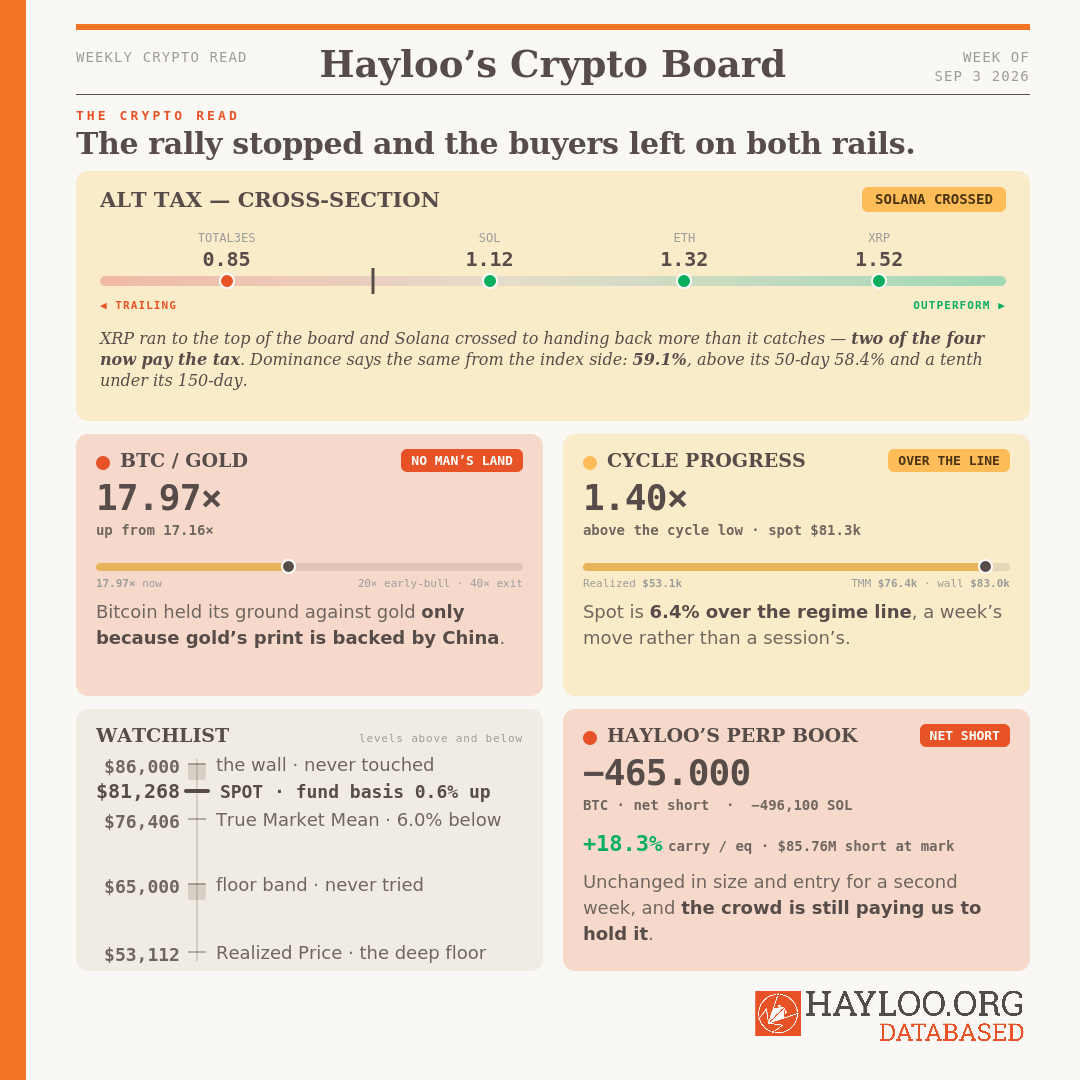
Bitcoin ran on the same borrowed calm and stopped where it always stops. The rally’s best daily close came in last night at $81,268, the exact level that makes the average ETF-dollar whole, and the supply met it there. The band between $83,000 and $86,000 is the big green sell wall this book has pointed at for months, more than a million long-term-holder coins that sat through the entire drawdown. It was never touched. The buyers were headline money: spot funds absorbed a peak $290 million a day, the average deposited dollar now sits at breakeven and see that, both Coinbase and Binance flipped to net sellers. Bitcoin profit ratio fell from 3.72 to 1.21 in three sessions, and now there are no buyers left.
Hayloo’s crypto book remains short, leveraged longs are paying us 18.3% of equity in annualized funding fees to sit still.
Liquidity Tape
Capital Wars’ Global Liquidity Index sits at $194.9 trillion, same as last week, the largest pile of money ever assembled. It’s the only number on the board that did not move. Everything else repriced: bonds moved, oil up gold up and bitcoin up. Global liquidity sat still but underneath it every rate rolled over: three-month momentum slowed down to 1.8% from 2.7%, the annual rate to 5.8% from 6.2%.
The foundation this record liquidity is standing on is the Shadow Monetary Base, central-bank money plus the collateral the system borrows against, and its three-month rate crossed from +0.8% to −1.1%. The base is creating nothing under a headline that has stopped growing.
What props headline liquidity up is the same trick as last week: a bond market kept quiet so lenders take less collateral for the same loan and the same collateral carries more borrowing power. The Treasury bought that silence by paying for its own long debt, but this week the bill came due.
U.S. Treasury Secretary Scott Bessent thought this through and it looks like he underestimated the task. The ten-year is back at 4.81%. The buyback relief, and the rally it produced that this book refused to join, lasted eight trading sessions.
Meanwhile, the dry liquidity through Michael Howell’s Capital Wars called three months ago is here. The late-May liquidity trough hit markets in late August and delivered the first rejection. The deeper trough lands early November. This week’s −1.1% starts a third clock that lands early December, on top of the November one. Howell still has the cycle low in January 2027. We are waiting for him to push it out.
🔴 The biggest pile of money in history is being starved by an engine running backwards.
— Global Liquidity Director (Julian Harlow)
Macro Tape
Bessent’s increased buying of his own debt bought eight trading sessions and, we hope, a few nights of sleep. The ten-year is back at 4.81%, near a three-year high. The thirty-year is back at 5.27%, the exact print it held the moment before the operation was announced. Nothing was repaid. Nothing was refinanced cheaper. The Treasury showed up with money, the long end took it, and eight sessions later asked for more.
We would not want the job. Whether Bessent flies to Tokyo or buys his own paper, every time he opens his wallet the free trial becomes a subscription, and it cannot be cancelled before his boss’s term runs out. The fiscal system sitting underneath the world’s strongest economy has become a clown-show, no wonder the Dutch asked for their gold back.
Bessent is not alone in his grief. Gilts in London 5.29%, the highest level since August 2007. German Bunds go for 3.39%, last seen in 2011. France is at 2008 levels. Japan’s ten-year through 3.000% for the first time since October 1996. This planet’s bond market has stopped telling sovereigns apart. It is grading the sum of everyone’s policy errors that lead to a barrel of oil nobody can sustain and shipping lanes nobody can afford.
Kevin Warsh, Donald Trump’s pick at the Fed, told Jackson Hole that inflation is not meaningfully slowing and that policy does not look restrictive enough. Sounds like a pretty clear forward-guidance to us. September hike odds went from 35% to 60% before he left the stage, so we’re not alone in the camp of those who believe that rates will go up globally.
The U.S. Treasury has admitted to pressuring Japan into rate hikes and an end to big stimulus. Bluntly: the Treasury intervened to keep Japan’s currency from blowing up. The intervention failed. But at the same time, Washington now virtually dictates Japan’s rate path.
🔴 Eight sessions of relief, and the bill came back to Bessent like a Netflix subscription.
— Chief Macro Strategist (Theodore Brennan)
Geopolitical Tape
No ship has been counted through the Strait of Hormuz in six consecutive days. That is the one fact that matters. The rest was announcements, threats and gunfire: after a month of sanctions Washington went back to shooting, and one of the things it shot was a goddamn wedding.
Two supertankers were hit leaving the strait. Saudi Arabia confirmed two seafarers dead on the Saudi-owned Sidr. A Saudi ship, a Filipino crew, hit in water Washington says it controls, water that’s arguably seeded with Iranian mines, no insurer will underwrite the next “safe” passage through Hormuz on those terms.
The president spent a day talking the campaign’s length down while his aides told Reuters the next escalation waits until after the 3 November midterms. Shorter clock, wider map, same afternoon. These days, nobody in Washington seems to know what the man beside him is thinking, let alone the pace of the rollercoaster they have all strapped into.
Half a world away a Ukrainian drone set Ust-Luga on fire, the Baltic terminal Moscow moved its oil exports to to get away from the Black Sea. The alternative route for Russian oil is now burning, and that cost lands on top of the Iran war.
🔴 A Filipino crew dead on a Saudi hull in water Washington says it controls. No insurer will underwrite more of these voyages.
— Geopolitical Intelligence Officer (Margaux Lindqvist)
Commodity Tape
Crude fell three sessions this week. American diesel set a four-year high anyway, $5.783 a gallon, on distillate stocks that have never been this low for the season. WTI sits 27.2% above the 100-week average line, and the line itself has climbed 1.16% over thirteen weeks.
Last week this desk split. One side read the barrel loosening: Gulf neighbors filling the Iranian gap, a good chunk of pre-war export flow moving while Tehran was still drafting laws around the strait. The other side read the refinery, the distillate shortage rebuilding underneath. The week settled it the hard way. The barrel came back up, the product spread widened with it, and refineries are not ready for heating season in the northern hemisphere.
🔴 Crude fell three sessions and diesel set a four-year high, which is a refinery problem peace cannot fix.
— Inflation & Real Asset Analyst (Sienna Whitfield)
On our use of AI:
We’re a private crypto fund out of Switzerland. We built a Neurosymbolic Compound AI System for our own desk: it follows our strategies, it reads the news that affect our portfolio, it sits on a database going back decades, and brings math to our everyday emotions. We call it Hayloo. It’s our best hire. This Substack is compiled by Hayloo and written by us.
Humans have written machine-assisted for centuries. What never changes is who decides.
Nothing at Hayloo INC. was ever decided by a machine.
What we publish is what we defend as a team. When it’s wrong, it’s wrong because humans signed it.
Jordi Federer, Founder, Hayloo INC.
Hard Assets
Gold’s concrete floor is poured in Beijing. China’s sovereign issuance ran at 65% of quota through August, a third of the year’s paper still to sell in four months, and the liquidity that rides with that paper issuance ends up in gold.
Hence, gold has grounds to stand on, while everything around it reprices. Oil ran, Bitcoin ran, and both ratios moved with them. Gold/Oil came in to 49.23×, which looks like progress, and BTC/Gold reads 17.97×, still under the 20× early-bull band this desk measures.
The move that matters came from Amsterdam. De Nederlandsche Bank confirmed it shifted 86 tonnes of gold out of New York and Ottawa to London, citing geopolitical unrest. Until this summer New York held the largest single share of Dutch gold. It now holds the smallest. A central bank does not move seven tonnes a month across an ocean for convenience. Where do you stash your wealth?
🟠 Gold’s floor is Beijing’s paper issuance, and Beijing still has a long way to print in 2026.
— Hard Asset Strategist (Marcus Vasquez)
Equity Tape
The S&P sits 0.55% under its 20-day average line after four sessions running closed beneath it, Wednesday’s half-percent bounce included. The 20-week line is still 2.26% below price, and nothing structural has broken. However, all four horizon slopes turned negative inside one week: that is what a market looks like before it breaks.
The fast money did not wait to find out. Goldman’s prime desk has hedge-fund net leverage at 47.6%, the first percentile on a year; the nimblest book in the market went defensive before the counter started, not in response to it. JPMorgan put a 5% to 8% correction on the table before the midterms and blamed rising yields.
Under the index the AI trade is being marked. Broadcom is $520 billion off its June high. Nvidia raised $3.5 billion in convertibles through MediaTek. Roughly a trillion dollars of investment-grade paper trades wide for its own rating, which is where compute financed as infrastructure debt shows up first, while the index-level spread looks serene.
The link to our crypto book is a rule, not a view. Bitcoin’s thirty-session correlation with the S&P fell toward zero through this squeeze; Glassnode calls that transient, local exhaustion during sovereign selloffs rather than regime change. The institutional book that holds Bitcoin against a fixed allocation band sells it when equities shrink, and nobody at those desks decides anything. The mechanism is not firing today. It is one drawdown from arming, and JPMorgan and Goldman look positioned for exactly that drawdown in the fourth quarter.
🟠 The tactical line is gone, every trajectory turned, and the fast money is already defensive.
— Technical Analyst (Lukas Marchetti)
Bitcoin Stopped Short of the Wall We Sold
The rally's best close landed on the $81,796 deposit-weighted ETF cost basis, and both Coinbase and Binance sold into the strength.
On-Chain Tape
Even after yesterday’s +5.2% close, this Bitcoin rally has yet to touch the wall: more than a million coins sitting green between $83,000 and $86,000, the cluster this book has named for months. The other boundary sits between $62,000 and $65,000, where short-term holders defend the entries they bought this summer. Bitcoin walked into this range in January, and nothing about either zone is new or exciting. The only thing worth mentioning is: We’re at the upper band of the range.
What is new is the profit overhang, and it explains why $80,000 failed on a weekly close so far. When Bitcoin traded near $78,000 in May, about 65% of supply was in profit. When it came back to the same price in late August, 68% was. Summer accumulation reset the short-term-holder cost basis, so the identical number on the screen now wakes a bigger pool of profitable coins, and every one of them is a seller with a reason. The same $80,000 level costs more to get through now than it did on the first attempt four months ago.
Who bought the rally matters more than how far it went. Spot funds absorbed a peak $290 million a day through the move while secondary turnover sat near $3 billion a day, well under earlier expansions: a lot of buying and very little trading. The deposit-weighted cost basis of every dollar in those funds sits at $81,796, so in addition to a sell-wall waiting at $83,000, Bitcoin must first clear an exchange-traded fund (ETF) wall sitting above spot.
This week, the seven-day volume delta went negative on both Coinbase and Binance, and the options crowd went home. Short-dated skew swung to −1.84 on August 30 and is back at +4.51, a full round trip, while 180-day skew never moved: long-dated optionality intact, short-dated enthusiasm gone.
The number that moved most this week moved against the bull case. The profit ratio reads 1.21, after 2.21 on the 31st and 3.72 on the 30th, against a thirty-day mean of 1.78. Seven prints above 2.0, and then the collapse. That is holders taking profit at a level that says distribution, not accumulating at a floor. Price sits above max pain, between two boundaries it has tested neither of, and the people who can are selling.
🔴 The rally never reached the wall, and both spot venues turned sellers on the way back down.
— Capital Flow Analyst (Priya Sandoval) · Fundamental Research Analyst (Charlotte Donovan)
Solana Crossed to Our Short Side of the Trade

Hayloo’s Altcoin Tax. Beta is one number: when Bitcoin moves one percent, how far does the other coin move? Beta above one is an altcoin amplifying Bitcoin. A beta below one damps Bitcoin’s moves. Th…
Hayloo’s Perp Book
Size and direction. Net short both legs, unchanged in size and entry for a second week. Bitcoin: 465 coins short from $78,749, long leg closed since August 24. Solana: 496,100 coins short from a blended $93.42.
Funding Rate Carry. The four-week smoothed mean reads $7,035 a day over sixteen populated sessions, which annualizes to $2.57 million and 18.3% of equity. Today’s print is $9,084. Leveraged longs are still paying us the best rate of this cycle to hold still.
Position versus thesis. The thesis is intact and it did not need defending this week; it needed nothing but the calendar. The engine printed negative on the leg that matters, the rally keeps meeting overhead supply, both spot venues turned sellers, the fund window flipped, and the long end took the Treasury’s relief back. Two of the three conditions that kept us up last week are putting us to sleep seven days later. We have said for a month that our money was on the wall rather than on Bitcoin. The wall never had to even take a punch. We remain short Crypto.
— Lead Trader (Jordi Federer)
🔴 Short unchanged, with funding income that beats all yields in the market.
Forward Thesis
Our direction is unchanged over the next four to twelve weeks and the ground under it is firmer than it was seven days ago. There are now three dated liquidity pressure windows stacked up: now, early November, and early December from this week’s −1.1% print. Bitcoin’s Realized Price sits at $53,112 and is the deep floor this trade has always been built toward.
What changes our mind, each against its current value.
Michael Howell’s next GLI weekly prints the three-month clearly positive without a base effect, with the level rising alongside it. Now −1.1% from +0.8%, and the annual leg at +0.2% is a rounding error that counts for nothing. This one moved further away than at any point in the window.
A completed weekly close above $80,000 with both spot venues’ seven-day volume delta positive on the same window. Both limbs read unmet: the completed close printed $77,659, and both Coinbase and Binance turned negative.
The profit ratio sustained above 2.0 with confirmed accumulation. Now 1.21 with a thirty-day mean of 1.78, after seven prints above the line.
Watchlist
Bitcoin at $76,406, 6.0% below spot. The True Market Mean. A close back through it restores the bear regime read.
Sunday’s weekly close against $80,000 with the venue bid. Both limbs are unmet today: spot is 1.6% above the line tonight, and the close that counts is Sunday’s.
The profit ratio at 1.21. Read on its thirty-day mean at 1.78. Three-fold swings inside a week make the single print useless.
The thirty-year against 5.27%. The year’s ceiling, tested a third time. Above it breaks the year, and the Treasury has already shown what its bid is worth – too little too late.
The Bank of Japan on September 18. A rise with the dollar 0.76% under its 20-week line is the carry-stress path, and it removes one of the four supports holding record liquidity up.
Capital Wars’ next weekly read. The three-month against zero on a basis with no base effect in it. The single highest-information number of the next month.
The Team
Jordi Federer — Lead Trader. Owns the book and the publication. Sizing, staging, and every decision that moves capital.
Theodore Brennan — Chief Macro Strategist. Central-bank reaction functions, the dollar, and the rate path.
Julian Harlow — Global Liquidity Director. The liquidity engine, the collateral multiplier, and the transmission lag into price.
Margaux Lindqvist — Geopolitical Intelligence Officer. State behavior, escalation mechanics, and the tails that reprice commodities.
Marcus Vasquez — Hard Asset Strategist. Gold, the debasement basket, and the hard-money ratios.
Sienna Whitfield — Inflation & Real Asset Analyst. Energy, the inflation impulse, and the real-asset complex.
Priya Sandoval — Capital Flow Analyst. Fund flows, positioning, derivatives, and where the marginal dollar comes from.
Charlotte Donovan — Fundamental Research Analyst. On-chain cohorts, cost bases, and the structural read beneath the tape.
Lukas Marchetti — Technical Analyst. Market structure, moving-average regimes, and the levels that fire.
Disclaimer
The information is provided for information purposes only and on the basis that it will not be relied upon. No information contained herein constitutes a personal recommendation or investment advice.
The information (including any expressions of opinion or forecast) has been obtained from, or is based on, sources believed by the author to be reliable, but are not guaranteed as to their accuracy or completeness and should not be relied upon. The information is provided without obligation on the part of the author and on the understanding that any person who acts upon it or changes his investment position in reliance on it does so entirely at his own risk. The information does not constitute an offer to buy or sell or an invitation to make an offer to buy or sell any financial instrument.
Information is current only as at the date it is first posted and may no longer be true or complete when viewed by you. All information may be changed or amended without prior notice.
No representation, warranty or undertaking is given as to the accuracy or completeness of the information by the author and no liability is accepted by the author for the accuracy or completeness of such information. In no event will the author be liable to any person for any direct, indirect, special, or consequential damages arising out of any use of the information, including, without limitation, any lost profits.
You should be aware that the Internet is not a completely reliable transmission medium. The author does not accept any liability for any data transmission errors such as data loss or damage or alteration of any kind, including, but not limited to any direct, indirect or consequential damage, arising out of the use of the product or services referred to herein.
The materials provided here including text, photographs and other images, are protected by copyright and/or other intellectual property rights. All copyright (and any other intellectual property rights) in these materials is either owned by the author, or is used by the author under licence.
I love what you did here with the cover page! Well done.