


Signal is Hayloo’s newsreader, customized to the portfolio Hayloo scores, weighing every macro, geo, and on-chain headline against the risk in Hayloo’s portfolio and Hayloo’s market positioning. Signal respects Hayloo enough to stay quiet until the day’s noise becomes signal. To customize your own newsreader, go to hayloo.org.
TOP-OF-STACK SUMMARY
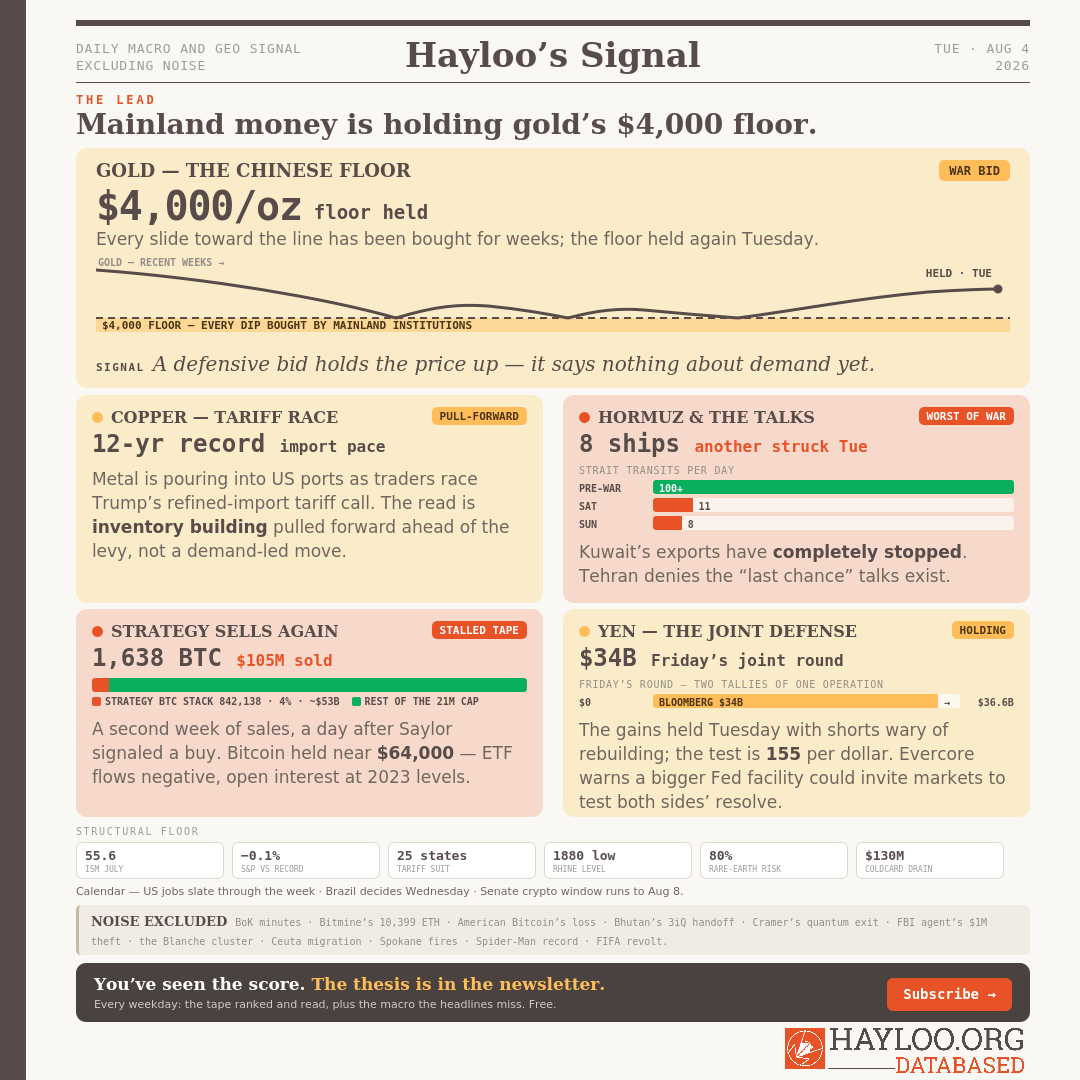
Chinese institutional investors have spent recent weeks buying gold each time it slipped toward $4,000 an ounce, and the floor held again on Tuesday as the metal traded steady into a week of US jobs data. Copper is meanwhile entering the United States at the fastest rate in at least twelve years, with traders racing President Donald Trump’s pending decision on refined-import tariffs. The two flows read on the same war economy, and neither flow says anything yet about demand.
The Strait of Hormuz carried eight ships on Sunday and eleven on Saturday, against more than a hundred a day before the war, and another vessel was struck there on Tuesday. Kuwait’s oil minister said the country’s exports have completely stopped. Saudi Aramco reported a 33% jump in second-quarter profit and kept exporting through a pipeline that avoids the strait. Trump called the new talks Iran’s “last chance” and demanded “total surrender,” while Tehran denied that any talks are happening.
Strategy disclosed it sold another 1,638 bitcoin last week, a day after Executive Chairman Michael Saylor had signaled a purchase might be coming, and bitcoin held near $64,000 through the news. BlackRock launched tokenized money-market funds built to sit inside stablecoin reserves. The yen held most of its intervention gains into Tuesday, with estimates of Friday’s joint round running from $34 billion to $36.6 billion.
#1 — Copper entered the US, Gold China, at a war pace
Chinese institutional investors have swooped on gold in recent weeks, Bloomberg reported on Tuesday, arresting a decline that had carried the metal toward $4,000 an ounce and keeping the price above that threshold.
Gold held steady on Tuesday as investors weighed conflicting signals on possible US-Iran talks and looked ahead to this week’s run of US jobs reports for clues on the Federal Reserve’s rate path, Reuters reported.
Meanwhile, copper is pouring into the United States at the fastest rate in at least twelve years, Bloomberg reported on Monday, as traders position ahead of Trump’s decision on tariffs for refined imports. The report reads the surge as tariff-driven inventory building rather than a demand-led move, with purchases pulled forward ahead of the levy.
#2 — Eight ships crossed the Strait of Hormuz on Sunday, against more than a hundred a day before the war
Eight ships passed through the Strait of Hormuz on Sunday and eleven on Saturday, according to ship-tracking firm Kpler, compared with more than a hundred a day before the war began; about a fifth of the world’s oil and gas moved through the strait before the conflict. Observable traffic stayed at a trickle into Tuesday as attacks on vessels and Iranian threats kept shipowners and crews away, Bloomberg reported, and a Kpler analyst called it the worst period for crude trade since the crisis began.
Kuwait’s oil minister said on Sunday that the country’s exports have “completely stopped” and that Kuwait is in talks with Saudi Arabia and other neighbors on a bypass pipeline that would take at least a year to build.
Saudi Aramco said on Tuesday that July’s attacks had no material impact on its operations, reported a 33% rise in second-quarter profit on war-driven prices, and said it is working to expand export capacity through the pipeline that bypasses the strait.
#3 — Trump called the new talks Iran’s “last chance”
Trump said on Monday that his latest offer of talks is a “last chance” for Iran, after he called off what he described as a major attack on the country. He called Tehran “duplicitous” and demanded “total surrender” after Iran denied it is in talks with the United States.
Gulf officials and analysts told Reuters that Iran is betting it can outlast Washington by turning the region’s trade routes, shipping lanes and energy infrastructure into pressure points that steadily raise the cost of confrontation.
#4 — Strategy disclosed it sold another 1,638 bitcoin for $105 million
Strategy disclosed on Monday that it sold 1,638 bitcoin last week for $104.7 million, cutting its holdings to 842,138 coins, a stack equal to about 4% of the eventual 21 million supply and worth roughly $53 billion.
The company raised $290.6 million selling common stock and bought back $81.2 million of its STRC preferred shares.
Bitcoin held near $63,600 to $64,000 through the disclosure and was up 1.9% over the 24 hours into Tuesday. Yusuf Fakhro of the trading firm ARP Digital said on Monday that the market’s weakness reflects stalled participation more than forced selling, with ETF flows negative and CME open interest back at 2023 levels.
#6 — A Bloomberg analysis put Japan’s Friday yen intervention near $34 billion
Japan likely spent about $34 billion supporting the yen on Friday, building on the previous day’s action in coordination with the United States, a Bloomberg analysis of Bank of Japan accounts indicated on Monday.
The yen held most of its gains on Tuesday with speculators wary of rebuilding short positions, and strategists told Bloomberg the test of the rally’s staying power is whether the currency can strengthen through 155 per dollar. Evercore ISI said the Federal Reserve facility that Treasury Secretary Scott Bessent wants enlarged could keep Japan from selling Treasuries to defend the currency, and that prolonged use could invite markets to test both countries’ resolve.
#7 — BlackRock launched tokenized money-market funds built as stablecoin reserve assets
BlackRock launched tokenized money-market funds in Europe on Monday, bringing blockchain settlement to its flagship cash products, and both funds intend to qualify as eligible reserve assets for US payment-stablecoin issuers under the GENIUS Act, the US stablecoin law.
The launch joins reserve-focused funds already running at Morgan Stanley, State Street and Fidelity. Morgan Stanley separately downgraded the stablecoin issuer Circle on Monday and cut its price target, citing tokenized money-market funds, Open USD and slower USDC growth as earnings headwinds, and Circle’s shares slid.
Mastercard completed its acquisition of the payments firm BVNK the same day to expand its stablecoin infrastructure.
OPERATIONAL/STRUCTURAL FLOOR
US manufacturing expanded in July at its fastest pace since 2022. The ISM gauge rose to 55.6 from 53.3, with production surging and firms adding workers, and euro-zone factory output grew at its fastest in nearly four and a half years, largely on order backlogs.
The Rhine fell to its lowest level since 1880. The record low is disrupting a key route for moving coal, fuel and industrial commodities across Europe.
About 80% of Japanese manufacturers called rare-earth procurement a pressing challenge or critical risk. The survey lands as China tightens export controls on the minerals.
Trump demanded Chevron cut US fuel prices immediately. He claimed the company’s success stems from his policies, as pump costs strain households and oil-major profits soar.
The Coldcard wallet drain entered a fifth day. Galaxy Research said losses could reach $130 million once a still-unconfirmed fourth wave is counted, CoinDesk earlier put the total near $114 million.
The crypto market-structure bill faces a pivotal Senate week before the August 8 recess. Bernstein said failure to pass this year would likely send crypto lower while accelerating SEC and CFTC rulemaking, and the Blockchain Association countered law-enforcement objections from the National Sheriffs’ Association.
NOISE EXCLUDED TODAY
Bank of Korea minutes backing further hikes with July inflation at a three-month low; Bitmine’s 10,399 ETH addition and Tom Lee’s ether-versus-Nasdaq comparison; American Bitcoin’s third straight quarterly loss and record mining quarter; Bhutan’s GMC handing part of its bitcoin treasury to 3iQ; the NEAR sovereign-fund proposal and the XRP-collateral RLUSD lending vault; Jim Cramer’s quantum-computing bitcoin exit, the FBI agent’s $1 million crypto theft, POAP’s shutdown, FalconX’s layoffs, Bithumb’s 2028 IPO plan, Bitget’s Japan exit, BitGo Link and the DEX share record; the Washington political cluster around the Blanche confirmation, the Reflecting Pool case and the Capital One account closures; the Ceuta migration crisis and the EU border response; Russia-Ukraine casualty and drone items beyond the strikes carried above; the Spokane wildfires, Japan’s heat deaths, the cyclospora deaths, and the culture and sport layer from the Spider-Man box-office record to Pochettino’s extension and the FIFA revolt against Infantino.
On our use of AI:
Measuring AI to value writing is like rating a restaurant by whether the chef used a food processor.
Humans have written machine-assisted for centuries. What never changes is who decides.
Nothing at Hayloo INC. was ever decided by a machine.
There’s no meter, no word count, no hour count, no token that tells you how much of us is in our work. We use AI, we run scripts, we process data, we ask questions, and we debate what the machine contributes.
What survives is what we defended as a team.
When it’s wrong, it’s wrong because us, the humans, signed it.
Jordi Federer, Founder, Hayloo INC.