


Signal is Hayloo’s newsreader, customized to the portfolio Hayloo scores, weighing every macro, geo, and on-chain headline against the risk in Hayloo’s portfolio and Hayloo’s market positioning. Signal respects Hayloo enough to stay quiet until the day’s noise becomes signal. To customize your own newsreader, go to hayloo.org.
TOP-OF-STACK SUMMARY
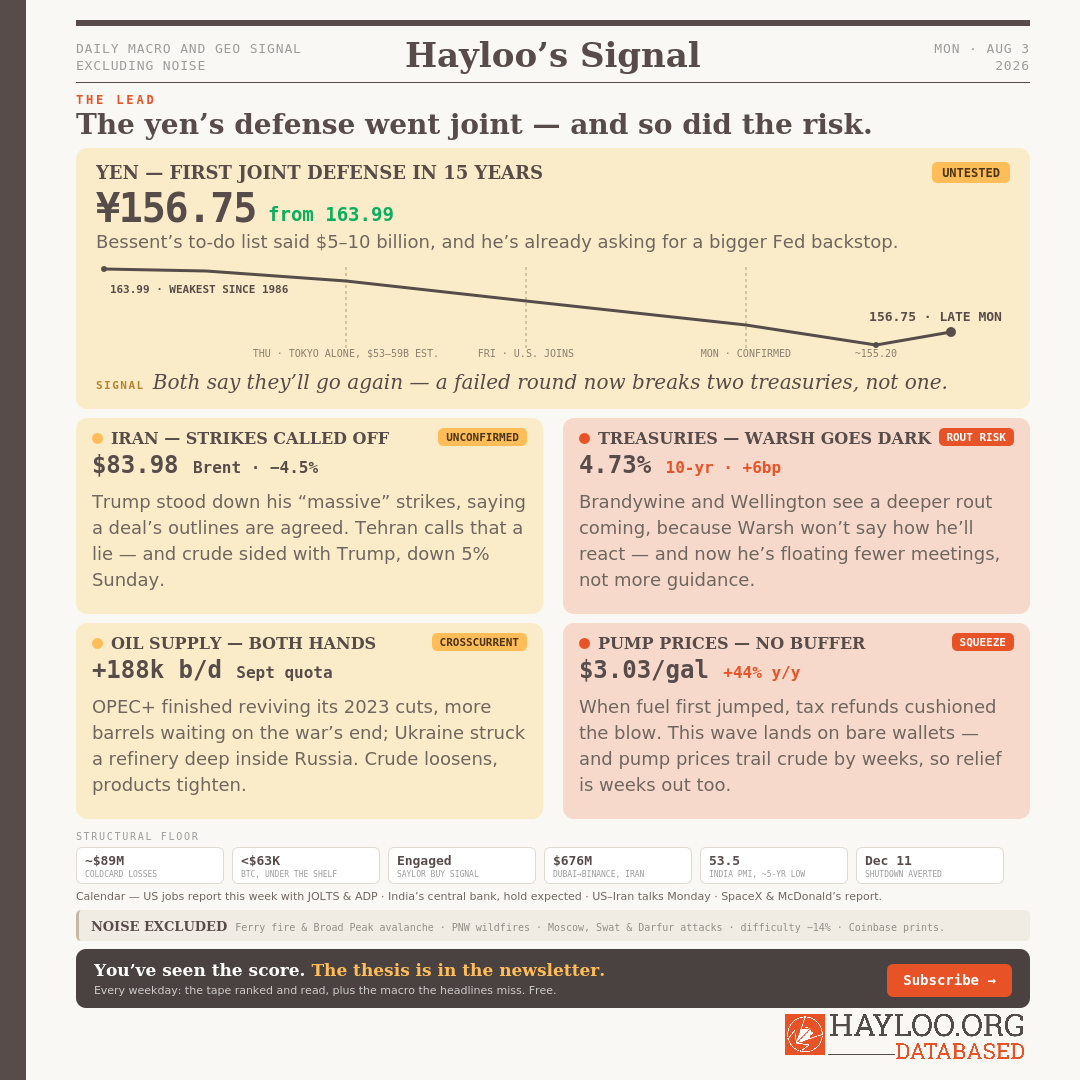
Japan and the United States confirmed on Monday that they bought yen together in the currency market on Friday, the first joint intervention in 15 years. The dollar fell to nearly 155 yen after the announcement and traded near 157 late Monday in Tokyo.
President Donald Trump called off what he said would have been “massive” strikes on Iran over the weekend and said new talks begin Monday, declining to set a deadline. He said Iran and Gulf allies asked him to hold off because the outlines of a deal had been agreed, covering the Strait of Hormuz and Iran’s nuclear program. Iran’s semi-official Mehr news agency called that claim “nothing but a new lie,” and Iran’s foreign minister, Abbas Araghchi, said Sunday that negotiations with Oman on a Hormuz arrangement are close to final. US crude fell 5% on Sunday and both benchmarks fell further in Asia on Monday, with Brent near $84 and US crude near $81.
Bond investors including Brandywine Global and Wellington Management warned that the risk of a deeper Treasury rout is rising, with Federal Reserve Chair Kevin Warsh giving little guidance and, the New York Times reported, considering fewer policy meetings. The 10-year yield ended last week at 4.73%. OPEC+ approved the last small quota increase needed to finish unwinding its 2023 cuts, Ukraine struck a major Russian refinery and a strategic airfield overnight into Sunday, and bitcoin slipped under $63,000 as losses from the Coldcard wallet flaw neared $89 million.
#1 — Katayama said Japan and the US intervened together on Friday for the first time in 15 years
Japan’s Finance Minister Satsuki Katayama said on Monday that Japan and the United States conducted a coordinated yen-buying intervention during New York trading on Friday, the first joint operation in 15 years, and that both governments will not hesitate to act again.
US Treasury Secretary Scott Bessent said on Sunday he will not hesitate to repeat the operation and urged that a Federal Reserve backstop for foreign central banks and monetary authorities be upsized, and a Reuters photograph on Friday showed a to-do list in front of him at a cabinet meeting reading “Buy Japanese Yen $5-10 bil.”
Trump said on Sunday the United States gained financially from the operation. After Monday’s announcement the dollar fell to nearly 155.20 yen and traded at 156.75 late in the Tokyo afternoon. A defense run by two treasuries under a standing agreement raises what a failed round would mean, because the next break would run through both of them.
#2 — Trump called off threatened strikes on Iran ahead of talks he said begin Monday
Trump said on Saturday he was calling off what he described as “massive” planned strikes on Iran. He said new talks would begin Monday, after Saudi Arabia’s Crown Prince Mohammed bin Salman, the United Arab Emirates and Qatar had urged him against striking Iran over the weekend. Trump explained that “there is a deal on Hormuz, and there will be a deal on the nuclear.”
Iran’s semi-official Mehr news agency called Trump’s Saturday claims “nothing but a new lie,” and Iran’s foreign ministry said it has no plans to receive a US delegation or send officials to Washington.
Araghchi said on Sunday that negotiations with Oman on a Strait of Hormuz arrangement are “on track for finalisation,” according to Iranian media. US crude fell 5% on Sunday to $80.79 a barrel and Brent fell to $83.87, and both slid further in Asian trading on Monday, Brent down 4.5% at $83.98 and US crude 4.6% lower at $80.74. The two accounts of the weekend cannot both hold, but crude priced Trump’s version anyways.
#3 — Bond investors warned the risk of a deeper Treasury rout is rising
Bond investors including Brandywine Global and Wellington Management said the risk of a deeper Treasury selloff is rising because Fed chair Kevin Warsh is keeping markets in the dark about how the Fed will respond to the economy, Bloomberg reported on Sunday.
Warsh is separately considering reducing the number of the Fed’s scheduled policy meetings, the New York Times reported on Friday. The 10-year yield rose to 4.73% on Friday, up six basis points on the day. The government has spent $827 billion on debt service so far this fiscal year, more than it has devoted to national defense, the Associated Press reported on Saturday. The long end is pricing uncertainty under a chair withholding guidance.
Week 31 – The Loudest Signal Met the Quietest Market

Tape of the Week – Both legs of the liquidity engine went negative for the first time, and Bitcoin answered at its narrowest volatility since January.
#4 — OPEC+ approved the last increase needed to finish unwinding its 2023 cuts
Major OPEC+ nations approved the latest small increase to their production quotas on Sunday, completing the theoretical revival of the supply halted in 2023 and leaving the group scope to add more barrels once the Middle East war ends; Xinhua put the September increase at 188,000 barrels a day.
ExxonMobil is standing by its Middle East growth plans even though the war has knocked half a million barrels of the company’s daily production offline, Bloomberg reported on Friday, and analysts expect the major oil companies to report large profits for the period when the fighting impeded shipments.
Cartel supply is arriving just as the war premium leaves the price; the group’s own line that more barrels wait for the war’s end ties the full supply response to an actual reopening.
#5 — Higher pump prices are hitting US consumers again, this time without tax refunds behind them
When fuel costs jumped earlier in the war, US consumers absorbed them with help from federal tax refunds, and a second wave of higher gasoline prices is now landing without that buffer, Bloomberg reported on Saturday.
Gasoline futures traded at $3.03 a gallon on Monday, down 2.7% on the day and up about 44% from a year earlier. The Fed’s preferred inflation gauge rose more slowly in June while staying above the 2% target, in data published Thursday, and the monthly US jobs report lands this week.
Pump prices trail crude by weeks, so the squeeze already in the tape keeps running while Monday’s oil drop works its way toward the pump.
OPERATIONAL/STRUCTURAL FLOOR
Losses from the Coldcard wallet flaw neared $89 million and pushed coins onto exchanges. Galaxy Research flagged a third wave of thefts on Saturday, now reaching about 4,500 addresses with the attacker targeting smaller balances and changing how funds are collected, and analytics firms said smaller holders are moving coins onto exchanges for safety, the reverse of the shift toward self-custody after FTX collapsed in 2022. Bitcoin slipped under $63,000 on Monday despite the Iran news.
Strategy Executive Chairman Michael Saylor signaled a bitcoin purchase may be coming after five quiet weeks. Saylor posted “Bitcoin Drive engaged” on Sunday, the company is tracking bitcoin’s 200-week moving average, and it held its STRC preferred dividend at 12% this month despite the shares trading below par.
India’s factory growth slowed to a near five-year low ahead of an expected central-bank hold. July’s manufacturing PMI fell to 53.5 from 54.5 with a third straight month of slowing job creation, and the Reserve Bank of India is expected to leave rates unchanged this week as inflation stays modest.
A Dubai exchange allegedly moved $676 million to Binance wallets for Iran. Reuters reported the Shelbit network has processed over $4 billion since May 2024 through channels tied to Iranian gambling sites, Iran’s central bank and the Revolutionary Guard.
Prediction-market volume set a record above $50 billion in July. Kalshi and Polymarket’s combined total hit an all-time high, with Polymarket’s US arm up 54% on June while its main platform fell 26%.
Senate leaders reached a short-term deal to avoid a government shutdown. The bill funds the government at current levels through December 11 and bars fund transfers to Border Patrol.
The acting attorney general rescinded the $1.8 billion fund for allies of the president. Acting Attorney General Todd Blanche formally scrapped the plan ahead of his confirmation vote.
Cuba went dark in a nationwide blackout. The country’s ageing grid collapsed on Sunday after a weekend of outages amid fuel shortages under US sanctions.
Calendar. The US monthly jobs report prints this week alongside JOLTS and ADP data, India’s central bank decides with a hold expected, SpaceX and McDonald’s report.
NOISE EXCLUDED TODAY
The Indonesian ferry fire and the Nirmal Purja and Broad Peak avalanche; the Spokane and Pacific Northwest wildfires, the Greek firefighting-helicopter collision and Italy’s heat alerts; the Moscow restaurant bombing, the Pakistan Swat suicide bombing and the Sudan Darfur drone strike; the Ceuta migrant surge and the EU’s emergency meeting on it; the FIFA World Cup private-equity collapse coverage; Aung San Suu Kyi’s ICRC meeting, Lula’s fourth-term bid and the Reflecting Pool charge dismissal; the CZ wallet-diversification commentary; bitcoin mining difficulty down 14%, Tether’s quarterly results, Circle’s New York trust charter.
On our use of AI:
Measuring AI to value writing is like rating a restaurant by whether the chef used a food processor.
Humans have written machine-assisted for centuries. What never changes is who decides.
Nothing at Hayloo INC. was ever decided by a machine.
There’s no meter, no word count, no hour count, no token that tells you how much of us is in our work. We use AI, we run scripts, we process data, we ask questions, and we debate what the machine contributes.
What survives is what we defended as a team.
When it’s wrong, it’s wrong because us, the humans, signed it.
Jordi Federer, Founder, Hayloo INC.