


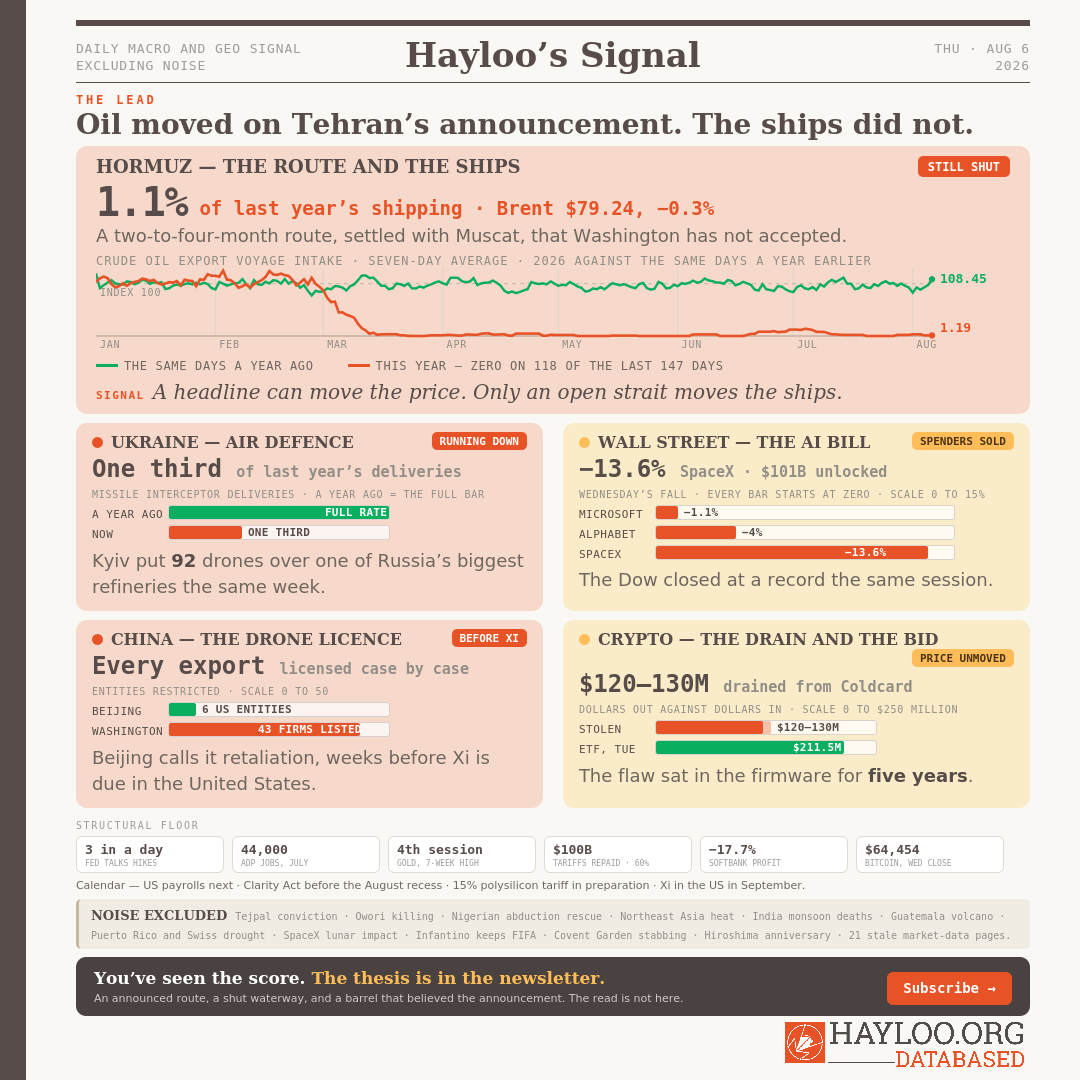
Signal is Hayloo’s newsreader, customized to the portfolio Hayloo scores, weighing every macro, geo, and on-chain headline against the risk in Hayloo’s portfolio and Hayloo’s market positioning. Signal respects Hayloo enough to stay quiet until the day’s noise becomes signal. To customize your own newsreader, go to hayloo.org.
TOP-OF-STACK SUMMARY
Iran’s foreign ministry said on Wednesday that it had agreed a shipping route through the Strait of Hormuz with Oman, down to the coordinates, and that the deal was in its final stages. What the coordinates mean, regional officials had told the Associated Press a day earlier, is that ships would enter the Persian Gulf through a route Iran controls. That is the arrangement Washington has said it will not accept, and any deal probably starts with the United States lifting its blockade of Iranian ports. Traffic through Hormuz and Bab el-Mandeb fell sharply the same day, after the Houthis said they had attacked a Saudi tanker. Neither Washington nor Muscat has commented.
Three Federal Reserve officials talked up rate rises inside a single day, and one of them said the increases should start now. The hiring number landed between them: ADP counted 44,000 jobs added in July, short of forecasts, while the service sector kept growing. Barclays and HSBC told clients the Fed looks slow on inflation, and that this is reason enough to own bonds which pay out when prices rise. The monthly payroll report comes next.
The American government has now refunded $100 billion of the tariffs the Supreme Court threw out in February, about 60% of everything that policy ever collected, and it is preparing a 15% tariff on polysilicon derivatives. Beijing chose the same week to put every drone export to the United States under review and to ban six American entities from trade, weeks before President Xi Jinping is due to visit.
#1 — Iran said it has agreed a Hormuz route with Oman
Iran’s foreign ministry spokesman, Esmaeil Baqaei, said on Wednesday that Tehran and Muscat had agreed the geographical coordinates of a route through the Strait of Hormuz, and that the agreement was “in the final stages.” The route would be temporary, open for two to four months. Ships would enter the Persian Gulf through a route Iran controls. That is the sticking point.
Washington has ruled out any deal that leaves Tehran gripping the waterway it has kept largely shut since February. Any agreement between the two parties likely requires the United States to lift their blockade of Iranian ports first. Iran continues to insist it is not negotiating with the United States and has no plans to.
Oil eased on the news. Brent traded at $79.24 a barrel on Thursday, down 0.3% in Asian hours, with West Texas Intermediate at $75.73.
Traffic through the Strait of Hormuz and through Bab el-Mandeb dropped significantly on Wednesday, however. The fall followed a Houthi claim to have attacked a Saudi tanker. Shipowners warned on Thursday that charging tolls to cross the strait would damage livelihoods worldwide.
Transit is the one measure of this war that an announcement cannot move, and it moved the wrong way on the day Tehran announced relief.
#2 — Three Federal Reserve officials talked up rate rises as hiring cooled
Neel Kashkari, president of the Minneapolis Fed, said on Wednesday that the central bank should start raising rates now, in increments, because inflation remains too high. Governor Lisa Cook said the same day that she is ready to move if inflation does not slow, and warned that policymakers may not get the luxury of waiting for inflation to return to 2% on its own. Mary Daly of the San Francisco Fed followed on Thursday. She backed last week’s decision to hold, then said high inflation could turn out to be a broader problem needing a more aggressive answer.
Barclays and HSBC told clients the same week that the Fed looks slow on inflation, and that this alone is a reason to hold bonds which pay out when prices rise.
All three officials spoke ahead of the monthly payroll report, which puts the hawkish line on the record before the number that could argue with it. ADP counted 44,000 jobs added by American companies in July, fewer than forecast, and read it as a cooling after a solid run. The service sector kept expanding through the month on new orders and business activity.
#3 — China banned six American entities
China’s Commerce Ministry said on Wednesday it will vet each export of drones, their key components and the technology behind them, case by case, and it barred six American entities from trade. Applied DNA Sciences and the campaign group Human Rights in China are among them.
Beijing framed the move as retaliation. It pointed to the Federal Communications Commission’s ban on Chinese drone imports and to the Department of Homeland Security adding 43 Chinese companies to the forced-labour entity list, said those measures violate what the two countries’ leaders had agreed, and warned it would sanction more if Washington keeps going. Xi is expected in the United States in September.
Washington is not slowing down. Reuters reported on Wednesday, citing sources, that the administration is preparing a 15% tariff on polysilicon derivative products.
#4 — Customs said the government has repaid $100 billion of struck-down tariffs
US Customs and Border Protection told a court that the government has paid back $100 billion to importers, roughly 60% of everything it collected under the tariff programme. A further $29 billion in claims sits with trade authorities awaiting review.
The Supreme Court ruled in February that using the International Emergency Economic Powers Act to impose broad import duties was unlawful. Amazon got about $600 million back in the second quarter, its finance chief Brian Olsavsky said, and some of that will go to customers who were charged.
#5 — The UN’s food agency warned of a fresh wave of food inflation
The chief economist of the United Nations Food and Agriculture Organization said on Wednesday that the world is close to another bout of food inflation. He named the wars in Iran and Ukraine and the arrival of El Niño, which together push costs up and crop yields down.
MORE SIGNAL
Investors took 13.6% off SpaceX the morning after it disclosed sharply higher AI spending. Roughly $101 billion of its stock became tradable on Thursday as an insider lockup expired.
Asia sold harder, with Korea’s Kospi down 4.4% on Thursday and SoftBank reporting April-June net profit down 17.7% to 347.33 billion yen. Samsung Electronics and SK Hynix, both sitting on record AI profits, now face shareholder demands for the cash. South Korea’s current-account surplus hit a record for a second month running while foreign investors sold a record amount of its shares.
Ukrainian drones hit Yaroslavl in what its governor called the region’s largest attack. Mikhail Evraev said 92 drones were shot down over the city, which holds the Slavneft-Yanos refinery; no source has confirmed damage to the refinery itself.
Japan sold 30-year bonds into firmer demand than its twelve-month average. Bank of America expects the yen to gain about 6% against the dollar by year-end, and the Korean won reached a ten-month high.
Brazil cut its policy rate to 14% at a fourth straight meeting. Inflation slowed by more than expected and growth cooled, and the bank left the door open to more.
Circle’s second-quarter revenue missed at $701 million as USDC circulation fell from its peak to $73.3 billion. It named BlackRock, Visa and DTCC among the validators for its Arc blockchain, and its shares rose 10% before falling 3%.
The UN human rights chief said Iran has executed at least 56 people on national-security charges since 19 March. Twenty-seven of those cases came out of January’s protests, and more than 100 people are at risk on similar charges.
Russian President Vladimir Putin signed a law allowing regulated retail crypto trading in Russia.
German factory orders for June beat forecasts. Britain’s jobs-market downturn has now lasted as long as the financial-crisis slump, as firms cut costs and turn to artificial intelligence, and Australia posted a surprise June trade surplus on the biggest jump in export values in four years.
LESS NOISE
The Tarun Tejpal conviction, the David Owori killing and the Nigerian mass-abduction rescue; the Northeast Asia heat wave, India’s monsoon deaths, the Guatemala volcano, the Puerto Rico drought and the Swiss drought and heat items; the SpaceX lunar impact and the Mexican influencer shooting; Gianni Infantino keeping the FIFA presidency after the collapsed World Cup stake sale; Ceuta’s request to move unaccompanied migrant minors to the Spanish mainland, and Sheikh Hasina’s vow to return to Bangladesh in December; the Covent Garden stabbing, the Gary Glitter hearing and the Alex Murdaugh suit; Rihanna, Ariana Grande, Ohtani, Messi, Salah, sumo and the LIV Golf financing; Japan’s non-nuclear-principles exchange and the Hiroshima anniversary; the Taylor Farms cyclospora outbreak and the hypoallergenic-dog gene editing; CASHCAT, the dead AI-agent token, the NFT founder indictment, the Binance-RedotPay suit and the ZIGChain and Ondo hires.
On our use of AI:
Measuring AI to value writing is like rating a restaurant by whether the chef used a food processor.
Humans have written machine-assisted for centuries. What never changes is who decides.
Nothing at Hayloo INC. was ever decided by a machine.
There’s no meter, no word count, no hour count, no token that tells you how much of us is in our work. We use AI, we run scripts, we process data, we ask questions, and we debate what the machine contributes.
What survives is what we defended as a team.
When it’s wrong, it’s wrong because us, the humans, signed it.
Jordi Federer, Founder, Hayloo INC.