


Signal is Hayloo’s newsreader, customized to the portfolio Hayloo scores, weighing every macro, geo, and on-chain headline against the risk in Hayloo’s portfolio and Hayloo’s market positioning. Signal respects Hayloo enough to stay quiet until the day’s noise becomes signal. To customize your own newsreader, go to hayloo.org.
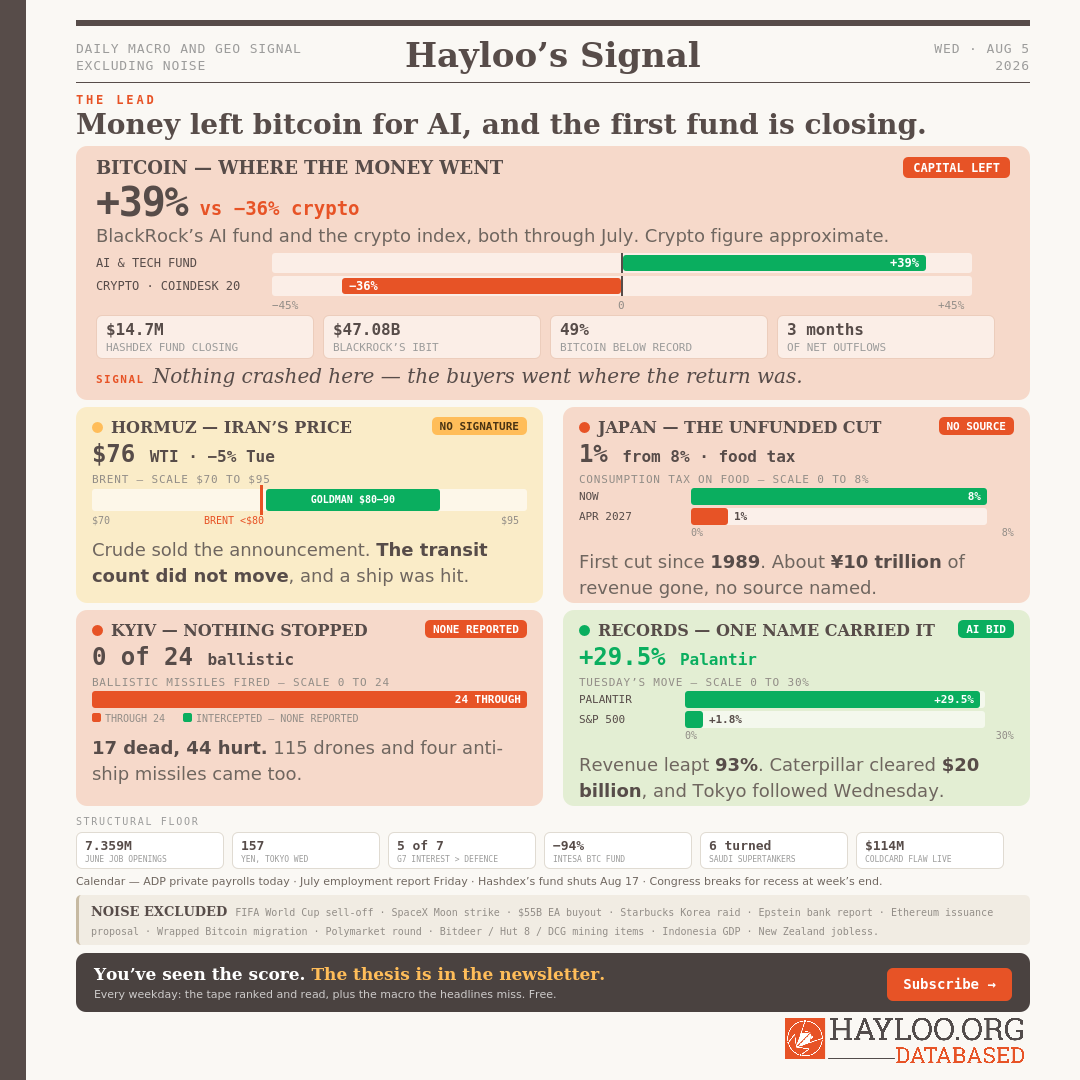
Japan’s cabinet approved a two-year cut in the food consumption tax to 1% from 8%. Prime Minister Sanae Takaichi has not identified a specific revenue source. Tokyo is now running an unfunded tax cut and a currency defence at the same time, and the bond market is where those two meet.
The revenue hole has to be filled from spending cuts nobody has named or from issuance the government has promised not to do, and the third door is a Japan that funds itself by selling what it holds abroad. That is the version the US should care about.
US Treasury Secretary Scott Bessent said the US joined the yen intervention because an undervalued yen threatens the whole region. But even if true. If the argument is that a weak yen drags the won and the yuan behind it, then the US Treasury has quietly taken a stand on a currency floor, and floors get tested by people who want to know how deep the pockets go.
The AI Trade Is Back as the First Spot Bitcoin ETF Shut
Hashdex is closing and liquidating its Hashdex Bitcoin ETF, ticker DEFI, in what CoinDesk reported may be the first liquidation of a US spot bitcoin offering. The fund held $14.7 million and is set to shut on 2026-08-17, with holders cashed out. DEFI is the smallest US spot bitcoin ETF by net assets and recorded the lowest cumulative net inflows. DEFI, launched into the biggest exchange-traded story of the decade, could not find enough buyers to cover its own running costs. The money bought chips instead.
CoinDesk reported on 2026-08-05 that the ratio of the S&P 500 to bitcoin has topped its 200-week moving average and established a firm foothold above it, and that the Nasdaq to bitcoin ratio shows the same first-ever crossover. CoinDesk described the ratio as having moved only in bitcoin’s favour for 14 years before decisively turning.
Its read is that the break above the average holding without a quick reversal suggests bitcoin’s era of outsized rallies versus equities has likely ended, that the superior-store-of-value framing could start to lose its edge, and that a stocks-to-bitcoin ratio no longer moving in bitcoin’s favour undercuts the asset’s appeal to macro traders and cuts against forecasts of $300,000 or higher in the next cycle.
CoinDesk separately noted on 2026-08-05 that bitcoin sits 49% below its record while the S&P 500 sets all-time highs.
Iran Sets Its Terms for Reopening Hormuz and Washington Plays Tough
Iran told Reuters it wants control over inbound Hormuz shipping as its price for reopening the strait. US Central Command said the southern route through the strait remains free and open for all commercial vessels seeking to transit. Put the two accounts side by side and there is no deal anywhere close. Tehran is dreaming up a permission system it controls and Washington is describing free passage. In the distance between those two is the whole war continuing. What moves crude is the announcement, but headlines don’t move ships. Reopening the strait is not a punchline, it is a transit number going up sharply.
The US Army has used virtually all of its long-range precision missiles during the Iran war, three people familiar with the data told Reuters, raising concerns about the military’s readiness for future conflicts.
A party that has spent all its stockpile negotiates differently from one that has real leverage. This is the quiet argument for why Iran offers the strait open on their terms. It also means Trump’s ultimatum reads rather hollow.
A Bloomberg survey found that OPEC’s crude oil production recouped more of its wartime losses in July with gains in Kuwait, Saudi Arabia and Iraq. These barrels need the strait to reach a buyer. Quota is a claim on future flow, and the flow has to get past Hormuz some day.
MORE SIGNAL
The Reserve Bank of India held its benchmark rate for a fourth straight meeting. – The Reserve Bank of India kept its benchmark repo rate unchanged at 5.25% on 2026-08-05 and retained a neutral stance, Bloomberg, Reuters and Xinhua reported. Bloomberg reported the central bank predicts inflation will ease further and growth will remain resilient even as it monitors the impact of higher energy prices from the Iran war, and Reuters reported it took comfort in still-modest inflation.
The Clarity Act sat idle entering the week before the congressional recess. CoinDesk reported on 2026-08-04 that the crypto market-structure bill is idle over a question about the president’s ethics, with Senators Elizabeth Warren and Richard Blumenthal asking the Securities and Exchange Commission to investigate Trump’s memecoin. The Block reported that tribal gaming regulators and senators are pushing to add a prediction-markets provision that would keep sports betting under state jurisdiction. CoinDesk reported that a group calling itself Crypto Watchdog has been running anti-crypto advertising in Washington and that its director will not say who funds it.
Every G-7 country apart from Germany and Canada now spends more on interest than defence, Bloomberg reported.
Intesa Sanpaolo cut its IBIT holding by 94% in the second quarter. The Italian bank tripled its holding of the iShares Staked Ethereum Trust while its total bitcoin ETF holdings fell 35%, CoinDesk reported.
SpaceX posted a $541 million loss in its first quarterly report as a public company, less than half what analysts forecast; the company topped Wall Street revenue forecasts.
Wells Fargo joined JPMorgan and Citi in tokenising settlement rails, adding crypto staking to its digital-asset custody platform.
BlackRock’s spot ether ETF will undergo a one-for-three reverse share split in October, The Block reported.
Honda’s April-June net profit more than doubled to 450.92 billion yen. Kyodo reported on 2026-08-05 that North American demand and the weaker yen drove the result, that the company raised its full-year net profit outlook to 400 billion yen from 260 billion — below the quarter itself because the year is a recovery from losses tied to an overhaul of its electric-vehicle business — and that its assumed exchange rate for the year is 155 yen to the dollar against 151 the previous year.
North Korea warned of further military steps over Japan’s rearmament. Kim Yo Jong, an executive of North Korea’s ruling party, condemned Japan’s recent test-firing of a Tomahawk cruise missile and branded the country a war-criminal state, Kyodo reported.
Washington moved on Chinese technology inputs on three fronts. Reuters reported that the administration is drafting a ban on Chinese data-centre devices, that the US is weighing a polysilicon price floor and tariffs to counter China in solar and chips, and that Samsung and SK Hynix are testing Chinese chip tools as a hedge against US risks.
Palantir Technologies shares rose 29.5% after Chief Executive Alex Karp said revenue leaped 93% in what he called an otherworldly quarter, and the company raised its full-year revenue forecast, per the Associated Press.
SpaceX reported a loss of $541 million for the three months to June in its first quarterly report as a public company, less than half what analysts forecast, on revenue of $7.8 billion, up more than 90%, with Starlink subscribers doubling to 12 million and capital expenditure up sixfold to $18.4 billion, per the Associated Press and CNBC.
Advanced Micro Devices (AMD) fell in after-hours trading despite results described as solid.
LESS NOISE
European and South American physical logistics tightened, the Rhine disruption after hitting its lowest level on record, drought-hit Britain heading for its worst cereal harvest in four decades, and Argentine grain exports halted as maritime pilots struck over a decree by President Javier Milei. Spain’s Ceuta migration crisis drew emergency EU talks. Italy suspended free movement with Spain. A suspect was arrested over the Spokane, Washington wildfire, Authorities said the suspect had twice been linked to other blazes as tens of thousands fled. Guatemala evacuated villages as the Fuego volcano erupted. Abdul El-Sayed won the Michigan Democratic Senate primary. Gaza held a mass funeral for 112 people killed in a 2023 Israeli strike. The families had waited three years for the remains. More than 150 people were rescued from a burning migrant boat in the English Channel. Gianni Infantino World Cup sell-off coverage, the largest single story in the window by row count; the SpaceX rocket striking the Moon; the Saudi-led $55 billion purchase of Electronic Arts; the Starbucks Korea police raid; the Epstein-related bank report and UK inquiry items; Ethereum’s EIP-8361 issuance proposal, the BitGo Wrapped Bitcoin migration, Dinari’s tokenised equities, Binance’s Lite Loan, Polymarket’s valuation round and the Eliza Labs wind-down as crypto-industry colour below the structural threshold; Bitdeer, Hut 8 and DCG mining-facility items; the bitcoin robbery and home-invasion prosecutions; Swiss domestic items; and celebrity, sport and weather rows.
On our use of AI:
Measuring AI to value writing is like rating a restaurant by whether the chef used a food processor.
Humans have written machine-assisted for centuries. What never changes is who decides.
Nothing at Hayloo INC. was ever decided by a machine.
There’s no meter, no word count, no hour count, no token that tells you how much of us is in our work. We use AI, we run scripts, we process data, we ask questions, and we debate what the machine contributes.
What survives is what we defended as a team.
When it’s wrong, it’s wrong because us, the humans, signed it.
Jordi Federer, Founder, Hayloo INC.